Chapter 3:
Forgive me, sister
The Saga Of OCTAVIA BRESSHEART - Vol 1
The ceremony awaits them.
The church is enormous and magnificent, a cathedral of pale stone that seems to drink in the sunlight only to give it back as golden reverberations upon the altars. The guests are already seated—a sea of hats, feathers, jewels, and ceremonial uniforms. Octavia walks down the central aisle with measured steps; her boots, which crunched on the field grass, now fall silent on the polished marble. She takes her place in the front row, next to her mother, who brushes her hand with nervous gratitude. Lieutenant Virek remains standing to the side, leaning against a column, his eyes never stopping their watch.
The groom is already at the altar. A young man with a clean face, in a dark uniform, shifting his weight from one foot to the other and adjusting his collar every three seconds. His hands tremble slightly, betrayed by a nervousness that even rigid military posture cannot tame.
Octavia watches him.
Are these the reasons to be nervous? She would sign up for this in a heartbeat. How can anyone tremble over something that is supposed to be as beautiful as marriage?
She spreads her fingers slightly on her knees, looks at the ring she does not wear on her finger. Who knows if she, when the war is over, will ever marry anyone. The question crosses her mind like a stray splinter: fast, cold, and dangerous only if you go poking at it with your fingers.
Then the answer comes on its own, sharp as a verdict. Ah, it is more likely for the war to end than for her to get married. She loves no one. She has never loved anyone. Not even a fixation on someone, not even that fleeting infatuation they talk about in novels she has never read. Can one be so incapable of loving?
It certainly seems so. She is the human example of this incapacity.
Octavia clenches her jaw slightly, but she doesn't care anyway.
The music begins. A wave of organ that fills the cathedral to its vaulted ceilings, and all the guests rise in a coordinated rustle of silks and uniforms. Octavia is the last to stand, as if her legs needed an extra moment to remember how to obey a rhythm other than that of cannons.
All eyes turn toward the entrance, toward the bride about to appear in a cocoon of lace and veil.
Not Octavia.
She looks up at the stained-glass windows. Great arches of colored glass telling stories of saints and miracles, but between one figure and another, between red and blue, wedges of real sky open up. A sky so blue, so perfectly, cruelly blue, that it seems unreal. As if painted by someone who has never seen dust rise from a battlefield. As if offered by a god who never had to choose whom to save and whom to let die.
The bride enters. The crowd sighs.
Octavia does not stop looking at the stained-glass windows for the entire ceremony. Not when the priest intones the litanies, not when the bride and groom exchange their vows, not when the crowd holds its breath for the ring. The colors of the sacred stories slide over her without touching her, and the blue sky beyond the glass is the only thing that feels real. Or perhaps the only thing that feels distant enough.
Then finally the bride and groom kiss. A collective sigh lifts the cathedral, someone applauds, the mother beside her has tears in her eyes. Octavia is still looking at the blue when the church door opens.
Not violently. With urgency.
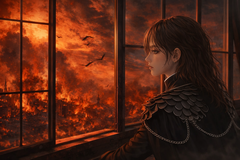
A soldier enters. The uniform is black as a starless night, but embroidered with baroque patterns on the chest, as if a ceremonial ensemble had become armor. A sash crosses the chest, held by buckles and straps, and from the waist hangs a sidearm. Reinforced shoulders, arms protected by layered leather bands, fitted gloves. Trousers tucked into tall, heavy boots, reinforced with plates and laces. It is the elegance of a dangerous elite: those who look know this soldier did not come to pray.
The soldier is panting. Their chest heaves under the embroidery, as if they had run for miles.
Lieutenant Virek lifts his head, pulls away from the column with a quick, silent movement. His eyes, behind his lenses, have stopped smiling.
Octavia looks.
The panting soldier on the threshold, the afternoon light bleaching hair of ash-blond now too long—and smiles.
"Armin," she breathes. The name of a soldier, of someone who should never have crossed that threshold except for true urgency.
Octavia stands. The movement is dry, without a single unnecessary crease, and her mother grabs her wrist for an instant before letting go. Then the mother gives a small nod of assent—a barely hinted bow of the head, eyes that say go, we knew it—and Octavia turns toward the altar.
Her sister is watching her. The bride, still veiled, still gripping her bouquet with white fingers.
Octavia bows. A deep bow, military, but also fraternal. Then she says, in a voice clear and steady despite the cathedral stretched tight as a violin string: "Congratulations, sister. Forgive me. I have to go."
She does not wait for an answer.
She turns and walks down the central aisle under everyone's gaze. The guests part like branches before a sudden wind, her shoes—no longer field boots, but elegant black ceremonial shoes—marking her step on the marble. Lieutenant Virek follows one pace behind, a faithful shadow.
At the door, Armin still waits, panting, cheeks red from running, eyes saying everything that his voice hasn't yet had time to say.
Octavia approaches him. The smile is gone, but not the calm. That cold, surgical, anesthetized calm.
"About time."
Everyone in the enormous and magnificent church has already understood: war has just called back its finest daughter.







Please sign in to leave a comment.