Chapter 2:
Baby General
The Saga Of OCTAVIA BRESSHEART - Vol 1
Octavia opens her fingers one phalanx at a time and sets off toward the villa. She walks up from the privet hedge, past the wrought-iron gate, along the gravel driveway where every step crackles like a dry bone. The sounds of the party reach her muffled: laughter, clinking glasses, a string quartet playing Mozart. They sound like noises from another planet.
On the threshold, in the cool shadow of the portico, stands Lieutenant Kael Virek. He waits at ease, hands clasped behind his back, her general's cap gripped between his fingers. It is an almost intimate object: glossy black visor, gold insignia, the inner lining still warm from the last time she wore it. He hands it to her without a word, with that rigid respect only long-serving soldiers know how to offer.
Octavia looks at him for a moment. "Lieutenant," she says, and the word is both a greeting and an acknowledgment, a seal that sets the order of things back in motion. He answers with a barely perceptible nod.
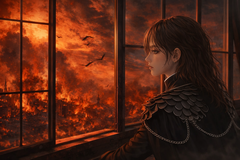
She takes the cap. Her fingers brush her hair, feel its familiar weight, the leather worn smooth by her brow. She lifts it, places it on her head with a slow, almost ceremonial gesture, and adjusts it tilted a few degrees to the right—as always. Suddenly, the world returns to what it was before: war, command, blood. The countryside sunlight becomes a distant memory.
As she straightens her collar, she asks, in a low, measured voice, as if asking for the time: "Any word from Armin?"
The Lieutenant holds his breath for a quarter of a second. Then he replies, with that imperturbable calm only her most loyal soldiers can maintain: "No, General. No word from Armin. In fact, the Army General has ordered him not to interrupt her temporary leave unless strictly necessary. And in that case, he is to deliver the message in person."
Octavia sighs. It is not a sigh of relief. It is the tired sound of a string vibrating in emptiness, finding no chord.
The Lieutenant adjusts his glasses on his face with two fingers—a light press on the bridge—and then sketches a small smile, something almost human, almost out of regulation. "Enjoy the peace of the countryside, General, and your family's company. For one day, at least."
Octavia shifts her gaze to the wide glass doors of the villa, where silhouettes in light-colored clothes, a set table, a man laughing with a glass in his hand are visible. Then she looks back at the Lieutenant and gestures dryly toward it all, as if pointing at a field of rubble. "How can I enjoy this," she says, "when General Kaltrow is fighting on the western front at this very moment?"
The Lieutenant doesn't blink. He knows there is no answer that can comfort, yet he tries anyway. "The only scenario in which he might ask for your help is if he himself were dying. Otherwise, as you well know, there's no chance you'll be recalled. Especially today, at your sister's wedding."
Octavia crosses her arms over her chest. The cap slips a little lower on her forehead, and for a moment the shadow of the visor hides her eyes. When she emerges again, her gaze is hard as tempered steel. "I'm quite convinced that by now the General is already losing enough soldiers to recall me. But how can I fight the pride of a man who would do anything to avoid admitting he needs a…" She pauses, and her voice drops, sharpens. "What is it he calls me, Lieutenant?"
The Lieutenant lowers his gaze for a moment, then looks back up with embarrassment. He bites the inside of his cheek, but knows he cannot lie. "He calls you… 'the baby general,' General."
Octavia nods slowly. The nickname settles on her like a wet coat: cold, heavy, humiliating. Because that is exactly what she is in Adrian Kaltrow's eyes: a young woman with rank, a child playing at war, someone to keep on the sidelines while real men fight and die. Yet she is the best. She wins the battles he loses. And he knows it, but pride is stronger than reason.
"Baby general," Octavia repeats, tasting the bitterness of the syllables. Then she turns toward the villa, straightens her shoulders, and takes a step forward. "Fine. Then let's go to this wedding, Lieutenant. And let us pray, at this point, that Kaltrow doesn't decide to die before dessert."
Octavia crosses the threshold of the villa followed by Lieutenant Virek, who stops one step behind, in the shadows, like an armed shadow. The entrance hall is a cascade of marble and crystal chandeliers, and the air smells of lilies and warm wax. But before her eyes can adjust to the luminous twilight of the room, two figures approach her with open arms.
Her father. Her mother.
He with silver hair impeccably combed, she in an ivory dress and her hands outstretched as if trying to hold onto something that has been slipping away for too long. Her mother embraces her first, with that anxious urgency that tastes of guilt and tenderness at once. Her father places a hand on her shoulder, just above the scratch of the cap's strap, and looks at her with eyes that have learned to ask no questions.
"Octavia," her father says, and his voice trembles with the gratitude of someone thanking a god he no longer believes in. "You made it. Thank you. Thank you so much, despite your duties."
Octavia lets herself be hugged without returning it, rigid as a fixed bayonet. When her mother pulls back, she adjusts her cap—a nervous gesture, almost a tic—and answers with a frankness that cuts like a knife. "I wouldn't want you to get too used to my presence, Father. I am quite convinced that before the ceremony begins, I will have to leave the party."
Her father's smile freezes for a moment. Her mother bites her lip.
But before anyone can reply, a third figure slips into the family circle with the ease of someone who wasn't invited. He is an aristocrat—you can tell from the fabric, the gait, the way he looks at the windows as if they were mirrors. He wears a suit of such a bright blue it seems electric, with satin lapels and a polka-dot pocket square that screams for attention. His sleeves are too long, his buttons too shiny. Octavia narrows her eyes, annoyed at her irises as if by a splinter of reflected light.
The man clears his throat, puffs out his chest, and says with an unctuous smile: "If it weren't for your work with the famous platoon and how much the war has improved in the last year, I might find your arrogance insolent, General."
Octavia looks at him. She doesn't remember his name. Perhaps she never knew it. She studies him from the tips of his highly polished loafers to the top of his impeccable hair part, and answers with a frozen slowness, chiseling each word as if carving it on a tombstone.
"If I can afford it, sir, I allow myself the luxury."
The silence that follows is so thick you could slice it with a trench knife. The aristocrat retreats half a step, his smile now a grimace. Her mother coughs softly. Her father looks away, toward the buffet, toward anything but the fire in his daughter's eyes.
Lieutenant Virek, behind her, adjusts his glasses and says nothing. But his small smile—the earlier one, almost human—makes a fleeting return.








Please sign in to leave a comment.