Chapter 0:
PROLOGUE
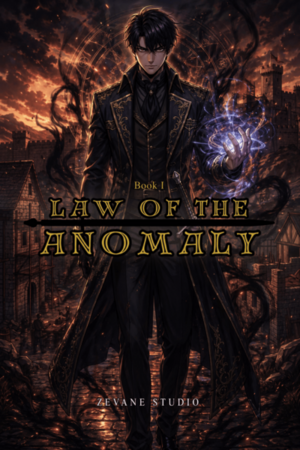
Law Of The Anomaly
The Last Thought of the Man Who Owned the World
The room was quiet in the way only a room at the end of a long life could be quiet.
Not empty. Not abandoned. Ordered.
Every object within it had been chosen for function and then left undisturbed long enough to suggest permanence. The curtains were half drawn over the floor-to-ceiling glass, softening the lights of the city below into a field of distant gold. A decanter rested untouched on the side table. Three screens mounted into the dark wood wall still glowed with live data feeds—currency indexes, maritime movement, commodity balances, a conflict-risk dashboard updated every ninety seconds by a system that did not require human attention anymore. The air carried the faint scent of cedar, polished leather, and antiseptic. A machine beside the bed displayed a clean, orderly line of numbers any physician would have found reassuring.
Nothing in the room suggested an emergency.
Nothing in the room suggested loss of control.
Adrian Vale lay against the raised head of the bed, one hand resting on the blanket over his abdomen, the other on the armrest beside a closed black notebook. At eighty-three, he still did not resemble the men his age whose bodies had long ago surrendered the argument against time. His shoulders remained straight. His face had thinned, but not weakened. The silver at his temples only sharpened the severity of his features. His breathing was even. His pulse was stable. His eyes, when open, were the same eyes that had unsettled ministers, financiers, military chiefs, and kings of industry for more than half a century—not because they were cruel, but because they were exact. To be looked at by Adrian Vale had always carried the faint, disorienting sense that one had already been measured, understood, and placed inside a larger design.
A physician stood near the foot of the bed with a tablet in both hands, reviewing the same results for the third time. He was a discreet man in his late fifties, dressed in a private clinic’s dark suit rather than a hospital coat, careful with his tone, careful with his posture, careful not to allow confusion to become visible on his face. He had treated heads of state. He had signed off on deaths that moved markets. He did not rattle easily. Yet for the last twenty minutes, he had failed to make the numbers in his hand agree with the condition of the man before him.
“There is no organ failure,” he said at last, setting the tablet down on the side console as though changing where it rested might change what it meant. “Your cardiovascular function is diminished, but not critically. Your neural activity remains consistent. Your bloodwork is cleaner than that of men thirty years younger than you. If this were anyone else, I would say exhaustion, but even that does not fit. You should not be…” He paused, then corrected himself. “You should not be declining this way.”
Adrian turned his head slightly and looked at him. “But I am.”
The physician let out a restrained breath. “Yes.”
On the other side of the room, a woman in a dark skirt suit stood near the window with both hands clasped in front of her. Elena Ward had served as Adrian’s chief of staff for twenty-two years, though the title only suggested a fraction of what she had actually been. Gatekeeper. Executor. Archivist. Interpreter of his silences. She was one of the vanishingly few people on Earth who could enter his private rooms unannounced and leave with instructions capable of shifting the positions of states. Her hair, once black, had gone iron-gray in the years since she first accepted his offer. Her expression rarely changed. It has changed now.
“Do you want the Zurich call postponed?” she asked. “The consortium directors will wait if I tell them there has been a medical complication.”
“There is no medical complication,” Adrian said.
The physician lowered his eyes at that, because there was no point in contesting it. Something was happening in the room, certainly. But complication implied disorder. This was not disorder. It was something more disciplined, and for that reason more unnerving.
Elena took one step closer. “Then I will tell them what?”
“That the meeting proceeds without me,” Adrian said. “The draft instructions are already in their secure folders. If Matsuda resists the shipping realignment, Ward onboards the Indonesian route independently and leaves him to explain the delay later. If the Scandinavian fund insists on voting down the energy transition package, leak the pension exposure estimates through the Helsinki channel and let domestic pressure educate them.”
Elena gave a small nod. “Understood.”
The physician glanced between them, hearing in the exchange the kind of language powerful people used when discussing matters far larger than rooms and bodies and deathbeds. “Mr. Vale,” he said carefully, “with respect, I think this may be the time to consider rest.”
Adrian’s mouth moved in something too slight to be called a smile. “Doctor, the world has been resting on instructions I wrote before you entered this room.”
The physician said nothing after that.
He had known, in the abstract, who Adrian Vale was. Everyone in certain circles knew, although most knowledge of Adrian existed in layered forms—rumor to the public, suspicion to governments, certainty to the few who had once tried to oppose him and discovered too late that he had accounted for them years in advance. He had never held office. He had never chaired a central bank. He had never commanded an army or campaigned before cameras or stood at the podium of the United Nations. Yet presidents altered language after private recommendations from unnamed intermediaries. Corporate mergers failed or succeeded according to pressures no journalist could fully trace. Regional wars cooled without a visible cause. Entire supply chains shifted before public crises were acknowledged, as though the world’s most fragile systems possessed some invisible reflex that moved them out of disaster’s path.
The physician had once asked Elena, years ago, and more out of curiosity than courage, whether Adrian was truly as powerful as certain people implied.
Elena had replied, “Most powerful people need to be seen exercising power. He only needs results.”
Now, standing in that quiet room with a patient who should not have been dying and yet clearly was, the physician found himself wishing the explanation were physical. Physical things could be named. Named things could be fought.
Adrian turned his gaze back toward the city.
Far below the glass, the night remained bright with movement. Rivers of headlights cut through the avenues. Helipads blinked on distant rooftops. The harbor, miles away, was a geometry of motion and electricity, cranes lifting freight in silence from the water onto land and from land onto trains and trucks that would carry the materials of civilization inland before dawn. He had once spent two uninterrupted years mapping the global cargo system, not because anyone paid him to, not because he intended at that time to rule anything, but because he wanted to understand the hidden skeleton on which modern life hung. By the end of that study, he had known which ports could starve continents, which insurance firms quietly controlled geopolitical risk, which rail chokepoints mattered more than public treaties, and which five executives in the world possessed enough logistical leverage to start a recession by making three phone calls in the wrong order.
He had been thirty-one then.
At seventeen, he had solved a global economic collapse before governments fully understood it existed.
At twenty-four, he had begun advising institutions that believed they were hiring a prodigy and only gradually realized they were accepting terms from something more dangerous than talent.
At thirty-two, he had placed eleven heads of state, directly or indirectly, inside a network of mutual dependence that allowed him to influence policy without ever drafting legislation in his own name.
At forty-seven, he had prevented a resource war by orchestrating a domestic political scandal in one capital and a currency stabilization program in another, leaving both governments too busy surviving internally to begin killing each other externally.
At fifty-one, a rival consortium had tried to expose one of his shell structures through a fabricated corruption probe. Within seventy-two hours, prosecutors in four jurisdictions had moved against the rival instead, each action lawful, documented, and impossible to dismiss as a coincidence. The man had retired from public life six months later and spent the rest of his career insisting he had never understood who he had actually challenged.
At sixty-four, Adrian had designed the succession architecture for three of the largest private financial networks on Earth, ensuring continuity not through loyalty but through elegantly aligned self-interest. That had been one of his favorite achievements. People romanticized loyalty because they lacked the patience to engineer incentives properly.
At seventy-two, he had turned down the only direct offer of formal rule ever made to him. A fractured coalition of states, desperate after a decade of compounding crises, had proposed an emergency supranational authority with powers broad enough to make him visible. He had rejected it within ninety seconds. Elena had asked afterward whether he had at least been tempted.
He had replied, “Crowns are for people who need witnesses.”
That answer had become one of the most quoted things he had ever said in rooms where his words were repeated but never officially attributed.
His life had not been built through charisma. He possessed it when necessary, but never trusted it. Charisma depended too much on mood, timing, and the weakness of others. Adrian preferred systems—governments, markets, legal frameworks, logistics, intelligence networks, research funding channels, cultural pressure points, public narratives, private incentives. Systems could be understood. Understood systems could be predicted. Predicted systems could be steered. And once enough systems overlapped, the world itself became less an untamable mass of nations and people than a vast mechanism awaiting the correct sequence of pressure.
He had never called it a conquest.
Conquest was a vulgar word, too attached to banners and blood and the vanity of men who wanted history to remember their names. Adrian had no interest in history’s affection. He had built something better than an empire.
He had made the world move.
The physician, perhaps sensing that his presence had become unnecessary, gathered the tablet and said, “I will remain on call in the adjoining room.”
Adrian gave a faint nod.
When the doctor left, the door whispered shut behind him. The quiet deepened. Elena remained where she was for several seconds, then stepped closer to the bed until she stood within reach of the low light falling from the ceiling.
“There are eight sealed contingencies left that still require verbal confirmation,” she said. “Three concerns the Eastern Energy Compact. Two are succession locks. One is the Nairobi archive release. One is the Marseille patent cluster. The last is the—”
“The orbital vote,” Adrian said.
“Yes.”
He closed his eyes for a moment, then opened them again. “The energy compact holds if Delacroix keeps the environmental waiver narrow. If he broadens it, the northern bloc fractures, and you will lose six years. Give him the alternate projections and let him think the compromise was his. The succession locks remain unchanged. Nairobi releases in phases if the Board attempts consolidation. Marseille goes public only if the biomedical lobby tries to bury second-stage licensing again. The orbital vote delays by twelve months unless the launch insurers agree to pooled liability.”
Elena listened without writing. She had learned long ago that her memory sharpened around his voice in a way it did nowhere else.
When he finished, she asked, more quietly, “And if they ask what you would have wanted beyond that?”
Adrian looked at her, and for the first time that night, there was something in his expression she could not immediately classify.
“Beyond what?”
“The world you arranged,” she said.
The question remained between them.
For most of his life, no one had been foolish enough to ask it.
Adrian had been born without lineage, without wealth, without any inherited protection against the world’s appetite for swallowing the weak. He entered it as Adrian Vale only because an administrator had needed something to write on a form. The orphanage had records of extraordinary cognition before he was old enough to understand what intelligence meant to other people. He did not read early so much as immediately. Patterns settled into him with unnatural ease. Language, mathematics, strategy, behavior—he did not experience them as different disciplines. They were merely different surfaces on the same deeper structure.
Other children learned rules. Adrian learned why rules existed, what pressures produced them, who benefited from them, and where they failed.
By adolescence, he could predict classroom conflicts before they happened, not because he read minds, but because most people announced themselves long before they acted. Teachers called him gifted, then difficult, then exceptional, then alarming. Scholarship boards praised him. Research programs courted him. Men with polished shoes and gentle voices offered mentorships that were, on closer inspection, attempts to place a harness on something they did not understand.
At seventeen, he had seen the shape of a global financial seizure hidden inside shipping data and sovereign exposure patterns. By the time governments publicly admitted the danger, he had already redirected enough capital and pressure to contain the worst of it. That had been the first moment the world, in its more private chambers, learned his name.
The decades afterward had not changed his nature. They had refined his reach.
He had not feared death since nineteen. Fear belonged to uncertainty, and uncertainty was a problem category he spent his life reducing. Death itself was not uncertain. It arrived. Biology ended. Structures failed. Breath stopped. People surrounded these facts with religion and poetry because they could not bear how simple the boundary appeared from a distance.
What lay after the boundary, however, remained untouched.
It was the only problem that had never yielded to method.
Not because he lacked discipline. Not because he had lacked time. But because every system he mastered, every institution he bent, every crisis he solved, every human network he aligned, every technology he accelerated, every war he prevented or repurposed—all of it existed within the same closed frame. One world. One life. One reality bounded by death.
He had reached the edge of control years ago. Most men would have mistaken that for completion. Adrian had recognized it for what it was.
A limit.
Elena said softly, “You are somewhere else tonight.”
“No,” Adrian replied. “I am exactly where I should be.”
That answer did not comfort her. She moved to the side table, poured a finger of water into a glass, and handed it to him. He accepted it, drank once, then set it back down.
“Do you want me to call anyone?” she asked. “There are people who would come.”
A man less consistent than Adrian might have laughed. Not because the suggestion was absurd, but because it was touching in its humanity.
“There is no one who needs to be here,” he said.
Elena lowered her eyes, though whether in acknowledgment or sorrow, even she may not have known. Adrian had known people, many of them. Brilliant people. Useful people. Loyal by the standards their natures allowed. He had respected a few, trusted almost none, and relied on even fewer. There had been women in his life, but never for long enough to call permanence. There had been conversations he remembered, minds he admired, bodies he enjoyed, alliances he found pleasant, but nothing that ever outweighed motion. Intimacy required a degree of mutual surrender that Adrian had never considered efficient.
He did not regret that. Regret was for people surprised by the cost of their choices.
Still, as he looked past Elena toward the city, he understood what she was really asking. She was not offering him any witnesses. She was offering him the ritual most humans reached for when the end approached: the gathering of those who proved one had belonged somewhere beyond utility.
Adrian had belonged to the world. The world had been enough of an occupation to fill multiple lifetimes. It had not been enough of an answer.
“Elena,” he said.
“Yes.”
“When I’m gone, destroy the handwritten notebooks.”
Her head lifted. “All of them?”
“All except the black one.”
“The final notebook?”
“Yes.”
“What should I do with it?”
“Seal it with the archive that opens only if someone reaches the correct conclusion.”
She hesitated. “Which conclusion?”
His gaze settled again on the city lights. “That control is only the first language.”
Elena did not understand. She accepted it anyway.
“Very well,” she said.
Minutes passed.
The data screens continued their cold rhythm. Somewhere beneath the building, secure elevators moved. On the far side of the city, a cargo aircraft lifted through the clouds with medical components whose patents Adrian had quietly forced into fair licensing eight years earlier. In the southern hemisphere, two governments maintained an uneasy peace because he had spent six months making war financially irrational to the men funding both sides. In orbit, satellite constellations repositioned according to contracts whose clauses he had personally rewritten through three layers of intermediaries after concluding that communications sovereignty would become the next century’s silent battlefield. Universities taught theories seeded by grants from foundations he controlled. Public health agencies relied on datasets cleaned by analytical tools developed in institutions whose existence could be traced, if one were both brilliant and patient, back to decisions he had made decades before.
He had touched everything without touching everything directly. That had always been the elegance of it.
Yet from the bed, with breath still steady and body still functioning and mind still sharp enough to run ten scenarios beneath a conversation, Adrian knew with absolute clarity that none of it reached beyond the wall now standing before him.
Life had become transparent to him. Death had not.
The physician returned once, briefly reviewed the monitors, failed again to identify any acceptable medical explanation, and left with professional helplessness carefully hidden behind courtesy. Elena fielded three secure messages, answered two with a single sentence each, and disabled the line that would have connected Zurich. The room dimmed further as the automated system adjusted toward midnight lighting.
At some point, she said, “The board in Geneva has requested a final advisory statement in case of transition.”
“Send the continuity directive.”
“They will want something personal.”
“Then disappoint them.”
Her mouth almost moved. Almost. “As you wish.”
The city below shifted deeper into the night. Adrian watched its patterns as he had watched patterns his entire life—not as beauty, though it possessed that, but as function rendered visible. Towers of finance. Reservoirs of labor. Chokepoints of movement. Engines of consumption. Nerves of communication. The whole species had spent centuries telling itself stories about freedom while building one integrated planetary system after another. Most people found that website overwhelming. Adrian had found it legible.
He had solved what could be solved within it.
That knowledge came without triumph.
When he finally spoke again, his voice was lower than before, not from weakness, but from distance.
“I used to think the problem was scale,” he said.
Elena turned toward him. “What problem?”
“That there was always another institution above the one beneath my hand. Another market affecting the market I understood. Another political variable shaping the decision behind the decision. Another hidden layer.”
“And there wasn’t?”
“There was,” Adrian said. “Until there wasn’t.”
She stood still, listening.
“I kept moving upward through systems,” he continued. First schools. Then firms. Then states. Then the arrangements between states. Then the infrastructures beneath them. Then the narratives that made populations consent to arrangements they never examined. Every time I thought I’d reached the top of a structure, I found another structure containing it. That was the work. That was the fascination.”
He paused, his eyes still on the city.
“And now?” Elena asked.
“Now I have reached the highest structure this world permits.”
The quiet after that seemed to press against the walls.
Elena asked the question before she could stop herself. “Is that why you’re dying?”
Adrian turned his head and looked at her.
For all her discipline, the question had come from somewhere unguarded. Not administrative. Not professional. Human.
He considered it.
“Yes,” he said.
It was the first answer that truly frightened her.
She said, “That’s not possible.”
“Possible is a provincial word,” Adrian replied. “The body obeys more than chemistry. Most people never cultivate that truth far enough to encounter its limit. I did.”
“That sounds like surrender.”
“No,” he said, and there was the faintest edge in his tone now, enough to remind the room of the force that had once made nations reposition around his will. “Surrender is what people call endings they did not choose.”
Elena held his gaze, then lowered hers. She understood enough not to argue further.
Another stretch of silence followed, longer this time. Adrian’s breathing remained measured. The monitors remained calm. Nothing was dramatic. That was appropriate. Drama belonged to those who confused noise with significance.
He thought of the world he was leaving behind. Not sentimentally. Inventory rarely became sentiment in him. He thought of completed structures and unfinished ones. He thought of the orbital framework, the biotechnological threshold, the energy transition, and the legal harmonization systems that would outlive him by decades because he had ensured no single government could unwind them without harming itself. He thought of the people who would imagine themselves inheritors and the smaller number who actually were. He thought of the black notebook beside his hand.
He thought, finally, of the only unresolved problem worthy of the term.
If there is something beyond this world, he thought, then that is the next system.
No prayer accompanied it. No plea. No fear. He had never dealt in supplication.
Elena, sensing some invisible change though nothing on the machines had yet become unstable, stepped closer to the bed. “Adrian?”
He did not answer immediately.
His eyes had shifted—not unfocused, not fading, but fixed on something beyond the ceiling, beyond the room, beyond the city. The physician was called and entered quickly, checked the monitors, then checked them again, because the readings still refused to support what instinct told him was happening. The heart remained present. The oxygenation remained possible. The brain remained alive. Yet something in the room had already crossed a threshold no instrument had been designed to recognize.
“Mr. Vale,” the physician said, too professionally. “Can you hear me?”
Adrian heard him. The voice arrived as a diminishing external detail.
The city lights blurred.
The data screens softened into meaningless brightness.
The room’s edges loosened.
He felt no pain. That would have been a crude ending. Instead, there was only an extraordinary narrowing, as though the entire machinery of bodily life were withdrawing from its distributed operations and concentrating into one final point of precision.
Elena’s voice reached him through that narrowing. “Adrian.”
His hand, resting beside the black notebook, moved once. Not in distress. In a decision.
The physician leaned closer, watching vitals that still made no sense. “Stay with us.”
Adrian would have found the phrase almost amusing under other circumstances. Stay where? Is the structure already completed? Within the closed field, he had exhausted?
The narrowing intensified.
The world he had mastered receded without resistance.
There was no revelation. Not yet. No god descending. No chorus. No moral accounting. Only the clean sensation of a boundary being crossed by someone too disciplined to flinch from it.
In the last lucid instant granted to Adrian Vale within the world he had owned, he arrived not at regret, nor relief, nor tenderness, but at the same conclusion that had governed everything worth doing in his life:
Control was never the destination.
It was proof that a destination could be reached.
His final thought was simple, exact, and utterly without hesitation.
If there is something beyond this world, I will own that too.
The monitors changed.
The physician inhaled sharply.
Elena did not move.
The room, so carefully ordered, remained quiet.
Then the quiet broke—not with sound, but with absence.
The city vanished.
The glass vanished.
The bed, the screens, the cedar, the antiseptic, the carefully maintained order of a life spent bending reality into obedience—all of it fell away at once, not torn from him, not stolen, but discarded by scale.
Darkness came.
Then it failed to remain in darkness.
Something opened.
And Adrian Vale, who had ruled one world without a crown, entered another with his will intact.










Please sign in to leave a comment.