Chapter 1:
Chapter 1: The Boy Who Solved the World
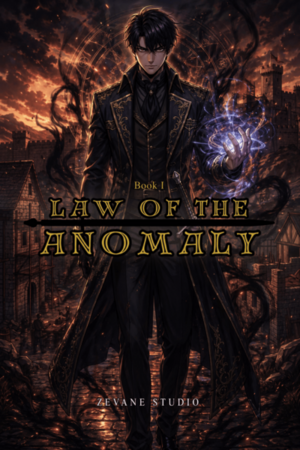
Law Of The Anomaly
The Beginning of Absolute Control
The first sign was not a headline. It was a delay of six hours in a shipping report that should not have been delayed at all.
Adrian Vale noticed it at 4:12 in the morning, seated alone in the dim blue light of a secondhand monitor whose casing had yellowed at the edges. Outside the narrow apartment window, rain dragged itself down the glass in uneven lines, blurring the city into fractured light. The buildings across the street looked half-submerged in mist, their red warning beacons pulsing above the haze like the slow blink of something mechanical and alive. The room smelled faintly of dust, instant coffee, and overheated circuitry. A cheap floor fan turned from side to side, pushing warm air over stacked papers, marked-up reports, and a wall covered in pinned printouts linked by a thin black thread.
He leaned forward without hurry, one hand resting against his jaw, eyes moving across the columns of numbers. The delay was small. Insignificant, if seen in isolation. A minor deviation in a minor port transfer. The sort of thing analysts dismissed because the world produced too much noise for anyone to listen to every false note. But Adrian had never looked at data the way other people did. He did not sort it into headlines and footnotes, important and unimportant, signal and background. He looked at movement itself—where things slowed, where they accelerated, where one hesitation in one system forced a compensation in another three steps away.
A six-hour delay in a shipping report. A discrepancy in agricultural inventory. An unusual rise in overnight lending rates in three banks that had no obvious reason to distrust liquidity. A procurement order was placed by a semiconductor subcontractor in Taiwan at three times its normal volume, then quietly reduced before market opening. On paper, the events had no relationship. In reality, they were already speaking to each other.
Adrian clicked open a second screen, then a third. The spreadsheets arranged themselves in his mind faster than the software could render them. Trade flows became pressure lines. Credit movement became hot. Shipping routes became arteries. He watched the map of the world reform into something less geographical and more biological—a single vast organism with money for blood, policy for nerve impulses, and human confidence as the fragile current holding everything together.
At seventeen, Adrian Vale had reached a private conclusion that no one else on Earth had yet earned the right to speak aloud.
The world economy was about to seize up.
He sat back for a moment and looked at the rain on the window. His face in the reflection was pale, composed, and far too young for the pattern he had just recognized. The fluorescent light from the kitchenette cut a white bar across his cheekbone. Nothing in his expression changed. He moved one hand to the keyboard and began opening new files.
By 6:00 a.m., he had sketched the first outline of the collapse. By 7:20, he had mapped its first-phase victims. By 8:03, he knew which governments would misread it, which institutions would deny it, which corporations would accelerate it out of fear, and which markets would panic first once someone important finally admitted what had happened. He also knew, with the same cold certainty, that he could move ahead of it if given access to the right levers.
At 9:00, he shut the laptop, changed into a clean dark shirt, and left for the Global Cognitive Aptitude Benchmark.
The testing center occupied the fourth floor of a concrete government annex whose elevators smelled faintly of sanitizer and old paper. The lobby was crowded with students carrying folders, bottled water, and the stiff anxiety of people who had been told this day could alter their lives. Some whispered formulas under their breath. Some stared at their phones without seeing them. Others sat too straight in plastic chairs, hands pressed flat to their knees, as if posture might somehow improve performance.
Adrian passed through them with the detached calm of someone entering a routine appointment.
A staff member checked his identification twice, glanced at him once more because he looked younger than his file suggested, and pointed him toward Room 4C. He stepped inside to a chorus of clicking keyboards and shuffling papers. Rows of terminals stretched under humming fluorescent panels. A digital timer was projected on the front wall. The proctor, a thin man with square shoulders and tired eyes, motioned him to an empty station near the back.
“Phones off. Bags under the desk. Once the exam begins, no speaking,” the man said.
Adrian nodded, sat, and placed his hands lightly on the keyboard. Around him, the room vibrated with nervous energy. Someone two seats away kept bouncing a knee. Another candidate exhaled in short bursts, trying and failing to steady her breath. The timer reset. A tone sounded.
The first section opened.
Patterns. Language inversion. abstract reasoning. Historical synthesis. Multilayer predictive modeling. Questions built to force the limits of conventional cognition. Adrian read the first prompt once and understood not just its answer but the assumptions beneath its construction. By the fifth question, he understood the architecture of the test. By the twelfth, he could predict what kinds of misdirection the designers believed would confuse the upper 0.01 percent.
He moved through it without wasted motion.
For others, the examination was a mountain. For Adrian, it was an inventory. He did not rush. He simply did not need to stop. Numbers resolved into shape. Shape resolved into cause. Cause resolved into inevitability. The machine accepted each answer with a muted click. Fifteen minutes in, a small red indicator appeared in the corner of his monitor, flagging his response rate for review. The proctor’s attention flicked toward him. Adrian kept going.
By the midway point, he was no longer thinking about the test itself. The structure bored him. It could identify speed, memory, abstraction, recall, and compression. It could not identify the scale. It could not measure what happened when a mind did not merely solve isolated problems but saw systems in their living totality. It could not conceive of someone who looked at intelligence not as performance but as control.
He finished with thirty-seven minutes remaining.
The red indicator on his screen pulsed harder. Another appeared on the proctor’s tablet. Somewhere in the system, alerts were being forwarded upward. Adrian folded his hands in his lap and waited while the rest of the room continued working in strained silence. One candidate rubbed her forehead as if trying to push an answer loose from behind her brow. Another swallowed repeatedly before striking the keyboard with sudden, frustrated speed. The timer ticked down in large white numbers.
When the session ended, chairs scraped back. The room filled with exhausted noise.
The proctor approached Adrian first. “Mr. Vale,” he said, managing professionalism with visible effort, “please remain seated a moment.”
Adrian looked up. “Of course.”
The other candidates were filtered out. A few glanced over at him on their way past, sensing without understanding that something unusual had occurred. When the room emptied, the proctor cleared his throat and said, “There are some people who would like a word.”
He led Adrian through a side corridor into a private conference lounge with sealed windows and a polished table that had never been meant for teenagers. Three people were waiting inside.
The first was a silver-haired man in an expensive charcoal suit with the posture of someone practiced in public authority. The second was a woman in navy, perhaps in her early forties, holding a tablet in one hand and a stylus in the other, as if both were extensions of her fingers. The third was a younger man with a banker’s face—carefully neutral, watchful, already assessing risk.
They all stood when Adrian entered.
“Mr. Vale,” the older man said with a smile trained for cameras. “Thank you for staying. I’m Dr. Malcolm Whitaker, executive chair of the Assessment Board. This is Evelyn Chen from Echelon Ventures, and Gabriel Ruiz representing the Intercontinental Monetary Stabilization Group.”
Adrian took in the names, the tailoring, the watches, the small tensions hiding beneath practiced ease. Whitaker had influence, but not direct power. Chen had capital and the habit of deciding quickly. Ruiz had access to information far more valuable than either.
He shook Whitaker’s hand first. “You expected to meet a result,” he said. “Not a person.”
Whitaker’s smile shifted, faintly strained. “A fair observation. Still, your score appears to have exceeded several modeled ceilings. That creates… interest.”
“Interest from whom?”
Chen answered before the others could. “From institutions that know how rare genuine outliers are, and how wasteful it is when they’re left unguided. You’ve just done something no one in this program’s history has done. There are scholarships, incubators, advisory tracks, and private research placements. We can make sure your abilities are properly supported.”
Ruiz leaned forward slightly. “And put to use where they matter.”
Adrian remained standing for a second longer before taking the empty chair opposite them. “Support,” he said. “Use. Guidance. Those are all words people employ when they want compliance dressed as opportunity.”
Whitaker gave a soft laugh. “You are direct.”
“There is no value in being otherwise.”
Chen tapped her tablet awake. “Very well. Direct, then. We’re interested in what kind of future you envision for yourself. Research. Finance. State analysis. Predictive modeling. We can open doors that stay closed to almost everyone.”
Adrian looked at her for a moment, then at Ruiz. “Your doors are less useful than your data.”
Silence followed that, brief and sharpened.
Ruiz spoke first. “What data?”
“The live transactional exposure between central reserve institutions and second-tier clearing networks,” Adrian said. “Shipping lane bottleneck analytics. Large-volume sovereign adjustment forecasts. Agricultural reserve discrepancy reports before they’re sanitized for distribution. That would be useful.”
Whitaker frowned. “That is not a request a seventeen-year-old should know how to make.”
“No,” Adrian said. “It’s the request someone makes when he already knows what’s coming.”
Chen’s stylus stilled. Ruiz’s gaze narrowed. Whitaker’s public smile vanished entirely.
Adrian rested one arm on the chair and continued in the same even tone. “Within ninety days, there will be a global liquidity shock triggered by a supply rupture that your current models are not treating as systemic. You are each here because my score forced attention. That is the least interesting thing I will do this quarter.”
Ruiz’s voice lost its diplomatic smoothness. “Explain.”
Adrian did.
He laid it out point by point, not dramatically but precisely: Eastern port anomalies. Silent warehouse congestion in agricultural sectors, whose pricing should have discouraged overstock. Sudden insurance repricing hidden in shipping contracts. Changes in inter-bank lending behavior indicated that private fear had already outrun public narrative. Secondary manufacturing stress in Taiwan, logistics drag in the Strait, commodity hedging patterns in Singapore, bond spread widening in exactly the markets governments would ignore until it was too late.
As he spoke, Chen’s eyes flicked across her tablet, verifying what she could in real time. Whitaker’s expression grew still. Ruiz’s fingers locked together.
“You are describing the early conditions of a synchronized confidence event,” Ruiz said at last.
“I’m describing the first tremor of a collapse,” Adrian replied. “Confidence event is how institutions speak when they want responsibility to sound abstract.”
Whitaker exhaled slowly. “If this is real, governments will respond.”
“Late,” Adrian said. “And bluntly. They will wait for visible damage, then overcorrect for cameras. The first interventions will stabilize messaging, not systems. By then, panic will have already priced itself into the arteries.”
Chen set the stylus down. “What exactly are you suggesting?”
“I’m not suggesting anything,” Adrian said. “I’m telling you the current trajectory. If you want a different one, you need someone who can operate ahead of institutional lag.”
Ruiz watched him in silence. “And you believe that someone is you.”
Adrian met his gaze without effort. “I know it is.”
For the first time, none of them had an immediate answer.
Whitaker folded his hands. “Suppose we entertain this. What would you require?”
“Two things,” Adrian said. “First, access. Real access, not filtered summaries prepared for committees. I want live transactional visibility across the networks you influence. Second, a capital vehicle with operational distance from all three of you. Ten million to start. Blind management under proxy control. I will direct its positions.”
Chen stared at him. “You want us to fund you.”
“I want you to buy the cheaper outcome.”
Ruiz’s expression hardened. “You are describing insider manipulation on an international scale.”
“I’m describing preemptive leverage against a failure none of you saw.” Adrian’s tone never rose. “If you would prefer principle to survival, decline.”
Chen’s gaze sharpened. “And if we agree?”
“Then the collapse becomes a redirection instead of a crater.”
Whitaker asked quietly, “And what do you gain besides money?”
Adrian looked at him as though the answer were self-evident. “Proof.”
“Of what?”
“Those systems obey when properly understood.”
No one spoke for several seconds. Rain tapped faintly against the sealed glass. Somewhere beyond the conference room, a printer started, stopped, and started again.
Finally, Ruiz said, “We’ll need verification before anyone consents to this.”
Adrian rose.
“In forty-eight hours, a Taiwanese mid-tier electronics manufacturer will announce an unexpected production halt tied to ‘temporary component constraints,’” he said. “That language will be intentionally soft. It will still trigger the first visible fracture in tech confidence. When it happens, check whether the banks you trust begin hoarding liquidity before market close. If they do, contact me within twelve hours. After that, you will still be able to respond. You will simply no longer be able to shape.”
He moved toward the door.
“Mr. Vale,” Chen said.
He paused.
“If you’re wrong?”
Adrian turned his head slightly. “Then you lose a meeting and an afternoon.”
“And if you’re right?”
His gaze settled on the three of them, flat and unreadable.
“Then you met the most important person in the room too early to understand it.”
He left them with that.
The first message arrived thirty-nine hours later.
WE NEED TO TALK.
No greeting. No signature. Chen.
Adrian was at the same table in his apartment, the laptop open, three phones laid out beside it, a pot of coffee gone cold within reach. The Taiwanese manufacturer had published its statement eight minutes earlier. Markets had not yet fully interpreted it. Social channels were beginning to churn. Financial desks were calling it “localized disruption” because that was what they always called the first symptom when they were afraid of naming the disease.
He replied with an address.
An hour later, Chen arrived with Ruiz. Neither had brought aides.
The elevator in Adrian’s building groaned before opening. Chen stepped out first, composed but carrying the tight focus of someone who had just watched a wall appear where there had once seemed to be open road. Ruiz followed with a leather portfolio in hand and the look of a man trying not to let urgency rearrange his dignity.
Inside the apartment, both stopped for the same reason: the room.
There was no luxury in it. No sign of performative genius. Just organization. Printouts. maps. code fragments. financial overlays. handwritten notes pinned against the wall in concentric flows that turned trade, energy, media, debt, and policy into a single visible organism. Near the center, written in a narrow, controlled hand, was a phrase neither of them commented on.
Everything moves if the correct pressure is applied.
Chen looked at the wall, then at Adrian. “You built all this yourself?”
“Yes.”
Ruiz set the portfolio down. “You were right.”
“I know.”
A beat passed. Chen almost smiled at the bluntness, but didn’t. “The vehicle is ready. The capital is in place. Limited oversight, as discussed. I had to promise blind strategic compliance for seventy-two hours.”
“That will be sufficient.”
Ruiz opened the portfolio and slid several documents across the table. “These are your access conditions. Temporary authentication credentials. Live reserve activity through designated channels. Preliminary exposure maps. If this gets traced—”
“It won’t,” Adrian said.
Ruiz stopped talking, not because he had been interrupted, but because he believed him.
Adrian sat and began reviewing the material with astonishing speed. Chen and Ruiz remained standing for a moment before taking the other chairs. On the laptop screen, market windows multiplied. Futures were starting to slide. Shipping insurers were repricing risk in real time. A rumor had begun circulating in Seoul. Someone in Frankfurt was already lying on television.
“What do you need from us?” Chen asked.
“Obedience,” Adrian said, still reading.
Neither of them liked the word. Both understood why it had been chosen.
He began assigning tasks without flourish. Chen would move capital into selective commodities, short-duration sovereign instruments, and three logistics-linked equities positioned to benefit from rerouted freight pressure. Ruiz would watch for overnight inter-bank anomalies and push, through channels he could not officially admit to having, a quiet recommendation that reserve institutions prepare coordinated liquidity optics before actual injection. Two ministries in two countries would receive anonymous advisories within the hour. A regional freight firm in Singapore would encounter a private incentive to divert capacity before competitors understood why.
Chen listened, then asked, “You’ve already planned this.”
“I planned it before the exam.”
Ruiz studied him. “How long have you been watching this?”
“Months.”
“And you’re certain you can stop it?”
Adrian glanced up. “No. Stopping systems is crude. I can redirect it, contain narrative panic, and profit from the correction while your institutions pretend they acted in time.”
Chen let out a slow breath. “You say these things like they’re simple.”
“They are simple. Large systems are only difficult to people who insist on treating symptoms as causes.”
The next sixty hours passed with the brutal compression of a storm front crossing land.
The tech sector fell first. Not catastrophically, but enough to stain every financial network red. Commentators went on air with careful language about “temporary stress.” Adrian watched which firms sold hardest and which ones hesitated. Hesitation told him who was afraid but uninformed. Those were the ones easiest to exploit.
He moved capital in silence.
Shortened the exposure. Bought the indispensable. Timed sovereign stability instruments against projected intervention rhetoric. Identified a rare earth transit choke point and entered positions before the corresponding news could be connected by anyone else. Triggered secondary rumors only, where rumors would accelerate protective policy. Avoided any move flashy enough to attract forensic curiosity.
The world did what frightened systems always did: it overreacted in the wrong places and underreacted in the right ones.
By the second day, overnight rates spiked exactly as Adrian predicted. Ruiz called with no preamble.
“It’s happening.”
“I know.”
“What now?”
“Now your institutions perform concern while I give them room to survive it.”
Anonymous advisories began moving through mid-level channels in finance ministries and reserve offices, phrased not as warnings but as recommendations consistent with already existing doctrine. That was the key. People rejected foreign intelligence. They embraced their own beliefs when skillfully reflected in them. Adrian never asked institutions to become smarter than they were. He only pushed them to behave in ways their egos could survive.
A temporary importer incentive appeared in one country six hours before its need became obvious. A treasury guarantee was floated to press before actual confirmation, soothing exactly the panic it had not yet been designed to address. Strategic reserves moved in one market while traders were still arguing online about whether there was any real shortage at all.
By the third morning, the Federal Reserve and two partner institutions announced coordinated liquidity support.
The market exhaled.
News anchors praised swift leadership. Analysts spoke admiringly of resilience. Governments congratulated themselves for the preparedness they had not possessed. Stocks clawed back enough ground to calm the public. The crisis did not vanish. It simply failed to become the version of itself that would have broken everything.
In Adrian’s account structure, the blind vehicle closed its major positions with gains that turned ten million into a sum large enough to purchase quiet influence in places that mattered.
Chen came to his apartment that evening alone.
The city outside was washed clean by fresh rain. Headlights dragged gold across the wet street below. Adrian was standing by the window when she entered, one hand in his pocket, the apartment darker than before except for the glow of the monitors behind him.
“We closed,” she said. Her voice carried a note he had not heard from her before—not fear, not exactly. Respect sharpened by disbelief. “The board thinks we were lucky. Ruiz knows better. I know better.”
Adrian said nothing.
She stepped farther into the room. “Do you feel anything?”
He turned slightly. “About what?”
“What you just did.”
Adrian regarded her for a moment. “A system moved as expected. That is not emotional.”
Chen looked at him as if trying to locate the border between brilliance and something colder. “You prevented a global collapse.”
“I prevented an inefficient one.”
She laughed once, softly, because the alternative was to admit she believed him. “They want to meet you. Not the way they did before. Properly, this time. Funds. policy people. Security figures. People who don’t ask twice.”
“They’ll ask as many times as necessary until they understand the answer.”
“And the answer is?”
“I do not work under anyone.”
Chen studied him, then glanced at the wall of pinned systems behind him. “You really mean that.”
“Yes.”
She nodded, slowly. “Then let me say it differently. They want to know whether you intend to save the world or strip it for parts.”
The room fell quiet except for the muted hum of the machines.
Adrian looked back out at the skyline. The towers rose into the low cloud cover like instruments awaiting command. Somewhere in those buildings, men with titles were already rewriting their memories of the last three days to place themselves at the center of outcomes they had failed to foresee. Somewhere else, committees were drafting language to describe what had happened without admitting how close they had come to disaster. And beneath all of it—markets, ministries, shipping lanes, reserve systems, media feeds—the same living architecture remained exposed before him, vast and responsive and, increasingly, familiar.
He answered without turning.
“Save is a sentimental word.”
Chen watched him in silence. “And own?”
He finally faced her.
There was nothing theatrical in his expression. Nothing grand. Just certainty so complete it made ordinary ambition look childish.
“Own,” he said, “is at least structurally honest.”
She held his gaze a second longer, then let out a breath and gave the smallest nod, as if some private conclusion had just settled into place. “There’s a car coming for you tomorrow morning,” she said. “National security directorate. Someone much higher than Ruiz pushed for it. They won’t say for whom.”
“They don’t need to.”
Chen moved to the door, then stopped with her hand on the knob. “For what it’s worth, Adrian… most people spend their lives trying to matter. You walked into the center of the machine before anyone even knew your name.”
He said nothing.
She left.
A few minutes later, there was another knock.
Adrian opened the door to find Mrs. Alvarez from across the hall holding a plastic container wrapped in a dish towel. She was in slippers, her silver hair tied back, concern written plainly across her face in the unguarded way only ordinary kindness ever managed.
“Young man,” she said, “you’re up at these awful hours again. I made stew. Take it before it gets cold.”
Adrian looked at the container, then at her. After the last three days, the gesture was almost incomprehensible in its simplicity. No negotiation. No leverage. No subtext. Just food, because she had noticed he forgot to eat when he was thinking.
“Thank you,” he said.
She smiled and pressed it into his hands. “Whatever those fancy people want, don’t let them convince you they made you. You were something before they arrived.”
Then she turned and shuffled back toward her door.
Adrian stood there for a moment after she disappeared inside. The dish was warm against his palms. Behind him, his screens continued to glow with maps, numbers, and the afterimage of a world that had nearly buckled. In his inbox, a new secure message had already appeared.
CONSULTATION REQUEST. VEHICLE ARRIVES 0900.
No signature.
He set the container on the table, walked back to the window, and watched the city breathe beneath the rain.
At seventeen, Adrian Vale had solved a global economic collapse before governments fully understood it existed. Not because he wanted applause. Not because he believed in service. Not because he was driven by heroism or fear. He had done it because the pattern had presented itself, and once he saw the pattern, allowing it to unfold without intervention would have been an admission that the world contained forces beyond his reach.
It did not.
Not yet.
Far below, traffic moved through the streets in obedient lines of red and white. Market towers, ministries, security agencies, investment boards, media floors—their lights burned into the wet dark like a nervous constellation. From this height, it all looked organized. From his perspective, it looked unfinished.
Somewhere, in rooms he had never entered, powerful people were speaking his name for the first time.
They would speak it more carefully soon.
Adrian rested one hand against the cool glass.
The beginning never announces itself with thunder, he thought. It begins with a discrepancy, a delay, a line out of place. It begins when one person notices the structure beneath the noise and understands that once a system reveals itself, it has already surrendered.
The city waited.
The world, though it did not know it yet, had begun to do the same.
And by morning, when the black car came, and the next door opened, one truth would have settled quietly into the foundations of power:
This boy would either save the world—
Own it.








Please sign in to leave a comment.