Chapter 1:
Part One: The Stadium
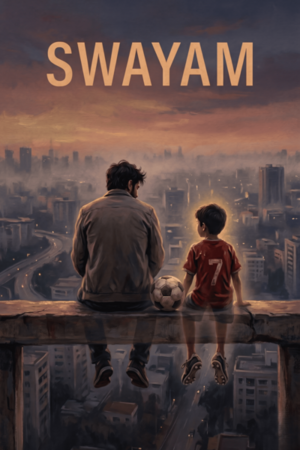
Swayam
The midday heat hit like a physical thing. It pressed down on the football stadium with a heaviness that made the air shimmer at the edges, made the grass look almost liquid. The man walked slowly through the stands, and with each step, he noticed something new. Not the way a tourist notices, cataloging things to remember later. But the way someone notices when they're trying to convince themselves they still exist.
He noticed how the sun caught the leather of the football when it was kicked—that split second of brightness before the rotation took it. He noticed the sound it made: different depending on where the boot connected, on whether it was a pass or a shot. A soft thud. A crack. He noticed the way the players moved, the awkward geometry of young bodies learning what they could do.
There were teenagers in one corner of the stadium, locked in a proper match. Fast. Sharp. Their movements had a grammar to them already. But something was missing. They were already too old for something he couldn't quite name.
The younger kids were elsewhere, in practice. Their movements were rough, uncertain. Beautiful in their clumsiness.
The man found a spot in the stands and sat, alone. He was sweating through his shirt. The heat was relentless. He watched everything, trying to feel it all again—the smell of cut grass and sun-warmed earth, the dust rising when the ball landed, the voices of coaches calling out drills. It was like trying to remember a dream by analyzing every detail. You know something is slipping away, so you grab at everything, and the harder you grab, the faster it disappears.
That's when he noticed the boy.
He was sitting alone in the stands, far from where the rest of the kids his age had gathered near the field to prepare for their match. The boy was small, maybe ten. He had the kind of stillness that came from being used to solitude. His legs dangled from the bench—he was too small to touch the ground. His hands were folded in his lap. But his eyes were on the field, on his teammates, and there was something in those eyes that didn't match the rest of him. Something older. Something that looked too much like longing.
The man didn't think about it. He just walked over and sat down next to the boy. Not too close. Just close enough to be present without demanding attention.
The boy didn't look at him immediately, but the man felt him notice. Felt the small shift in the boy's attention, the awareness of another body nearby. It took a long moment, and in that moment, the boy seemed to be weighing something. Whether this was a threat. Whether this stranger was worth acknowledging. Whether he should move.
He didn't move.
After what felt like a long time, the boy turned slightly. He unscrewed the cap of his water bottle—a bright blue thing with Cristiano Ronaldo's face printed on it in white. His fav footballer, the man would learn. The boy held the bottle out toward the man without speaking, watching to see what he would do.
The gesture was simple, but there was something profound in it. An offering. A quiet kindness that came easily to him, born from the kind of politeness that comes from being ignored often enough to understand what it means to be thirsty.
"You're sweating a lot," the boy said. His voice was soft. Not timid exactly, but careful. Like he was used to not taking up too much space in the world.
The man took the bottle and drank. The water was warm, tasting of plastic and something faintly sweet—coconut water, maybe, or something the boy's mother had mixed in. It was exactly what he needed. He felt it cool his throat, felt the relief of it move through him. For a moment, he was present in his body in a way he hadn't been in a long time.
He handed the bottle back and said, "Thanks."
The word felt small, insufficient. But the boy seemed to understand that gratitude had been offered, and he accepted it by taking the bottle back carefully. He screwed the cap on with deliberate care, using both hands to make sure it was tight, as if doing it right mattered very much. And maybe, in his world, it did. Maybe he'd learned that taking care of small things was important.
They sat in silence for a while. It wasn't an uncomfortable silence. It was the kind of silence that exists between two people who don't know each other but aren't afraid of each other either. The boy's eyes kept drifting to the field, to his teammates in their uniforms, lining up, warming up, preparing for their match. The man could see the tension in the boy's shoulders, the way he leaned forward slightly, the look of someone watching something they wanted desperately but couldn't have.
"That's a cool bottle," the man said after a time.
The boy glanced down at it as if he'd forgotten what he was holding. He looked at the face of Cristiano Ronaldo printed on the blue plastic, and then looked back at the field. He didn't say anything. There was no rudeness in it, just a simple return of attention to what mattered. To what was happening on that field. To the thing he wanted.
The man tried again, softer this time. "Cristiano Ronaldo, huh?"
This time, something shifted. The boy's head turned slowly, and he looked at the man properly for the first time. His eyes were curious, cautious, but there was a spark of something. Recognition, maybe. Or hope. The man met his gaze and smiled slightly, the kind of smile that says: I'm not here to hurt you. I'm here to understand.
"You like football?" the boy asked.
The words were simple, but they contained a question underneath them. Do you understand this thing that matters to me? And would you listen if I talked about it?
"A lot," the man said. He was quiet for a moment, and in that quiet, something shifted in his face. A memory arriving. A feeling arriving. Something he'd forgotten he carried inside himself. "There was a time when it was my escape. I used to watch Ronaldo every chance I could. I'd see him shoot the ball to the top bins, and I remember..."
He paused, getting the words right. Seeing it clearly in his mind.
"I remember the next day I'd go to the ground. The field near my neighborhood. And I'd spend hours—literally hours—trying to replicate what he did. The same run-up. The same technique. The same amount of power, or at least what I thought was the same amount. Over and over again. Until my legs were burning and my feet were blistered and I couldn't kick anymore."
He was speaking slowly, pulling the words from somewhere deep. Not from his head, but from somewhere his body remembered. His eyes had gone soft, unfocused. He was there, in that field, feeling the grass under his feet, feeling the ball connect with his boot.
"I thought I was going to be him," the man continued. "Not just like him. Literally him. I was going to play at the biggest stadiums in the world. I was going to score the goals that made people stand up and cheer. People would know my name. People would look at me the way people looked at Ronaldo."
The boy was watching him now, completely still. Listening with his entire body.
"I was going to be someone," the man said.
The silence that followed was thick with meaning.
Then the boy asked, with the directness only children have: "Then what happened?"
The man's smile faded. It wasn't a sudden fade. It was slow, like watching a light dim. He looked down at his hands, at the sweat gathering in the creases of his palms, and he was quiet for a long moment. So quiet that the boy thought maybe he wouldn't answer.
But then he did.
"I don't know," the man said. His voice had gotten quieter. "Life just... started to move faster than I could catch up with it. Responsibilities piled up. Work started. Bills came. Rent came. And somewhere in all of that, football just started to fade away. Slowly. Not all at once. Just... slowly."
He paused. The sounds of the stadium continued around them—the voices of coaches, the thud of the ball, the grass being torn up by running feet.
"Every day a little less than the day before," the man continued. "Until one day I realized it had been weeks since I'd thought about it. Then months. Then years. And by that point, I was too old. Or too tired. Or too busy. Or something like that."
He didn't say the rest of it. That he had faded away too. That somewhere between childhood and now, he had become someone he didn't recognize. That the thing that used to make his heart race—the thought of kicking a ball, of running, of that perfect moment when the boot connected with leather and you knew, in your bones, that you'd hit it right—had become a distant memory. Something that happened to someone else. Something that happened to the boy he used to be.
The boy turned back to the field. The practice was picking up. The boys were running drills now, their young legs pumping, their voices carrying across the stadium. One of them kicked the ball cleanly, and it sailed perfectly to another boy's chest, and he controlled it like he'd been doing this for his whole life, which, in a way, he had.
When the boy spoke again, his voice had changed. It had taken on a certainty that was almost startling. The voice of someone who hasn't yet learned that certainty is fragile. That dreams can fade. That life moves faster than you think.
"I could never let that happen," the boy said. "I don't think I could, even if I tried. Football is everything to me. It's the only thing I know how to do right. It's the only thing that makes me feel like I exist."
He said it all to the field, not to the man. But the man could hear the weight underneath it. The desperate hope mixed with the terrible knowledge that the world doesn't always let you do the things you love. That people get in the way. That mistakes happen.
"I'm going to be the greatest player in the world someday," the boy continued. "And when I am, people will look at me. They'll praise me. Everyone will want to be like me. Everyone will know my name. When I score goals, stadiums full of people will stand up and cheer. And I'll be someone that matters."
He said it with absolute certainty, as if he could make it true by believing it hard enough.
The man laughed. But it wasn't a cruel laugh. It wasn't a laugh that said: you're stupid, you'll never make it. It was a laugh at the innocence of it. At the absolute, unshakeable certainty. At the purity of a dream that didn't know yet that the world was in the business of breaking dreams. At the beauty of this boy, sitting alone, still believing in himself completely.
"I hope you do become the greatest," the man said. And he meant it with everything in him. "I hope you become everything you want to be. And I'd love to see you on the big screens someday. I really would. I'd sit in the stadium and watch you play, and I'd remember this moment. Sitting here with you when you were ten years old and absolutely sure of yourself."
The boy glanced at the man, and there was something like gratitude in his eyes. Not because the man had promised him anything—he hadn't. But because he'd said it like he believed it. Like it was possible. Like this boy, sitting alone in the stands, wasn't invisible.
They sat together and watched the match begin. The teenagers' match continued with its smooth precision. But the younger kids' match was on a different part of the field, further away, slightly smaller. The boy's attention was split, though mostly it stayed on the field where his friends were.
And then something happened. There was a good pass—crisp, clean. A boy ran to get it. He moved into position. He lined up his shot. And then—
The ball flew into the net.
A goal for the boy's team.
For one moment, the boy's entire body came alive. He jumped up from his seat without thinking about it, his arms going up automatically, a shout of joy breaking out of him—pure, unfiltered excitement. His face transformed completely. This was what joy looked like when it wasn't complicated yet. When it wasn't afraid of being seen. When a ten-year-old could just be happy without apologizing for it.
But then, almost immediately, he remembered where he was. Remembered that he was sitting alone in the stands, far from his team, separated from them by distance and failure and shame. His arms came down slowly. He sat back down, careful and quiet. The joy retreated behind something else. Something sadder.
The man noticed all of it.
He waited a moment, letting the silence settle back between them. Then he asked, and his voice was very gentle: "So you love football so much. So much that you jump up and celebrate, and you dream about being the greatest, and you've got a water bottle with Ronaldo on it, and you think about the game even when you're not playing. But you're sitting here. Far away from the game. Far away from your teammates. How come?"
The boy's entire expression changed. It was like watching a door close. His face became smaller somehow, more guarded. His shoulders hunched inward slightly. The man could see him deliberating about whether to speak, whether it was safe, whether this stranger had earned the right to know the answer.
The silence stretched between them. The boy's hands curled into fists in his lap, the knuckles white. His jaw clenched.
When the words finally came, they came quietly. Each one seemed to cost him something. Each one was like admitting a failure.
"Because I don't play very well," the boy said. His voice was so quiet now the man had to lean in slightly to hear him. "In the last game, when the coach subbed me on, I caused an own goal. I made a mistake. A really bad mistake."
He paused. The man could see him gathering courage for what came next.
"My coach got angry," the boy continued. "He started yelling at me. Not a little bit. A lot. In front of everyone. In front of all the other players and all the parents who were watching. He yelled about how I didn't belong on the field and how I'd cost the team the game."
His voice had gotten even quieter.
"And my teammates... they made fun of me. They laughed at me. Not just a little. A lot. They said it was my fault we lost. They said I should never play again. They said I was terrible and I'd never be a real player. And when I went to get my water bottle, they were still laughing. When I left the field, they were laughing at me."
The boy's eyes had gotten shiny, but he was trying hard not to let tears actually fall. He was doing that thing kids do when they're trying not to cry—keeping very still, breathing carefully through his nose, like any movement might break whatever fragile control he had over himself.
The man was listening completely now. Not just hearing the words, but watching the boy's face as he spoke, seeing the way his jaw had tightened, the way his eyes had gone wet, the way he was holding himself like he was trying to take up as little space as possible.
"But here's the thing," the boy went on, and there was a note of defensiveness in his voice now. Like he needed to make sure the man understood this crucial detail. "I'm not a defender. I'm not supposed to be defending. I'm meant to be a striker. I'm meant to be like Ronaldo. I should be playing upfront, trying to score, not standing in the back guarding the ball. That's not my position. I don't know how to defend. I know how to attack. I know how to score."
His voice had started to shake slightly.
"I just... in the heat of the game, I got nervous. I wasn't ready. The ball came at me and it was fast and I panicked and it just slipped through my legs. I couldn't control it. And the keeper—our keeper—he couldn't save it either. So it went in on our side. An own goal. And it was my fault."
The boy's voice had cracked on the last word. His eyes had filled with tears now, though he was still trying hard not to let them fall. They just sat there, at the edges of his eyes, making them shine.
"Everyone was so mad," he said. "And they were right to be mad. I ruined everything. I'm the reason they lost. And I didn't even mean to. I didn't even do anything wrong on purpose. I just made a mistake and now everyone hates me and everyone thinks I'm terrible and I don't deserve to play and maybe I don't. Maybe I'm just not good enough."
The man didn't say anything right away. He just looked at this boy—this small boy in a too-big world, sitting alone with his humiliation and his dreams and his desperate need for someone to understand that it wasn't entirely his fault, that he's supposed to play striker, that he couldn't have known the ball would come at him that fast, that everyone was wrong to laugh, that he mattered even though he'd failed.
The silence stretched between them. It wasn't uncomfortable. It was the kind of silence that says: I hear you. I see you. Your pain is real and it matters. You are not invisible.
The boy's hands slowly uncurled from fists.
Then the man started to speak. When he did, his voice was very measured, like he was being very careful to tell this story right.
"Let me tell you something," he said. "A few months ago, I had a boss. And one day, during a meeting with everyone there—all my colleagues, everyone from the office—I made a small mistake. Nothing huge. Just a small error in a spreadsheet. A number in the wrong column. Something that should have been easy to fix."
He paused, remembering it clearly. The man could see the memory playing across his face.
"Except it wasn't my mistake," he continued. "It was his. He'd done it, and somehow he blamed me for not catching it. And in front of everyone—and I mean everyone, the whole office, maybe thirty people—he started yelling at me."
The boy had stopped crying. He was listening now.
"He didn't just raise his voice," the man went on. "He yelled. He stood up from his desk and he yelled so loud that I think people on other floors probably heard. He told me I was incompetent. He told me I didn't deserve my job. He said I was a waste of the company's money. He said I was the worst employee he'd ever hired."
The man's hands had clenched without him noticing. His voice had gotten quieter, but there was anger in it. The kind of anger that comes from old wounds.
"And I just stood there," he said. "I couldn't say anything. I couldn't defend myself. I couldn't tell him he was wrong, even though he was completely wrong. I just stood there while he yelled, and while my colleagues watched, and I could see them trying not to smile. I thought they were on my side, but they were laughing. Not out loud, but inside. I could see it in their eyes. They were laughing at me. They were enjoying watching me get humiliated."
The man's hands had clenched so tightly his knuckles had gone white.
"I wanted to hit him," he said. "I wanted to grab him by the collar and throw him against the wall. I wanted to scream at him and tell him he was a liar and a coward and a terrible person. But I couldn't. I couldn't do any of that. I just had to stand there and take it. And then I went back to my desk, and I worked the rest of the day like nothing had happened. And nobody said anything about it afterward. It was just... it was just something that happened. Something that I had to accept."
He finished speaking and was quiet. The weight of the story settled between them like a stone.
The boy could feel it. Could feel the man's frustration, his sense of injustice, his helplessness. And he understood, in the way that only someone who has recently been humiliated can understand, exactly what that felt like.
"I'm telling you this," the man said slowly, "because what happened to you in that game... that's exactly what happened to me. Someone else made a mistake, but you got blamed. And now they're laughing at you. And everyone thinks it's your fault. And everyone thinks you're worse than you are. And the worst part—the absolute worst part—is that you can't fix it. You can't go back and undo it. You just have to live with people thinking you're terrible. You just have to accept that they're angry, and that they laughed at you, and that you hurt them. And you didn't even mean to."
The boy's eyes had started to leak tears now, despite his efforts. But he wasn't looking away.
"Both of us," the man said, and his voice was very gentle now, "we're very similar. We both got blamed for things we didn't deserve. We both had people laugh at us. We both just had to stand there and take it. We both felt like we were worthless because other people told us we were."
The boy looked at the man. His small hands had completely uncurled from fists. He was looking at this stranger like he had just seen him for the first time. Like he had just understood that this man wasn't a stranger at all. That they were the same kind of person.
"Both of us," the boy said very quietly, "we could be best friends."
The man felt something break open inside his chest. Not a sad breaking. A breaking open. Like a door that had been locked opening suddenly. He laughed—a real, genuine laugh that surprised him. It came from deep inside him, from somewhere that hadn't laughed in a very long time.
This ten-year-old kid, who'd been sitting alone, humiliated, with the weight of the world on his shoulders, had just decided, in a moment, that they were friends. That easily. That simply. Like it was the most obvious thing in the world. Like kindness was a door you could walk through whenever you wanted. Like understanding someone was the same as loving them.
The boy smiled slightly, watching the man laugh. The smile was small, but it was there. And it was the first real smile he'd smiled all day.
"You know what?" the man said, still smiling. "Let's do something. Let's get away from here for a bit. Let's take a walk around the stadium. We can walk past where they're playing. We can see the rest of the match. And..."
He paused, and there was something gentle in his pause.
"And I'll buy you an ice cream. What do you say? Do you like ice cream?"
The boy hesitated. The man could see the calculations happening behind his eyes. Stranger danger. His parents' warnings about talking to people he didn't know. But weighed against that was loneliness, and a man who had just understood him completely. A man who had looked at his shame and recognized it. A man who had told him that he mattered.
"Okay," the boy said finally. His voice was small, but sure.
They stood up together and started walking.





Please sign in to leave a comment.