Chapter 2:
Part Two: The Walk
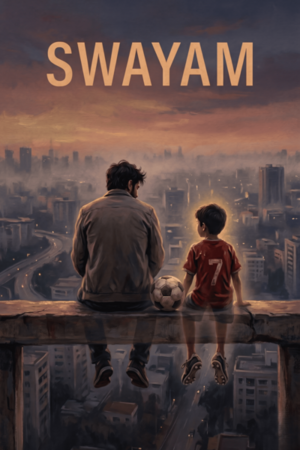
Swayam
The stadium felt different as they walked through it. Smaller somehow. Or maybe just more real. The stands had emptied out a bit—some of the younger kids' match had finished, and families were starting to pack up. The man and boy walked slowly, not in any particular hurry. The boy was smaller walking beside the man, and he had to work to keep pace, but he didn't complain. He just walked.
For a while, they didn't talk. They just walked and listened to the sounds of the stadium—the coaches still shouting instructions, the slap of the ball being kicked, the calls of the boys still playing.
After they'd been walking for a few minutes, the boy said, "Do you still live near that ground? The one where you used to practice?"
The man smiled slightly. It was a sad smile, but not a cruel one. "No. I moved cities a few years ago. For work. I don't even know if that ground is still there anymore."
"You should go back sometime," the boy said. "You should go back and play there again."
The man didn't say anything right away. The boy had no idea what he was suggesting—that the man go back to that field, back to that boy he'd been, and try to recapture something that was long gone. The idea was so young, so innocent, that the man felt something catch in his throat.
"Maybe," the man said finally.
They walked more. The boy mentioned his school. How he had one best friend named Arjun. How the other kids sometimes excluded him. How he spent lunch sitting with Arjun most days, and on the days Arjun wasn't there, he sat alone.
"How many friends do you have?" the boy asked.
The man considered this carefully. "Not many. I have one. Arjun too, actually. From university. I don't know if he's still my friend though. We lost touch."
The boy looked at him like this was a tragedy. Which, in a way, it was.
They arrived at the ice cream stand. It was a small operation, just a man with a cart and a cooler, parked near the stadium entrance. Other kids were there with their parents getting ice cream after the match. The stand's colors were faded—it had been there for years, probably. The man could still smell the ice cream, that sweet cold smell that belonged to childhood and summer.
"What flavor do you want?" the man asked.
The boy looked at the list written on a small board. "Butter Scotch," he said.
And without thinking about it, without consulting the list again, the man said, "I'll have Butter Scotch too."
They looked at each other for a moment, and then they both smiled. It was a small thing, but it felt significant. A moment of recognition. Of being the same, somehow.
The man pulled out his wallet. He had the new 100 rupee notes—the blue and purple ones from 2026. He handed one to the ice cream man.
The ice cream man looked at it. His face changed. He looked confused, then annoyed.
"Stop joking," he said, not meanly but with a kind of tired irritation. "Why are you handing me children's bank fake money? Is this some kind of prank?"
The man felt his face heat up. His cheeks burned. He looked down at the note in his hand as if he'd never seen it before. And for a moment, standing there, feeling the weight of this stranger's dismissal in front of this kid, he felt very small.
The boy didn't hesitate. He dug into his small backpack and pulled out a 100 rupee note. A real one, apparently, because the ice cream man took it without question and handed over the two ice creams.
As they walked away from the stand, the boy said, "It's okay. My mom gives me lunch money. Today I had lunch from my friend Arjun's lunchbox. His mom made the best aloo parantha."
He said this matter-of-factly, but there was something underneath it. Something that said: I understand embarrassment. I've felt it too. It's okay.
"That was kind of you," the man said quietly. "To pay for mine."
"That's what friends do," the boy said simply.
They found a bench overlooking the field where the matches were still happening. The teenagers' match had ended. Now only the youngest kids were still playing, their movements less organized, more chaotic. They sat down together, the man and boy, licking their ice cream in the heat.
The boy's team had lost their match. The man noticed this.
"Your team lost," the man said.
"Yeah," the boy said. He didn't sound devastated. Just matter-of-fact. "They would have won if I was playing."
The man almost laughed, but he caught it. He understood this wasn't a boast. It was just fact, in the boy's mind. Absolute certainty.
"Obviously," the man said. "You would have scored at least ten goals."
The boy smiled. "Maybe more. Ronaldo scores a lot."
They sat together in the heat and finished their ice creams, not talking much. Sometimes conversation isn't necessary. Sometimes just being next to someone is enough.
After a while, the boy asked, "When is your birthday?"
The man paused mid-lick. He actually had to think about this. When was his birthday? It was coming up soon, he thought. But when exactly?
"I... I forgot, actually," he said slowly. "I've been very busy the past few weeks. Very busy with work and everything else. And I just... I forgot that my birthday was coming up."
He said this like it was a normal thing, but the boy could hear something under it. Something sad about a grown man who could forget his own birthday.
The boy's face lit up. "Really? Mine is in a week! A week exactly! My birthday is coming in a week!"
"Do you like your birthday?" the man asked.
"Of course I do," the boy said, and he said it like the question didn't quite make sense. "It's the most special day of my life. It's my birthday."
He said it like a complete explanation of why it mattered.
"Tell me about it," the man said. And he meant it. He wanted to know.
The boy took a breath, and then he started talking. And the words came out faster and faster, like they'd been waiting for someone to ask them.
"I wake up in the morning," the boy said, "and the first thing my mom and dad do is come to my room and wish me. They sing to me. And they're both there, and they're both smiling, and they're both happy. Then my mom makes my favorite breakfast. Aloo parathas with pickle. And after breakfast, my dad takes me to school. But not just regular—he takes me with a whole bag of chocolates. Good ones. And he gives them to my teacher, and then my teacher announces to the whole class that it's my birthday, and all my friends come and get a chocolate."
He paused to take a breath.
"And then the whole day," he continued, "all my friends are with me. All ten of them. They walk with me the whole day. We sit together at lunch. We play together in the break. I'm never alone. I'm the center of everything. And everyone is nice to me. Everyone wants to be my friend that day."
The boy's eyes had gotten shiny, but he was smiling as he talked.
"And then after school," he said, "when I come home, my whole house is decorated. There are streamers and balloons. And all my friends come. And some of my family comes. My aunts and uncles and cousins. And we sit together and we cut the biggest cake. And I blow out the candles. And I make a wish. And then there are presents. So many presents. Cool toys and books and things I really want. And everyone is celebrating me. Everyone is happy because it's my birthday."
He finished speaking and was quiet.
The man had been listening to all of this, watching the boy's face as he talked about his birthday like it was the most perfect day that could ever exist.
"It really does sound like the best day of your life," the man said slowly.
And then he paused. And his voice changed slightly.
"But... do these things actually happen?" he asked gently. "Or is it something you want to happen?"
The boy's face changed. The light went out of it slightly. He became very still.
The man watched him carefully. He wasn't trying to be cruel. He was asking a real question, from a place of understanding something about disappointment.
The boy didn't answer right away. He looked down at his ice cream. It was starting to melt.
Then the man took out a pack of cigarettes from his pocket. He shook one out and lit it with a lighter. He took a puff, and the smoke curled up into the hot summer air.
The boy's face twisted. He covered his nose with his hand, closing his eyes, his expression showing disgust very clearly.
The man saw it immediately. Without a word, he put the cigarette out, crushing it under his shoe, and threw the rest of the pack away. He didn't say sorry. He just did it.
The boy uncovered his nose slowly.
When he spoke, his voice was very quiet, and there were tears in his eyes.
"My mom and dad keep fighting," he said. "I don't know why they fight so much. They used to be happy together, but now they yell at each other a lot. They yell when I'm home. They yell when they think I'm asleep. I can hear them through the walls."
He paused. His small hands had curled into fists again.
"But I hope they make up before my birthday," he said. "I hope they do. Because the birthday I told you about... that only happens if they're both happy. If they're both smiling. If they're not angry at each other."
The man felt something cold run through him. A shiver. A recognition of something he couldn't quite place. Something familiar about a child's hope, fragile and desperate, hanging on the hope that his parents would put aside their anger for one day. For his day.
The man didn't know what to say. So he was quiet.
The referee's whistle blew, signaling the end of the children's match.
"Come on," the man said, standing up. "Let me walk you home. Where do you live?"
The boy hesitated. The man could see him doing the calculations again. How much did he trust this man? Was it safe to tell him where he lived?
But then the boy said, "My house is just a few blocks from here. I came on my bicycle."
"Come on then," the man said. "Let's go."
The boy had considered the man his friend by then—more than a friend, actually. Something more. He agreed.



Please sign in to leave a comment.