Chapter 2:
CHAPTER 2: The Black Volume
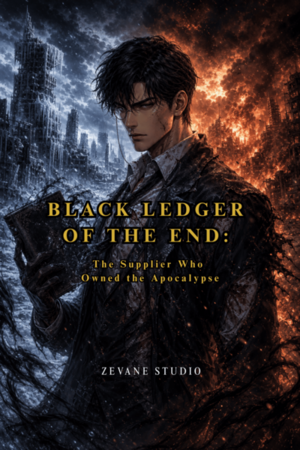
Black Ledger of the End: The Supplier Who Owned the Apocalypse
Cargo from a Dead Man
Two days after waking from death, Atlas Silva returned to the coast where the impossible had first entered his life.
The southern Cebu shoreline did not look like the beginning of anything. It looked like a neglected strip of wet sand, black rock, seaweed, and broken driftwood pressed beneath a gray morning sky. The tide had dragged trash against the shore in uneven lines: plastic crates, rotten rope, fragments of foam, old bottles, and splintered boards swollen from seawater. Farther out, fishing boats moved in slow silhouettes, their engines coughing beneath the wind.
The sea was calm.
Atlas did not trust calm things anymore.
His vehicle stopped before the local barricade at exactly 7:18 AM. Orange plastic barriers had been dragged across the road leading down to the shore, and two municipal police officers stood beneath a temporary canopy with clipboards, radios, and the bored tension of men assigned to something they did not fully understand. Beyond them, near a cluster of dark rocks, the cargo container rested half-buried in sand and shallow water.
It was there.
Dark blue exterior. Rust along the upper edges. Salt scars across the metal. A peculiar mechanical door facing inland, sealed by a lock system that did not match ordinary cargo standards. Even from a distance, Atlas recognized its shape with a clarity that made his fingers tighten around the steering wheel.
January 5, 2999.
In the first timeline, this had been the day one of his contacts called him to inspect unusual cargo found on the south shore. He had arrived later than, less cautious, less quiet, and less aware that a single object inside the container would turn his high-average discipline into something sharper. Back then, he had treated the incident as business first and curiosity second.
Now he understood that he had been standing before the remains of a dead man’s world.
He parked beside a municipal truck and stepped out.
The wind carried salt, engine fumes, and the damp smell of sea rot. Atlas adjusted the cuffs of his shirt, closed the vehicle door, and scanned the site before moving forward. Three local officers. Two barangay staff. One salvage crew. A small rented truck near the road. Four laborers are smoking near the shade of a coconut tree. One municipal engineer is checking the container door with a flashlight. Two guards near the shoreline, keeping curious fishermen at a distance.
The authorities had controlled the area well enough to avoid public commotion. Not perfectly. Nothing in small-town administration was perfect. But enough.
Atlas had made sure of that in the first timeline after Marco called him. The cargo looked foreign, possibly sensitive, possibly military-adjacent, and possibly useless. Local officials disliked all three possibilities. If they opened it publicly and found contraband, they would be responsible. If they hid it and a foreign party appeared, they would be accused. If they ignored it and it became dangerous, their names would be dragged through investigations.
So they called someone useful.
Someone with logistics knowledge, private trucks, salvage contacts, and enough connections to make the problem move.
Atlas walked toward the barricade.
One of the officers looked up. “Sir Atlas?”
Atlas nodded once.
The officer lifted the barrier after checking his name against the paper. “Sir Marco is near the container.”
“Any media?”
“None, sir. Barangay captain said keep it quiet.”
“Good.”
The officer hesitated. “Is it dangerous?”
Atlas looked toward the dark blue container.
“In my experience, dangerous things are usually handled by people who insist they are safe.”
The officer did not know whether to smile.
Atlas moved past him.
Marco Reyes—not related to Yasha’s family, despite the surname—stood near the container with his sleeves rolled to the elbows and a cigarette tucked unlit behind one ear. He was in his early forties, lean, sun-darkened, and always looked as if he had slept badly inside a truck cabin. In the first timeline, Marco had been one of the few men Atlas could call reliable in logistical emergencies. Not loyal. Atlas no longer gave that word easily. Reliable meant Marco liked being paid, hated unnecessary drama, and understood that cargo work rewarded silence.
Marco saw him and lifted a hand. “Atlas. You came fast.”
Atlas stepped closer.
“You said the door was unusual.”
Marco snorted. “Unusual is polite. The damn thing looks like someone made a vault and called it cargo.”
They shook hands.
The moment their palms touched, a thin black line flashed across Atlas’s vision.
[OBSTRUCTION LEDGER]
Potential threat proximity detected.
Classification:
Pending.
Atlas’s grip did not change.
Marco’s hand was dry, calloused, familiar. A working man’s hand. In the first timeline, Marco had not been part of the final betrayal at the base. At least, Atlas had never seen him there. But absence from the final room did not equal innocence. The apocalypse had many corridors. Some men betrayed by opening the gates. Others betrayed by giving directions, selling schedules, or mentioning names when they thought survival required only a small compromise.
Atlas released his hand.
The warning flickered once more, then faded.
He ignored it.
Not because it did not matter.
Because the cargo mattered more.
“What do we know?” Atlas asked.
Marco turned toward the container. “Reported by a fisherman’s son last week. They thought it was normal debris first. Tide pushed it higher two days ago, enough for the barangay to notice the locking mechanism. No one opened it. No markings except old serial plates, too damaged to trace cleanly. Paint looks commercial, but the build is strange.”
“A week?”
“More or less.”
“No one claimed it?”
“No foreign rep. No shipping company. No embassy call. No military instruction. If it had confidential items, someone should have been screaming by now.”
Atlas looked at the container’s upper frame. The rust pattern was the same as he remembered. The left hinge had been weakened by salt exposure. The lower mechanical brace hid a release point beneath fused grit and corrosion. In the first timeline, it had taken nearly a week to open the container safely because they approached it like ordinary sealed cargo with possible hazard risk.
This time, one day would be enough.
“From outside the Pacific route?” Atlas asked.
“That’s my guess,” Marco said. “Could have fallen from a cargo ship during a storm, drifted for weeks, maybe months. Or smuggling gone wrong. But it’s too clean inside the locking system. Not local work.”
Atlas crouched near the door.
Rust flaked beneath his thumb. The metal was cold despite the morning heat. He studied the frame, the bolts, the strange mechanical grooves, and the layered seal where the door met the container wall. Behind him, municipal staff waited with the awkward impatience of people hoping a private specialist would accept responsibility.
“Get the cutting team,” Atlas said.
Marco frowned. “You sure? The municipal engineer wants to wait for a regional clearance.”
“The longer it sits here, the more people hear about it. If someone claims it later, we can say we opened it to check for public safety.”
“That sounds like a sentence designed to survive paperwork.”
“It is.”
Marco laughed under his breath. “You always make trouble sound legal.”
Atlas stood. “Who has authority on-site?”
Marco pointed to a woman beneath the canopy, checking documents with the municipal engineer. “Engineer Lacuesta. The barangay captain isn’t here. Police are only securing the area.”
Atlas walked to the canopy.
Engineer Lacuesta looked up as he approached. She was mid-thirties, tired-eyed, and already irritated by the sea wind throwing papers around her clipboard. Atlas knew her from the first timeline only by name. Efficient enough to be useful. Not powerful enough to be dangerous. Not yet.
“Mr. Silva,” she said. “I was told you could assist with transport assessment, not open the container without clearance.”
Atlas glanced at the papers. “If there are chemicals inside and it leaks into the shoreline, the municipality takes the first blame. If there are foreign confidential goods, you need proof that you secured and documented them properly. If there is nothing, delay only increases public curiosity.”
Her mouth tightened.
He continued, calm and practical. “Open it under safety justification. Record every step. I will sign as a private logistics consultant and shoulder the initial equipment cost. If the regional authority questions it, you acted to prevent a possible public hazard. If the military asks, you preserved the chain of custody.”
“Are you representing a military office?”
“No.”
“But you have contacts.”
“Yes.”
She studied him.
Atlas let the silence work. In small municipalities, influence did not need to shout. A known general in Manila had once used Atlas for discreet procurement routing and emergency supply assessments. That connection was not official enough to give Atlas command, but official enough to discourage unnecessary interference. Cebu authorities would not obstruct him unless the cargo screamed public danger.
This container would not.
Not in any way they could recognize.
Engineer Lacuesta exhaled. “You sign liability for cutting supervision and initial inspection.”
“I’ll sign.”
“And no item leaves until inventory.”
Atlas looked at her.
“Of course.”
The lie sat easily on his tongue because the only item that mattered would not remain physical long enough for inventory.
By 8:30 AM, the site had changed from a quiet discovery into a controlled operation. Tarps went up. More tools arrived. A compact generator coughed to life near the road. Workers scraped rust from the frame. The municipal engineer recorded video while Marco argued with a cutter about the angle and pressure. Atlas stood close enough to supervise, far enough not to appear impatient.
He knew where the weak parts were.
He pointed them out gradually.
Not too fast. Not as if he remembered the container’s anatomy from another life. Just enough to look competent.
“Here,” Atlas said, tapping the lower brace with a metal rod. “This section is more corroded. Don’t attack the lock directly. Release the frame tension first.”
The cutter wiped sweat from his temple. “Sir, this is thick.”
“I know.”
“Could damage the door.”
“We’re not preserving the door.”
Marco squinted. “How did you see that weakness?”
Atlas did not look at him. “The rust tells you where pressure has been uneven.”
“Rust talks to you now?”
“Cargo talks to anyone who loses enough money because of it.”
Marco chuckled and stepped back.
The day lengthened. The sea pulled away and returned. Local officers rotated shifts. Food arrived in plastic bags near noon. Staff ate under the canopy while the cutting team worked in sections. Sparks flashed against the dark blue metal. The smell of heated rust mixed with salt and diesel. Every hour, more of the mechanism surrendered.
Atlas remained on-site.
He answered calls. Gave instructions for unrelated shipments. Sent messages to one of his accountants. Checked the news twice. Not because anything world-ending would appear yet, but because habit mattered. He had spent the last two days building a private timeline in handwritten notes, encrypted files, and memory lists organized by month.
January: black volume recovery, initial capital repositioning, family observation, contact review.
February: early acquisition tests, supplier mapping, debt channels, first loyalty probes.
March to June: war pressure rising, military contracts expanding, global supply instability becoming profitable.
July to October: pandemic shadows.
November: family consolidation urgency.
December: cure delay, final conversion of money into matter.
January 3000: ice.
February 3000: heat. Betrayal. Death.
He did not write all the names yet.
Names carried weight.
Weight required structure.
By late afternoon, the container door had loosened enough for the crew to install secondary supports. Engineer Lacuesta wanted to pause until morning. Atlas refused with courtesy and pressure.
“The site is already known to too many workers,” he said. “If we leave it overnight unopened, someone will come back curious. Open it under the lights. Finish the first inspection. Seal the report.”
She disliked the logic because it was correct.
Work continued.
At 7:40 PM, the shoreline was under floodlights. Insects circled the lamps. The sea had turned black beyond the rocks. The container looked less like cargo and more like something pulled from beneath a grave, its blue paint almost invisible under night and rust.
Atlas lit a cigarette at 8:12 PM.
He did not smoke often. In the first life, he had used cigarettes during long waits at ports, military depots, and warehouse disputes where boredom invited impatience. Tonight, he used it to occupy his hand while the past approached the present with mechanical certainty.
Marco stood beside him, rubbing his neck.
“You think it’s empty?”
“No.”
“Contraband?”
“Not likely.”
“Then what?”
Atlas exhaled smoke toward the water. “Something someone stopped looking for.”
Marco frowned. “That’s worse than contraband.”
“Yes.”
At exactly 9:03 PM, the final brace broke.
The door released with a deep metallic groan.
Everyone stepped back.
The cutting team raised crowbars and slowly forced the mechanism open. Air escaped from inside, stale and dry, carrying the smell of old paper, dust, salt, and something faintly burnt. No chemical sting. No rot. No explosive pressure. No immediate hazard.
The floodlights shone into the container.
There were no weapons.
No military crates.
No gold.
No sealed contraband packages.
Inside was an office corpse.
Metal shelves overturned. Broken cabinets. Water-damaged files. Plastic storage bins. A ruined desk was jammed near the rear wall. Bundles of paper swollen by humidity. Corporate binders with unreadable logos. Loose stationery. Old datapads with dead screens. Trash bags. Shredded documents stuck together like gray skin. A cracked chair wedged sideways beneath a collapsed panel. Nothing valuable to anyone who did not know where to look.
One worker laughed. “All that for garbage.”
Engineer Lacuesta lowered her flashlight with visible relief. “Office waste?”
Marco stepped forward. “Very expensive office waste if someone sealed it like this.”
Atlas entered first.
The floor shifted under his weight. Papers crunched beneath his shoes. The air inside was warmer than outside, but dry in a way that did not match a container left near the sea. His flashlight moved over ruined documents and broken equipment, pausing briefly on fragments of a corporate seal stamped across several folders.
He had researched it in the first timeline.
The company no longer existed before 2999. That was the first mystery. Its registrations had vanished into old mergers, dissolved subsidiaries, and dead records. Some documents suggested foreign ownership. Others contradicted them. He had followed the trail for months, paying brokers, bribing clerks, searching shipping routes, asking quiet questions through contacts who knew how to read dead companies.
He found almost nothing.
Not because there was nothing.
Because his authority had not been high enough to reach the truth.
The owner of the black volume had been a dead man. Atlas had learned that much from fragments, dates, and absence. Whoever he was, he had belonged to a level of the world that ordinary records did not touch. A man with enough power to erase corporate trails before 2999. A man whose office trash could drift across oceans sealed inside a container no one dared claim. A man whose notebook could teach crisis economics like scripture and later become a system after betrayal and death.
Atlas had never learned his name.
Not then.
Not yet.
He turned toward the doorway.
“Marco,” Atlas said. “Tell the staff to step out and take a break.”
Marco blinked. “Now?”
“Initial visual safety is confirmed. No fumes. No weapons. No active hazard. I’ll do a quick documentation pass before we let everyone touch the papers and turn them into mud.”
Engineer Lacuesta looked doubtful from the outside. “Mr. Silva.”
Atlas turned the flashlight toward the floor, not her eyes. “If this becomes an evidence issue, contamination by ten workers will hurt your report. Give me five minutes to record the inside as found. Then the inventory can start.”
That was reasonable.
Reasonable lies worked best.
She hesitated, then nodded. “Five minutes. Guards stay outside.”
“Fine.”
Marco looked at Atlas for a moment longer. Something passed behind his eyes. Curiosity. Suspicion. Maybe only fatigue.
“Five minutes,” he said.
The staff withdrew. Their voices moved away toward the canopy and the food table. Two guards remained outside the open door, silhouettes under floodlight, close enough to respond but not close enough to see the rear drawer beneath the broken desk.
Atlas waited until their footsteps faded.
Then he moved.
No hesitation now.
He stepped over collapsed binders and broken plastic trays, crossed the narrow path between shelves, and reached the ruined desk at the back. The desk had been thrown sideways but not fully overturned. Its upper drawer hung open, full of wet papers and rusted clips. The main drawer beneath it remained shut.
In the first timeline, he had found it by accident after the staff had left him alone with the inventory for too long.
Tonight, he reached for it like a man opening his own grave.
The drawer resisted once.
Atlas pulled harder.
It slid open.
Inside, beneath a layer of black dust and torn paper, lay the volume.
It was exactly as he remembered and not as he remembered at all.
The cover was matte black, untouched by moisture, without title, author, or mark. It looked too simple to belong in the world. No ornament. No corporate seal. No lock. No visible damage. A book that had survived where everything else had rotted.
Atlas’s flashlight beam settled on it.
The air inside the container thinned.
For a moment, he heard the warehouse again. Counting. Seven days. Tan’s voice. The rifle. Yasha’s breathing is gone. Haven silent. Lucas is near the table.
Atlas reached into the drawer.
His fingers touched the cover.
The black volume glitched.
Not visually alone. Reality itself seemed to skip. The container walls bent inward for a breath. The flashlight flickered. The sound of the sea cut out. The book trembled beneath his hand, became transparent, returned solid, then dissolved upward into thin black particles that folded into his palm without entering his skin.
Atlas stepped back once.
The drawer was empty.
No book.
No dust outline.
No evidence.
Only his hand remained, cold from the contact.
The system opened in the air before him.
[ONE-TIME QUEST ACHIEVED]
Black Ledger Found: Fragment of the Past.
Acquired Successfully.
One-Time Quest Achievement Completed.
Token of the past and present combined.
Calculating reward...
Atlas stood in the broken office-cargo while the screen flickered over the empty drawer.
Outside, Marco’s voice drifted faintly through the open door as he spoke with one of the workers. The guards shifted their stance. The generator hummed. Floodlights buzzed. The sea continued breathing against the rocks.
Atlas waited.
One minute passed.
Then the system glitched sharply.
[DING]
[PASSIVE SKILL REWARDED]
Skill: Time Sense I
Rank: Basic
Type: Passive / Limited Active Simulation Support
Effect: Allows basic accelerated or decelerated mental simulation for up to 10 minutes of perceived planning time.
Uses:
Strategy planning.
Negotiation prediction.
Route analysis.
Betrayal probability testing.
Emergency decision-making.
Engineering and construction evaluation.
Restriction:
Does not stop real-world time.
Does not reveal unknown information.
Only accelerates Atlas Silva’s internal processing.
Additional Note:
Simulation quality depends on available data, user knowledge, and emotional stability.
Atlas read the reward twice.
Not storage.
Again, not storage.
A faint irritation moved through him, colder than anger. He had hoped, even after the forced Pandemic Countermeasure purchase, that recovering the physical volume might grant space, preservation, or a hidden utility related to resource concealment. Something directly useful for hoarding supplies beyond physical reach. Something that would let him build a pantry no looter could count.
Instead, the system gave him time inside his own mind.
Atlas looked at the words again.
Emergency decision-making. Route analysis. Betrayal probability testing. Engineering and construction evaluation.
The irritation settled.
Not useless.
Far from it.
He was not a born monster of intelligence. He had discipline, memory, logistics experience, and one dead man’s volume fused into a system. But he was still Atlas Silva. He could be overwhelmed by too many variables. He could miscalculate human hunger. He had already done so once, and his family paid for it.
Simulation would help close that gap.
It would let him test conversations before speaking. Routes before sending trucks. Shelter designs before pouring concrete. Betrayal traps before trusting a name. Evacuation sequences before the ground split. Project designs before workers realized what they were building.
A shelter that survived one disaster could fail in the next. A bunker could become a coffin. A truck route could become a death funnel. A loyal man could become a liability under the correct pressure.
Ten minutes of accelerated thought would not make him all-knowing.
But it would make him harder to surprise.
Atlas lifted his hand and touched the skill window.
The text folded inward.
A sensation settled behind his eyes, subtle and cold, like a second clock beginning to tick beneath the first. He looked at the broken desk, and for half a breath, he saw possible movements. Drawer removed. Desk photographed. Symbol recorded. Exit timing. Staff suspicion level. Marco’s questions. Engineer’s report. Evidence risk.
The simulation ended almost before he understood it had begun.
Atlas exhaled quietly.
“Good enough.”
He turned to leave.
Then stopped.
His flashlight, sweeping across the drawer’s interior, caught a mark carved into the back panel where the black volume had rested. It was small, almost hidden beneath grime, and would have been missed by anyone removing the desk for disposal. In the first timeline, the staff had likely thrown the desk out before he returned to inspect it. Or he had seen the symbol and failed to recognize its importance because no system had yet given him a language for it.
Now he recognized it immediately.
Not because he knew what it meant.
Because he had seen its shape in the system interface.
A circle broken by a vertical black line. Three smaller marks beneath it like closed gates. The symbol pulsed faintly when his flashlight touched it, though the light itself did not change.
Atlas took out his phone.
No flash.
He photographed it once, then again from a closer angle. After that, he used a small utility knife from his pocket to scrape away the surrounding grime without touching the mark itself. It was not ink. Not paint. Not burn damage.
It had been pressed into the desk material from the inside.
Atlas stared at it.
The dead man who owned the black volume had left marks inside ruined furniture, hidden within cargo no one claimed, under the shell of a company that no longer existed before 2999. That was not an accident. That was storage. Concealment. Transfer. Or burial.
A dead man’s office had washed ashore in Cebu.
And one year later, Atlas had died holding the dead man’s book.
The thought did not frighten him.
It clarified the scale of what he did not know.
His authority in the first timeline had not been enough to learn the owner’s name. His money had not been enough. His contacts had not been enough. His questions had touched only dead companies and sealed records.
This time, he would not chase the name first.
Names could wait.
Function could not.
He pocketed the phone and stepped away from the desk.
Before he reached the container door, the system appeared again.
This time, the panel was red-black.
[WARNING]
Obstruction Ledger response detected.
Atlas stopped walking.
The guards outside continued looking toward the shore, unaware. Marco laughed at something near the canopy. Engineer Lacuesta argued with a worker about documentation. The night remained ordinary around the warning.
Atlas opened the details.
The panel expanded.
[BOUNTY QUEST SYSTEM TRIGGERED]
Threat Grade: Normal Level
Target: Pending Identification
Future Hindrance Probability: 41%
Projected Future Role: Supply Route Informant
Condition: Target has direct proximity to Black Ledger recovery site.
Target may expose, sell, distort, or weaponize information related to Atlas Silva’s abnormal interest in the cargo.
Objective: Reduce the target’s future hindrance probability below 5%.
Acceptable Outcomes:
Silence.
Misdirection.
Dependency.
Isolation.
Discrediting.
Contractual control unavailable at the current level.
Reward: 100 AC
Death Mana Progress: 0 / 100 Normal-grade equivalent
System Note:
Death does not require slaughter.
Death requires a conclusion.
Atlas read the message once.
Then he looked out through the open door.
Under the floodlights, Marco stood with his cigarette finally lit, speaking to one of the guards. He turned slightly, as if feeling Atlas’s gaze, and their eyes met across the distance.
Marco smiled faintly.
Not guilty.
Not innocent.
Just human.
Atlas stepped out of the container with the empty drawer behind him and the system warning still burning in the corner of his sight.
The first threat of the second life had already been marked.





Please sign in to leave a comment.