Chapter 2:
EPISODE 2 - "THE PERSON WHO KEPT THE RIVER"
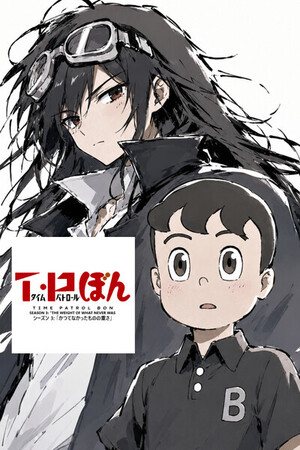
T・P BON — SEASON 3: "THE WEIGHT OF WHAT NEVER WAS" - Original Series By Fujiko F. Fujio
PART ONE: THE BRIEFING
"Her name is Lihua," Gayler said. "Sixty-one years old. Midwife. Hubei province, 1931."
The mission display assembled itself above the briefing table — the slow brown sprawl of a river that had outgrown its banks, villages half-submerged, the specific catastrophic ordinariness of the 1931 China floods, an event so vast that later historians would simply struggle to agree on how many millions had died, the number itself becoming a kind of argument rather than a fact.
"The flood reaches her village tonight," Gayler continued. "She is recorded as drowning at approximately 4 AM while attempting to retrieve an child from a partially submerged house. The kid — " he paused, the specific pause of a person delivering information he did not enjoy delivering, "— drowns regardless, one hour later, in a separate location, during a secondary collapse event. Her death changes nothing. She is yours to save."
Bon stared at the display. At the small marked dot that represented an entire human being who had organized his information into a province and a year and a cause of death.
"The kid dies anyway," Bon said. "Yes." "So she dies for nothing."
"She does not die for anything," Gayler said, and there was something in his voice that was almost — not quite, but almost — gentle. "She simply dies. The flood does not negotiate purpose. It only negotiates water level." He looked at the three of them. "Your job is not to find meaning in it. Your job is to make sure it does not happen to her specifically. That is the entire mandate."
Ream was quiet, looking at the file with an expression Bon had started to notice more, lately. Something careful. Something that had not been there before the Dimension Ball, before whatever it was that had nearly killed her inside it. She looked up. "Sixty-one years old. Fifty years as a midwife. Do we know how many—"
"The estimate in the regional records is approximately four hundred deliveries," Gayler said. "Unofficial. The records are incomplete. Most midwives of her era and region were never formally counted."
"Four hundred," Yumiko said quietly. "Four hundred recorded ones," Gayler said. "There were likely more."
[BON'S INTERNAL MONOLOGUE: Four hundred people exist because this person showed up. Four hundred people who had kids of their own to raise or something around those terms probably, who had whole lives, whole arguments and breakfasts and bad days and good ones, and all of it traces back to her hands doing the same specific work over and over for fifty years on the edge of a river that kept trying to kill her. And there's no statue. There's no book. There's a number with the word "unofficial" next to it. That's — that's the whole monument. A number with a hedge on it.]
"We go in at midnight," Gayler said. "You have four hours before the flood reaches her position. Standard protocol — observe, extract, no historical interference beyond the target." He hesitated. The hesitation was unusual enough that all three of them noticed it. "There's been another anomaly flagged in the region. Insignificant. Outside your operational radius. The Handling Unit is monitoring it. It shouldn't concern you."
"Another one?" Ream said.
"It's the fourth this month," Yumiko said, already pulling it up on her terminal with the specific quickness of someone who had quietly started keeping her own list. "That's — Gayler, that's more than usual, isn't it?"
"It's being monitored," Gayler said again, in the specific tone of a person closing a door on a conversation he did not want to have yet. "Go save that midwife."
PART TWO: THE RIVER
The village was small and built low and close to the water, the specific architecture of a community that had made peace, generations ago, with the river's temperament — the houses raised slightly, the paths designed to flood and drain, the whole settlement breathing with the water's moods like something that had learned to live inside a relationship rather than fight it.
Bon found Lihua in the second house he checked. She was not hiding from the flood. She was working through it — moving between two rooms with the specific brisk efficiency of someone managing a crisis she had managed many times before, boiling water on a small stove despite the rising damp, laying out cloth, calling instructions in a voice that carried without shouting.
"You," Lihua said, spotting Bon in the doorway without breaking her rhythm. "If you're not useful, leave. If you're useful, hold this." Bon held it. He didn't entirely know what it was. He held it anyway.
[BON'S INTERNAL MONOLOGUE: She just put me to work. She has no idea who I am, the water is rising in her own house, and she just put a complete stranger to work because the work needed doing and I was standing there. That's — I don't think I've ever met someone who triages that fast. That cleanly. No hesitation. Just: useful or not useful, decide quickly, the world doesn't wait.]
"You're not from the village," Lihua said, not looking at him, her hands occupied with something Bon didn't have the vocabulary for. "No," Bon said. "Doctor?" "Not exactly." "Then why are you here?"
Bon hesitated. The rules were the rules. "I heard you might need help tonight."
Lihua glanced at him — one sharp assessing look, the specific look of a person who had spent fifty years reading people quickly because the river did not give her time to read them slowly — and then returned to her work. "You heard correctly," she said. "Hold that higher."
He held it higher.
The kid on on the bed cried out from her terrible injuries. Lihua's voice changed instantly — softened, steadied, the specific transformation of someone whose entire profession lived in the gap between someone's fear and someone's courage. "You're doing well," she said. "You're doing exactly what you're supposed to be doing. I've done this four hundred times. I am not worried. Do you understand? I am not worried, so you don't need to be either."
"You're lying," the teenager gasped. "A little," Lihua said. "But it's helping, isn't it?"
The child laughed — a confused, startled, frightened laugh, the kind that arrives sideways through pain — and Bon, standing there holding a thing he didn't understand in a flooding house in 1931, felt something move through his heart that he didn't entirely have words for either.
PART THREE: WHAT SHE CARRIES
The wounds were patched at 2 AM, healthy and patched and done right, exactly the way injuries were supposed to be patched, and Lihua's whole face changed when she saw her no longer moving in pain from her injuries — not surprise, she had done this four hundred times, but something that had not worn thin despite the repetition. Something that looked, to Bon, very much like wonder that had decided to stay.
"Neatly patched," she said. "Good method. Good methods are everything when it came to the injuries I had to heal for you."
The child — Bon had to keep reminding himself that she was not the person they had come to save. It was a cruel truth he had faced on countless missions before. He knew that, like so many others caught in this devastating flood in China, she would likely never survive what was coming. Yet the mission had a specific target, and she was not it.
That knowledge never became easier to accept.
The kid looked down at the freshly patched wounds covering her body. They had been severe enough that, without treatment, she would have died before the day was over. Tears welled in her eyes as the reality settled in. She wasn't crying because she was hurt.
She was crying because she was going to live another day.
Bon watched in silence, carrying the familiar weight that came with being a Time Patrol agent. He could save one life because history allowed it. The countless others standing around that life were a different story. And sometimes, that was the hardest part of the job.
"You did that without flinching and messing anything up," Bon said, because he didn't know what else to say, and because it was true.
"I flinched fifty years ago," Lihua said. "The flinching wears out eventually. What's left is just the doing." She looked at him properly for the first time, the assessment complete now, something almost amused in her tired eyes. "You held the items very seriously. For someone who clearly didn't know what it was for."
"I know what it was for now." "Good. Next time you'll be useful faster." There would be no next time, Bon thought, and the thought landed heavier than he expected.
[BON'S INTERNAL MONOLOGUE: She's sixty-one. She's been doing this since before my grandparents were even alive and in about ninety minutes the river is going to come through that wall and take her, and she has no idea. She's just tired, and proud of her work, and already thinking about the next house she needs to check for injuries. She doesn't know there's a clock running on her. I do. That's the worst part of this job, every single time. I'm standing in the room with the clock and I can't tell anyone it's there.]
"There's another house," Lihua said, already moving, already reaching for her bag. "The Chen family, two streets over. The water will be worse there by now. I should—"
"It's not safe," Bon said, too fast, and Yumiko's voice came quiet and sharp through his earpiece — careful, Bon — and he pulled it back. "I mean. The water's rising fast. Maybe wait until—"
"Water doesn't wait," Lihua said, already at the door, "so neither do I." She paused, looking back at him, the specific warmth of someone who had decided, in the space of ninety minutes, that this strange kid who didn't know what the bandages was for in a way was someone worth a moment of her attention. "You're a kind one. Whoever you are. Go home. Whatever you came here for, you've done it."
She was wrong about that. He hadn't done it yet. She went out into the flood.
PART FOUR: THE EXTRACTION
The house she went to wasn't on the river's main collapse path — the historical record had been specific about that, a separate residence, a different street — but it was close enough that the water reached it fast, faster than Lihua's fifty years of experience had prepared her for, because this flood, like all the worst ones, had decided not to follow the pattern of the floods before it.
Bon followed her at a distance, Ream's voice steady in his ear — the house collapses in six minutes, Bon, you need to get her clear before that, not after — and Yumiko somewhere in the dark managing the timeline's other small threads, and Buyoyon a faint glow above the water marking a path that wasn't really a path, just the visible shape of somewhere safer than where they currently stood.
Lihua was inside the house when the wall gave.
Not collapsed — gave, the specific structural sound of something surrendering rather than breaking, water pressure finding the weakest point and simply continuing through it. Bon was already moving. He got his arms around her as the water took the floor out from under both of them, and for a moment — three seconds, four — there was only the dark and the cold and the specific roaring silence of being underwater in the middle of a catastrophe that did not care who you were.
He got her up. Got her breathing. Got her, somehow, soaked and coughing and furious, onto the higher ground of the next street over.
"You," she said, between coughs, glaring at him with the specific fury of someone who had just been picked up off her feet by a stranger and did not appreciate it regardless of the circumstances. "Why are you here. Why do you keep being here."
"I told you," Bon said, breathless, soaked, his chest aching in a way that had nothing to do with the cold water. "I heard you might need help tonight."
She stared at him. Something in her face shifting — the anger draining into something else, something that looked, for just a moment, like she understood more than she was saying, the specific recognition of a person who had spent fifty years on the edge of death and had developed an instinct for when death had, for reasons she would never know, decided to look elsewhere.
"The injured child," she said suddenly. "Did I—"
"The house was already cleared," Bon said, which was true, and which Ream had confirmed forty minutes earlier through the kind of quiet efficient field work that never got recorded anywhere either. "Everyone's safe."
Lihua sat down, hard, on the wet ground, and put her face in her hands, and Bon realized — with the specific knowledge of understanding that came at the end of every mission like this — that she was not crying from fear. She was crying from the specific exhaustion of fifty years finally being allowed, for one moment, to put something down.
PART FIVE: YUMIKO
They watched her from a distance after that — standard procedure, the memory-wipe administered at careful range, Lihua blinking in the gray pre-dawn light with no memory of a stranger pulling her from beneath a collapsing wall, only the bone-deep tiredness of a long night's work and the specific satisfaction of a child safely delivered to safety that, in a world that had tried, and failed, to take her.
Yumiko was quiet on the walk back to the time boat. Bon noticed it — the specific quiet that wasn't her usual focused quiet, but something heavier. "You okay?" he said.
"Four hundred people," Yumiko said. "And there's no record of her name anywhere that will survive past this province, past this century, probably past this decade. She'll die — eventually, naturally, whenever her actual time comes — and there won't be a plaque. There won't be a book. There'll just be four hundred people who got to exist, and none of them will fully know why."
"Some of them probably know," Bon said. "The kid knows."
"For a while," Yumiko said. "And then they die too, and the knowing goes with them." She stopped walking, looking back at the village, at the gray water receding slowly from streets that would spend the next month drying out. "Is that — is that what we do? Is that the whole job? We save someone, and the saving doesn't get remembered either?"
Ream, walking just ahead of them, didn't turn around, but her voice carried back clearly. "There's no rule against crying about it, Yumiko." Yumiko laughed — confused, surprised, the laugh arriving before the decision to laugh had been made — and wiped her face with the back of her sleeve. "I'm not crying."
"You're about to." "I might be slightly about to," Yumiko admitted.
[BON'S INTERNAL MONOLOGUE: She's right, though. Nobody will ever know Lihua existed except the people she touched directly, and even they'll forget eventually, the way everyone forgets eventually, the way history forgets almost everything that isn't written down by someone with the specific privilege of being remembered. And I think that should make the job feel pointless. I think, on paper, it should. But it doesn't. I don't know why it doesn't. Maybe because the four hundred people get to exist regardless of whether anyone remembers why. Maybe that's enough. Maybe that has to be enough, because it's all there is.]
PART SIX: THE STUTTER
The time boat's systems hiccuped on the return journey — a brief, sharp stutter in the navigational field, the cabin lighting flickering once, the specific lurch of displacement that every Time Patrol agent learned to recognize and never stopped disliking.
"What was that," Bon said, gripping the console.
"Minor instability," Ream said, already running diagnostics, her brow furrowed in the specific way that meant she didn't entirely believe her own explanation. "A micro-tear. Very small. Local to this timeline." "Another one," Yumiko said quietly. "It's probably nothing," Ream said. "That's what Gayler said about the last one," Yumiko said. "And the one before that."
Ream didn't answer right away. The diagnostics finished — green across the board, the system stable, the stutter already a closed incident according to every readout the time boat possessed. But she sat there a moment longer than the readouts required, looking at the data, the specific stillness of someone filing something away that she wasn't ready to say out loud yet.
"It's probably nothing," she said again, and this time it sounded less like a fact and more like something she was choosing to believe because the alternative wasn't comfortable yet.
Bon looked out the window at the dark rushing past — the specific featureless dark of the space between centuries, no stars, no markers, just motion — and thought about a person standing in flood water up to her knees, exhausted and furious and alive, who would never know that a stranger had been watching the clock the whole time.
He thought, too, about a shadow standing very still while London burned.
He didn't say anything. Neither did the others. But all three of them, in their own private way, were thinking about the same thing, and the silence in the cabin on the way home was not an empty one.
[NARRATOR: This is the part of the job that never makes it into any briefing. Not the saving — the saving is the easy part to explain. The part that's hard to explain is what it does to the people doing it, watching, over and over, the specific scale of a life that mattered enormously and will be remembered by no one. Lihua will go on delivering patches to many injuries for another nine years before her own time comes naturally, in her sleep, in the same village, beside the same river, and not one history book in any century will ever record that she existed. Four hundred and twelve people will, though. They will simply never know why. Somewhere else, in a century this village has never heard of, someone is counting. Watching the pattern of small fractures spreading across the timeline like a question slowly being asked. He is patient. He has been patient for a very long time. And tonight, in the quiet after the flood, something he made came close enough to Bon Namihira's time boat to leave a mark.]
TO BE CONTINUED — EPISODE 3: "CHAMPION"







Please sign in to leave a comment.