Chapter 1:
The Job
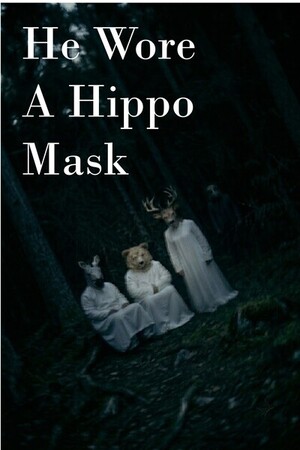
He Wore A Hippo Mask
I'm a manager at a Dairy Barn ice cream franchise now. Have been for about eight months. Comes with a dollar fifty extra an hour and two free scoops per shift, which sounds like a punchline until you've been doing it long enough to stop laughing at yourself. My brother finished his neurosurgery residency last spring. We had dinner to celebrate and I listened to him talk about the posterior cranial fossa for forty minutes and smiled and meant it, because I love my brother. My parents were there too, and they were proud of him in the way that fills a whole room, and proud of me in the way that filled a much smaller room, but still there.
I'm not writing this to complain about any of that.
I'm writing this because four years ago I was a park ranger at the Willamette National Forest in west-central Oregon—about sixty miles east of something or nothing—and on a rainy Thursday night in October I watched my only friend I had ever made step over the railing of my cabin's porch and fall a hundred feet onto a rock shelf below.
And I have never told anyone what I actually saw that night, that there was someone else standing on that porch when it happened.
I want to be clear about something before I start. I wasn't a particularly good ranger. I wasn't a particularly good anything, to be honest. Before the posting I'd spent two years in data entry at a logistics firm in Portland, flagged twice for performance, let go on a Thursday with a firm handshake and a box of my desk things.
Thirty-two years old, no wife, no kids. What I had, and had always had, was an almost embarrassing fondness for the wilderness. I'd been that kid. The one who brought home injured sparrows, who cried when the neighbor's cat died, who could sit at the edge of a creek for three hours just watching. Climbed every tree near me that could be climbed.
So I looked into it. The hiring requirements weren't nearly as strict as people imagine. A background check, a physical, a few basic certifications, and a willingness to live where most people wouldn't. I passed it all, which remains one of the more surprising outcomes of my life. They assigned me to Willamette because it was remote and understaffed, the kind of posting that experienced rangers tended to decline. An hour's drive from the nearest town on a county road that turned to gravel for the last twenty minutes. No cell service. A surprisingly well furnished two-room cabin with a kerosene heater that worked most of the time.
I loved it immediately.
There were plenty of rangers scattered across Willamette. At our station, there were two of us.
Pete W. Mid-forties, short, built like a barrel that had learned to walk. He had a grey beard that he kept trimmed badly and a laugh that arrived before his jokes did, which was fine because his jokes weren't very good anyway. He laughed at all of them. I liked him more than almost anyone I'd met in my adult life, which I realize says more about my adult life than it does about Pete.
He showed me some of the territory the first week. Two sectors: the south, which included the maintenance road, the access gate to my cabin, the creek trail; and the north, which was larger, less mapped, and backed up against a ridgeline that separated us from the next county. The north sector included some old fire roads overgrown to single-track, a series of rocky outcrops, and a shallow depression between two low ridges—maybe a mile out from the cabin—that didn't have a name on the map.
Pete pointed at it once and said: "The bowl. Nothing much out there. Apparently used to be some sort of important site for the Kalapuya."
Standard ranger duties were quieter than people expect. No heroic adventures involving lost hikers, just trail condition assessments, water source documentation, occasional liaison with the county on trespass incidents. We drove the maintenance road twice a day. We filed our reports. We drank a lot of tea.
Some day in early October Pete told me, over hot chocolate at the district office thirty minutes south, that Willamette was as calm a posting as existed in the state. The lodge was warm and smelled like woodsmoke and old boots. A few other rangers from neighboring districts were there for a quarterly allocation meeting, and I remember checking the bulletin board for updated schedule postings and noticing, between a campfire restriction notice and a flyer for something not important, a laminated donor acknowledgment card.
Station improvements and facility maintenance made possible through the generous private contributions of the following individuals.
Four names. I didn't recognize three of them. The fourth I recognized the way you recognize a face from television—not personally, just as the kind of name that appears on the sides of buildings. On the bottoms of plaques. At the bottom of press releases about things that affected a lot of people.
I remember thinking it was odd. A name like that, attached to a small place like this.
Pete came up behind me, handed me a fresh hot chocolate, looked at where I was looking.
"Nice facility, right?" he said. "Better than most remote postings. We're lucky."
I said yeah, we were.
I thought I'd found my place. The smell of the trees, the weight of the quiet, the specific low satisfaction of doing a simple job correctly. I thought I'd finally found the thing I was actually shaped for.
The feeling didn't last long.
It was the first week of October, a Wednesday, when we found the fire site up in the northwest sector.
We were doing the north perimeter check on foot—standard protocol, one of the informal trails that ran along the sector boundary. Pete was ahead of me, moving with the competent waddle of a man who had covered this ground a thousand times, when I nearly stepped on it. A stone ring, maybe 10 feet across, arranged too neatly to be accidental. Around the outer edge, low mounds of displaced soil—upturned and tamped back down. The ash inside was cold and old, a couple weeks at least.
I crouched down and started writing in my field log.
"University kids," Pete said, from about ten feet away. He hadn't come closer.
"It's a long way in for university kids." I turned over a piece of charred wood. Clean burn, no accelerant smell.
"You'd be surprised what bored twenty-year-olds will do." He came a little closer then, hands in his jacket pockets. "No garbage, no damaged vegetation, fire was completely out. They did everything right except get a permit. Office isn't going to lose sleep over it."
"I'll still log it."
"Knock yourself out, kid."
I found the rib as I was widening my inspection. It was mostly buried, just the curved end of it visible at the mound's edge. I worked it loose, held it up. Long and curved.
"Goat rib," Pete said.
"You can tell from here?"
"Curvature. Goats have a more pronounced arc than deer, more lateral spread."
He reached out and I handed it to him. He looked at it for a moment, and then put it in his duffel bag, already moving on.
"Come on. We've got the east boundary to cover."
I wrote "Animal remains, recovered by P. W." in my log. I looked at the mounds of turned earth. Then I followed him.
Two more weeks went by. Good weeks, genuinely. The birch along the north trail had gone gold. I saw a black-tailed deer one morning from the cabin porch, and I stood there in my socks with my coffee getting cold and watched it for ten minutes because I could. Pete and I ate lunch together most days. His cabin wasn't that far off. He told me about his daughters, six and ten, both of them obsessed with horses. His wife taught elementary school. He talked about them the way men talk about the things that have turned out better than they deserve.
I noticed, somewhere in that second week, that we hadn't been back to the north sector's inner area. When I mentioned it, Pete said he'd done a solo check while I was on the south creek documentation this week. Covered it himself, nothing to note. I had no reason to question this.
More days of nothing later, I was getting ready for bed once when I heard a vehicle nearby.
It was 1 AM, Tuesday night. It was somewhere up the fire road—not close, maybe a quarter mile northeast. I pulled on my boots and jacket and stepped outside. There were headlights in the trees, stationary, just sitting there. I stood on the porch and listened to the engine idle for three minutes, and then it went quiet, and the lights went out.
I picked up the radio.
Pete answered before I'd finished the sentence. Not groggy. Not half-asleep. Like he was sitting at his desk waiting.
"It's a logging survey crew," he said. "They have a county permit for the boundary that side. Ignore it."
"At this hour?"
"Early start. They camp overnight. Go to bed, Cal."
I went to bed. In the morning I walked down the road and found the spot where the vehicle had been—the gravel showed it clearly. They were standard light-truck tread, which meant they could have been Pete's truck, could have been mine, could have been a logging crew's. Could have been a dozen things.
But I kept thinking about Pete's voice. Being awake wasn't unusual. Ready was. Like he'd known why I was calling before I'd said a word.
I continued walking north along the fire road without really deciding to, just needing to move while the morning was still thin and cold. The birds had started up around me in scattered bursts through the trees, that early racket that makes a forest feel less empty than it actually is. I stopped at one point and just listened, head down a little, hands in my jacket pockets. When I lifted my eyes again I caught two points of stillness in the brush off the shoulder of the road that hadn't been there a second before, or that I hadn't noticed.
A deer. Maybe twenty meters out, half hidden behind a stand of young fir.
It was watching me.
Not the way deer watch you, all twitch and readiness, one wrong step from bolting. This one wasn't startled. Wasn't chewing. Wasn't doing one single thing a deer standing in open brush at sunup should have been doing. Its tail flicked once, a small black snap against all that wet green, and then it went still again, and so did I.
I raised my hands a little, palms out, and stepped off the road toward it. It didn't move. Didn't shift its weight, didn't lower its head, didn't do the thing where they freeze for a second and then go. I kept walking. I got closer than I had any business getting—close enough, by the end, that I could have reached out and touched it if I'd wanted to, which some part of me, the part that's always been soft for animals, badly wanted to do.
I remember thinking something was wrong with it. Sick, maybe. Caught on something I couldn't see, a snare or a length of wire half-buried in the duff. I crouched a little, and that's when I noticed its eyes weren't tracking me the way an animal's eyes track a moving thing. They were just open.
Then it snapped its head back, hard, like something had startled it from somewhere I couldn't see, and made a short, ugly sound before it bolted off through the brush so fast I lost it in three strides.
I stood there a while in the spot where it had been.
There wasn't a single track in the soft ground. Not one. I'd have understood a deer not leaving much sign on packed trail, but this was wet duff, the kind that holds a boot print for a week, and there was nothing. No depression where it had stood. No drag marks from the bolt. Just me, and the cold, and the birds starting up again like nothing at all had happened.
I wasn't sure why but I didn't log that in my report.




Please sign in to leave a comment.