Chapter 2:
The Bowl
He Wore A Hippo Mask
My four-day break started on a Thursday. Pete visited me in my cabin the night before—he was heading out himself in a few days. He said his wife had been after him about some trip she had planned for the family. I nodded along and wiped my nose with an old shirt I didn't wear anymore. I had a cold coming in: scratchy throat, that specific behind-the-eyes heaviness that means you're about to feel much worse. The weather wasn't helping. Clouds brewing in the distance, the particular grey of an Oregon autumn that you either love or find oppressive.
I woke up in the morning, packed my bags, drank some tea, locked up, and drove the cabin access trail out to the maintenance road south.
Pete was at the gate. It was pretty early in the morning. He was leaning against the post with his thermos, and he waved me through and gave me the kind of send-off you give someone at an airport. Drive safe. Get some rest. Don't spend the whole break in bed. I watched him in my rearview mirror as I pulled onto the county road. He was watching me go. Just standing there at the gate, watching the truck.
I made it about twenty minutes before my head started doing that thing where the road signs doubled up and the trees got blurry. I pulled onto the gravel shoulder. Sat there with the engine running and the heater on and the rain starting on the windshield. Twenty minutes, then forty. Trucks went past on the county road. I didn't feel better. If anything the stillness made it worse—that dizzy, dissociated feeling of being in a body that has decided to stop cooperating. The cold medicine I took that morning seemed to be kicking in.
I turned around.
The access road gate was locked when I got back. Pete's truck was gone. I parked on the shoulder, pulled my bag out, and walked the trail to the cabin. Twenty minutes on foot, the cold rain starting to get into the back of my collar. I unlocked the cabin, turned on the heater, made tea, and took two more of the cold tablets before getting into bed.
The plan was to sleep through the evening and leave again in the morning when I felt better.
The socket blew around five in the evening.
Not dramatically—just a pop and the overhead light in the main room went out. I found the fault at the wall socket under the bed; the wiring ran low in this cabin, an old quirk of the original build, which meant the junction box was accessible from below the bed frame. The bed itself was built into the wall, solid, no fold-out. So I got my toolbox and that same old rag of a shirt for my nose, lying on my back and sliding underneath the bed.
It was awkward work. Cold down there, and the light from my headlamp was the only source since the socket had taken out the whole room circuit. I had the panel halfway off when I noticed it—not sound, not movement, but light changing shape.
The door beside my bed was closed, but a thin strip of light came in underneath it. Two shadows stepped into it, almost blocking it whole.
I turned my head and peeked under one side of the bed.
I didn't call out.
I can't fully explain why. There was no decision, exactly—just the immediate, total cessation of movement. My hands stopped. My breathing went shallow. The shadow stood there. Five seconds. Ten. A person with any reason to be here would have knocked, called out, announced themselves.
They just stood there.
Then I heard keys.
A ring of them, from the sound of it. I heard him try the lock. The key turned in the cylinder but the door didn't open—I'd left my own key in the interior keyhole, blocking the external barrel. He tried twice more. Then the keys went away.
I lay completely still on the floor as he moved around the cabin. I tracked him by the light at each window. North window first: shadow passing, slow. Then the east window, where he stopped. Pressed close to the glass—I could see from my floor angle the bottom half of two palms against the pane, fingers spread, looking inside. The curtains were mostly drawn. He would have seen shapes, dark furniture, nothing much.
He stood there for what felt like a very long time.
Then the south window. Then around the back.
And then nothing. No more shadows. After several minutes I heard him move away through the undergrowth—not toward the access road, but into the trees. I heard the crunch of branches and leaves slowly fade away.
I lay on the floor under my bed until I was sure. Then I got up and went to the door, unlocking it and carefully looking outside. Empty. I went to the east window. On the glass where his palms had been: two faint oval smears, already going cold in the autumn air. I took a picture of them with my phone. Then I sat at my desk with the radio in my hand.
I keyed the mic.
"Pete, you copy?"
The speaker came back with continuous static as soon as I transmitted. I released it, checked the channel, and tried again. Same response. I cycled to the emergency frequency. Still only static on receive, no break or voice signal detected.
After a third attempt with no change, I stopped transmitting and set the radio down. I'd visit him in the morning to tell him about this odd encounter, but already knew what he'd say.
"Aww shucks, some college kids got you jumpin' at shadows?"
I wasn't sure it was college kids this time.
I finished fixing the socket. I made tea. I went to bed.
I'd been half-asleep for about five or six more hours when the rain really arrived.
Oregon rain isn't delicate. It arrives with an intention, loud on the metal roof, coming in off the ridge with enough force to rattle the windows in their frames. I lay there listening to it and not sleeping, the way you don't sleep when a cold has settled into your chest and you can feel every breath as a small event. Eventually I gave up and pulled my coat on over my thermals and went outside to the porch.
The smell of rain on pine is medicinal.
I stood there with my eyes closed for a minute and breathed.
When I opened them I saw a light I hadn't noticed before.
It was in the northwest bowl. Not a campfire's warm flicker—steadier than that, larger, the color of something that had been burning for a while now. I stood very still on the porch and looked at it. Then I went inside, got my binoculars, and came back out.
I pulled them up and adjusted the zoom on them.
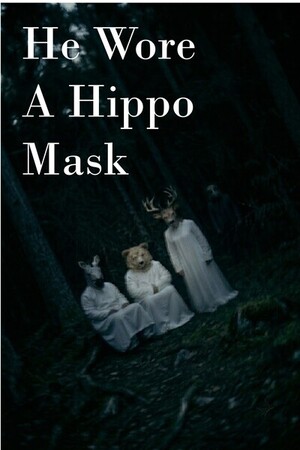
Ten people stood around a fire, in a circle, all of them wearing white robes that went to the ground, all of them wearing some sort of animal mask.
I'm going to write that again because I still find it hard to believe: Ten people around a fire wearing animal masks. Not Halloween masks—full sculpted heads, the kind built on a frame. I can tell you the animals because I went over them enough times afterward that they're catalogued in me now. Lion. Giraffe. Zebra. Two deer. A bull. A bear. Three I couldn't name from distance at the time.
And a figure in a black suit, standing slightly apart from the others at one edge of the fire. A black suit and a hippo mask.
I put the binoculars down. I picked up the radio.
Static, just like last time. Not the clean static of a lost signal—the furred, layered static that comes when something was blocking transmission.
Is that what it was?
I'd read about RF jammers in a safety bulletin some time ago, the kind that people used to block communications in remote areas. This was what that sounded like.
I tried three times. Nothing got through.
I went back inside. I opened the equipment cabinet and took out the long-range wildlife camera—the good one, a Nikon with a 500mm lens I used for documentation work. I came back to the porch and raised it.
The rain was making it difficult but the porch roof was blocking most of it. I saw the robes. The masks. The fire's light moving across all of it. The figure in the black suit and hippo mask still standing with his hands at his sides.
I stood there watching them for about half an hour, completely forgetting about the cold and the wind and the rain.
Then a black SUV arrived.
It came from one side of the bowl, along some trail I didn't know existed. Pete was the one doing most of the survey work up there. It stopped at the edge of the firelight. Two of the robed figures went to the back of it, opened the doors, and pulled a man out. His hands were bound behind him. His feet were bound at the ankle. He was conscious—I could see him moving. They put him in a chair.
Then they placed the chair in front of the hippo man.
The bound man was speaking. Even at this distance I could see the movement of his head, the desperate tilt and shaking. The hippo man looked at him without moving.
After a while the bound man stopped thrashing so much. Stopped fighting the restraints. Whatever was being said was being said very quietly.
The hippo man reached out and placed one hand on the bound man's head.
Then he bent down and pressed his mask to the man's forehead.
A kiss—like the one a mother gives to her child.
A gesture so innocent, so prepared, that it could only be the end of some ritual that had many steps before this one.
Then he stepped back…
And tipped the chair into the fire.
I made a sound. I couldn't stop it—it came out of my chest before I knew it was coming. I pressed my free hand over my mouth and held it there and through the little screen of the camera watched the fire accept what was given to it.
My hands were shaking. I breathed slowly. I focused. I pressed the shutter.
The flash fired.
The sound I made this time was different. I yanked the camera down and stared at the settings. It was triggered by the low-light threshold. I checked the image. It was blurred, overexposed at the center. You couldn't see what I'd seen. You could only see the fire.
I raised the camera again.
Thank god.
They hadn't noticed.
I went past them one by one through the lens. All of them fixed on the same point in the center of the fire.
Except one.
One of them wasn't staring at the fire. The one with a zebra head, as I recall. He was turned a little off from the rest, like he'd heard something behind him. I remember thinking that first—just that.
Then he turned his head.
Not fast. Just enough to look past the fire, toward the trees.
Toward the cabin.
He didn't move after that. Just stayed like that, looking.
I checked the others again.
One of them saw him.
Then another did. Then it spread, slowly, like they were all following the same thought as it reached them. One by one they stopped looking at the fire.
One by one they started looking out instead. Toward the tree lines.
Toward the cabin.
Toward me.
I couldn't move. I'm not ashamed of that. I stood on the porch of my own cabin in the rain with a camera in my hands and I could not make myself take a step in any direction. I watched through the lens as they began moving.
Not running.
Moving with the same unhurried deliberateness as everything else they'd done that night, filing out of the clearing in a line, following the trail toward the fire road.
Toward the cabin.
Toward me.



Please sign in to leave a comment.