Chapter 3:
I Didn't Say a Thing
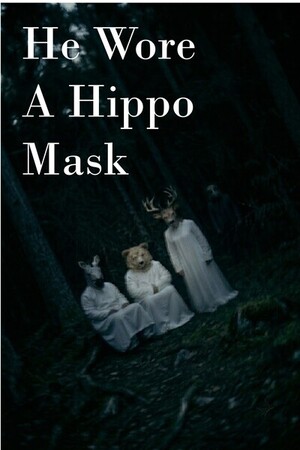
He Wore A Hippo Mask
I got inside. I don't remember deciding to. I was just inside, the door shut, looking at the walls of the cabin and thinking—with a clarity that I haven't experienced many times in my life—that these walls were not going to help. This cabin was built to specifications for animal intrusion. It was not built for whatever was about to happen.
I grabbed my radio. My headlamp. My emergency kit from the cabinet. I was out the back door and into the rain before I'd finished thinking it through.
The big pine on the east side of the cabin—I'd noticed it in my first week because I'd been that kid, the one who assessed every tree for climbability as a reflex. Low first branch, good separation above, enough canopy even in autumn to provide concealment from below. I went up it the way I used to go up the maple in my parents' backyard, quickly, without thinking about it, the bark wet and cold under my hands.
Why I didn't run for my truck, still parked out on the side of the access road gate? I'm not so sure myself. Perhaps in that moment I had realized it would have been futile, that they would catch up to me before I'd make it. I had no idea what they were capable of.
I got up to a high branch, maybe forty feet up, and pressed my back against the trunk and held still.
I could see the fire road from here. I could see the north face of the cabin's porch. I could see, just barely through the rain, the distant smear of orange where the fire in the bowl was still burning.
I adjusted the radio antenna, pointing it toward Pete's cabin southeast, and clicked the emergency SOS pattern three times. I waited. Clicked again. I thought I heard the static change slightly, a thinning in it, and I kept clicking. Maybe being higher up was helping.
They arrived a moment later.
Not running. Never running. They came along the fire road and fanned out around the cabin with the efficiency of people who had done this kind of search before, and something in the base of my skull understood that this was not their first time looking for someone who had seen them.
Two of them had hatchets and they went through the cabin door with a single blow—the latch-pin system holding for exactly as long as I'd predicted it would. The others circled. Checked under the porch. Moved through the brush. Some headed down the access road behind the cabin. One of them stood directly below my tree for close to thirty seconds, and I stopped breathing and held a sneeze in my sinuses with every muscle in my face, the cold rain still running down the back of my neck and spine. I watched the top of an animal mask—a bear, I thought, or a wolf maybe—tilt slightly upward in my direction.
I'd been in the tree for about forty minutes when I saw headlights on the road leading to the cabin.
Pete's truck. I knew it from the particular way one headlight sat slightly lower than the other—a mounting issue he'd been meaning to fix since who knows how long.
The robed figures saw it too. They moved back from the cabin, fast and quiet, back toward the fire road north, melting into the brush on either side. Within a minute they were gone from my sight. The clearing around the cabin was empty.
Pete parked and got out running, calling my name. He was in his ranger jacket over what looked like pajama pants. He went to the cabin door, saw it open, went inside, called my name again, then came back onto the porch. Looked around. Called my name a third time.
I had my mouth open to answer.
And I closed it.
Because I felt like there was someone else still here… I hadn't seen one of them yet.
I turned slowly on my branch, scanning. The fire in the bowl. The empty fire road. The dark tree line. The cabin. Pete on the porch, turning now to look out at the forest—
And he saw the fire. I watched his face change in the orange-grey light coming out of my cabin. Watched him look at the fire the way a man looks at something he recognizes and wishes he didn't. He said something under his breath that I couldn't hear from the tree. But I knew the shape of it.
It was a man saying a single swear word.
The hippo man came from behind the cabin.
No creak of the back steps. No announcement. He simply came around the corner of the building and walked to the base of the porch steps and stopped. His back was turned to me. I couldn't see his mask from where I was, just the silhouette of a man in a black suit, standing in the rain without appearing to notice the rain.
Pete made a sound. I couldn't hear it—I could see it. A full-body flinch, but quickly controlled. He put his hands up, not in surrender exactly, more in the way of trying to show that he was cooperating, that he understood the situation.
They spoke for a few minutes. The rain made it difficult—I got fragments, syllables, the emotional register of it more than the content. Pete's voice was the louder one.
I heard "wasn't going to be here this week".
I heard "I don't know, he might have changed his plans".
I heard something that sounded like "ease him into it, he wouldn't have been a problem, I swear".
The man in the hippo mask said very little, and what he said I couldn't catch. There was a quality to his stillness—even in the rain, even with Pete cycling through what looked like every register of appeal—of someone sitting at a very long table who had already looked at all the cards.
Who had already known the outcome.
It looked like Pete knew it too.
He was crying now. I could see it in the way he kept lifting one hand to his face. Pressing it flat against his cheek, lowering it, pressing it again.
Near the end Pete's voice came up enough for the rain to fail to cover it.
"My kids—My wife don't know nothin'. What you've done for them—I know what I owe you. I know—"
A pause.
"Whatever this is… don't let it go past me."
His head dipped. Stayed down.
"Please don't let it go past me."
The man in the hippo mask said nothing.
He simply looked at Pete. And Pete looked back at him. And in that look was an entire history of what Pete had agreed to, it seemed, and what it had cost him, and what it was going to cost him now.
Pete nodded. Small.
He put both hands on the porch railing.
He looked down at the rocks a hundred feet below—at the terrain he'd walked a hundred times, that he knew as well as the floor plan of his own house.
And he stepped over.
He didn't cry out. The sound he made was barely a sound at all—more of a release, a long breath. And then the other sound, which came up through the rain a few seconds later, and which I will not describe, except to say that it was conclusive and that I have not been able to sit in a room with my eyes closed since without it happening somewhere in my head.
The man in the hippo mask stood at the railing for fifteen seconds, looking down.
Then he turned.
He turned toward the tree line with intention—not searching, but with the movement of someone turning to address a room with many people.
His gaze moved slowly across the trees. It stopped right in the area of the pine I was in. I will not tell you it stopped exactly on me, because I'm not certain it did, and being honest about what I can't confirm is the only thing I have left to offer here. It might have stopped on me, it might have not.
But then he raised his right hand. Palm out, flat, fingers together. He held it in the direction of where Pete had gone over.
Still staring at where I might have been.
Three seconds. Then he lowered it and walked down the porch steps without looking back, down the road behind the cabin.
I stayed in the tree for two more hours.
When I came down I had stopped shaking, which wasn't the same as being calm. I walked around the cabin and I didn't go to the railing and I didn't look over it. I sat on the bottom porch step with the radio in my hands.
The static was gone.
I called ranger emergency services and I gave them my location, telling them my colleague had fallen from the porch railing in the dark.
They came. There were lights and vehicle noise and people in gear moving through the rain, and I pointed toward the porch and stayed where I was and didn't go with them. When they came back up they had a specific expression that I will also not describe.
I thought about telling them. I sat with my hands around a thermos of coffee someone had given me and thought very carefully about the man in the hippo mask, about how quickly Pete stopped being Pete.
Not argued. Not resisted. Just… done.
And then I thought about whether that kind of arrangement stays in one place. This had just been a park ranger… was this in other places too?
I thought about the raised hand. Palm out. Pointing to the drop.
I still don't know if that man had seen me… but then why did he make that gesture? Had he guessed?
Warning? Threat? A courtesy extended to a witness who was too small to bother with?
A witness who the man in the hippo mask knew would not tell what happened that day.
…and he was right.
I told the investigators that I'd been sick, turned back, found the gate locked, walked in, radioed Pete about a wiring problem, fallen asleep. Found his truck in the morning. Saw him over the ledge. It was true enough in its bones that it held together. They had a rain-soaked scene, emergency vehicles having already disrupted any tire tracks worth reading, and a new ranger with a straightforward account and no obvious motive. The investigation ran six weeks. They called it accidental. High winds, wet railing, low visibility.
I filed my resignation the next day. The confirmation came back in four hours, which felt fast, like someone had been waiting for it and was eager to get rid of me.
I couldn't blame them. I was used to that feeling, after all.
I took the job at Dairy Barn because my parents live twelve minutes away and the work requires nothing of me after hours, which is what I needed. I go in, I make things cold, I go home. I've gotten good at it. I was even promoted, which proves that if you lower the bar far enough I can eventually clear it.
Do I hear Pete sometimes, in the quiet? Yes.
Do I feel watched when I'm in a parking lot or waiting at a long light? Sometimes. Less than I used to.
Have I, for reasons completely unrelated to anything in this post, avoided every forest, park, and heavily-treed greenspace for four years? I have. The smell of a pine air freshener still does something to my breathing. I don't think that's going to change.
I've been sitting with whether to write this for a long time. I don't have any illusions about what it will do. I'm not naming the name on the donor board. I don't even know if it was the same man as the one I saw that night. I don't have the photo, it's blurred and proves nothing, and I left the camera at the cabin when I walked out.
But I needed to say it somewhere. Pete W. was a good man in most of the ways that mattered, and he made a deal somewhere along the line that swallowed him whole, and whatever comfort he found in it—in the quiet protection around his name, in the way certain problems never reached him, perhaps in the way his family's life seemed to stay just a little smoother than it should have, in not having to think too hard about what the bowl was used for—I think he paid for it in ways that started long before that porch railing.
The eyes have probably moved on from me by now. I'm just a man who manages an ice cream franchise.
I'm nobody's loose end.
Probably.





Please sign in to leave a comment.