Chapter 4:
Episode 4: Break the Rhythm
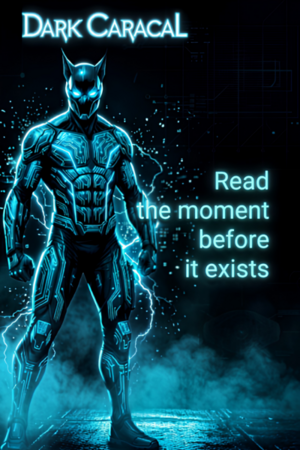
DARK CARACAL
### ISUUE 4 : BREAK THE RHYTHM
The night was moonless.
The city beneath him wasn't asleep, but it was quiet enough for thought to be heard.
Rakan returned to his apartment before dawn. The streets felt calmer than they should have been, as if nothing had happened the night before.
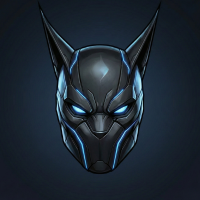
He removed the helmet and placed it on the table.
It wasn't just a mask.
It was closer to an advanced pilot's helmet, designed to read the world before colliding with it.
He sat down and closed his eyes.
The memory returned immediately.
The calm adversary.
The small movements.
The steady eyes.
The slow, calculated advances.
Every step had forced him into a rush, like a pilot suddenly losing altitude.
The HUD hadn't failed.
The pain in his arm still lingered—not enough to weaken him, but enough to remind him of one thing.
Noise.
Anger created noise.
And noise hid the most important signals.
The system had worked exactly as designed.
He opened the suit's interface.
The display resembled the flight panels he had studied in his father's research. The same logic. The same economy of information.
Lines of data appeared.
Reduced reliance on brute force.
Increased calculation and prediction.
Unplanned adaptive movement.
Delayed helmet response during provocation.
Rakan's eyes stopped at the final line.
He remembered what the Archivist had said.
His knowledge ran deeper than what you used.
He closed the display.
"Maybe I was fighting the easy way," he said quietly.
"Maybe he was building a mind designed to withstand constant pressure."
In the days that followed, Rakan moved through the city differently.
He observed.
The way a pilot studies the sky before a maneuver.
He greeted his neighbors.
Returned every greeting with calm.
But trust?
That was gone.
Every face became a possibility.
Every movement was calculated twice.
The injury hadn't weakened him.
It had taught him something.
Recklessness exposes you.
One sunny afternoon—a rare thing in the city—Rakan sat on the edge of a low rooftop and let the sunlight touch his face.
Then he saw it.
A bird flying close to the ground.
And a cat watching it.
No sound.
No hesitation.
The bird sensed danger before it saw it.
It didn't flee randomly.
It changed its path by a tiny angle.
The cat didn't lunge.
It adjusted its center of gravity and shifted its body, trying to intercept from another direction.
No speed.
No strength.
Only reading.
Rakan stopped thinking.
And began to understand.
His injured shoulder tilted slightly.
His balance shifted instinctively, the way an aircraft redistributes pressure instead of losing control.
Angle.
Not force.
Prediction.
Not reaction.
He spoke softly.
"Not every confrontation has to end with a blow."
That night, he opened his father's files again.
This time, he wasn't searching for combat.
He found a folder he had ignored before.
Behavioral Adaptation – Early Notes
Preliminary notes.
Incomplete.
Not suitable for a direct weapon.
That was why he had ignored it.
Now, he read it with different eyes.
The notes weren't commands.
They were questions.
Questions that looked strangely similar to aeronautical engineering.
How does the body behave under provocation?
How do decisions change when tension rises?
What happens if a decision is delayed by half a second?
Then he understood.
The flaw wasn't in the HUD.
The HUD calculated movement.
It didn't calculate provocation.
It was an excellent flight system...
Without pilot stress management.
Rakan began programming.
Not all at once.
Every night became an experiment.
Reducing alerts.
Reordering priorities.
Linking response to calmness instead of danger.
At first, he failed.
The helmet lagged.
Readings choked.
The system entered false safety states.
He corrected.
Returned.
Tried again.
Again.
And again.
Until one night—
It worked.
The night was moonless.
The city beneath him was silent.
Rakan stood at the edge of the rooftop.
He didn't jump.
That was the first sign of success.
The HUD was active.
But quiet.
No warnings.
No bright colors.
Only faint lines moving with his breathing.
CALM STATE: VERIFIED.
Adaptive Systems: LIMITED ACTIVE.
He took a step forward.
Then stopped.
Not from fear.
From assessment.
He adjusted his angle by half a degree.
And jumped.
The landing was softer than expected.
No shock.
No delayed correction.
Impact Distribution: Optimized.
He didn't smile.
Didn't celebrate.
He simply moved.
Across rooftops.
The way air moves between buildings.
Not faster.
Cleaner.
On a distant rooftop, he stopped.
Below him stood a cat.
Above it, a bird.
The same scene.
This time, the HUD displayed something new.
A faint line appeared ahead of the bird.
Not an escape path.
An avoidance path.
Rakan whispered,
"You see them... not because you're faster."
"You see them because you're calm."
The HUD logged the observation.
Behavioral Prediction: CONFIRMED.
Stimulus Anticipation: IMPROVED.
For the first time, Rakan felt something new.
Not dominance.
Harmony.
He looked over the city.
Then manually shut down the HUD.
In a low voice, almost a confession, he said:
"Now I understand why I was late."
"Not because the system was incomplete..."
"But because I wasn't calm enough to hear it."
He activated the display one last time.
A new line appeared.
FULL ADAPTIVE MODE: AVAILABLE.
ACTIVATION CONDITION:
MAINTAIN CALM UNDER PROVOCATION.
He didn't activate it.
Not yet.
He closed the display.
And disappeared into the shadows.
The city didn't notice.
But something within it had changed.
And for the first time...
The next confrontation would not be decided by force.
But by whoever could read the moment before it was born.
Chaos needs one second.
Understanding takes years.


Please sign in to leave a comment.