Chapter 1:
Chapter 1: Is It Wrong to Paint with Bone Ashes?
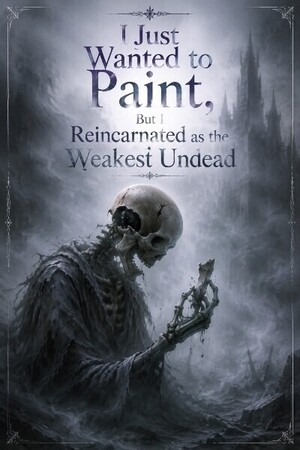
I Just Wanted to Paint, But I Reincarnated as the Weakest Undead
When consciousness returned, Ray knew something was wrong.
Not in the sense of "waking up"—he no longer had eyelids to open.
Nor in the sense of "coming to"—he no longer needed sleep.
He simply... resumed thinking.
And found his vision filled with pale gray.
Fog.
Thick fog, like cheap gray pigment, smeared across his entire field of view. Behind the haze, indistinct shapes loomed—like the ultramarine wash of a wet-on-wet watercolor, except those shapes—
Those shapes were off.
Ray tried to blink. Failed.
He tried to raise a hand to rub his eyes, and watched a pale, fleshless hand rise into his line of sight.
Finger bones. Palm bones. Wrist bones.
Every joint was perfectly visible. The shadows in the gaps between bones looked as if someone had carefully traced them with a carbon pencil.
He stared at that hand for a long time.
"......Huh?"
The sound that escaped him wasn't a voice.
It was a vibration—something resonating from deep within his skull, like pressing a tuning fork against his forehead.
Ray turned the bony hand over.
Back side.
Then front.
Palm side.
The knuckles bent. The wrist rotated. The crossing structure of the radius and ulna was so clear it could have been a medical student's skeleton model—no, medical models usually didn't have proportions this refined. This skeleton's proportions were beautiful. Long phalanges. Elegant joints. If he'd had a reference this perfect back when he was studying human anatomy, his professor wouldn't have yelled at him for an entire semester.
No.
Not the time for that.
Ray looked down.
He saw ribs.
His ribs.
From the inside looking out. One by one, their curves graceful, emerging and fading through the fog. Below the ribs, the spine. Below that, the pelvis. Below that, two leg bones. No muscle. No skin. No blood vessels. Clean. Articulate. Like a freshly finished ink line drawing.
He lifted his left foot. The knee joint gave a soft click.
He could walk.
He took a step.
Click. Click. Click.
The sound of bone striking stone echoed through the fog.
Ray stopped.
He reassessed his surroundings.
Fog. Everywhere. Thick, damp fog. Logically, air this humid should carry some kind of smell—the mustiness of soil, the mold of stone, the sour tang of rotting vegetation. Anything.
But he smelled nothing.
He found a puddle and looked down at himself—a clean, bare skeleton. Where his nose should have been, there were two holes. Hollow. Air passed straight through, carrying no sensory information.
He raised a bony finger and tapped his own cranium.
Thump. Thump.
Vibration. Bone conduction still worked.
So his hearing was probably fine. Vision... he could see, though the mechanism seemed different from before.
Human vision relied on eyes, retinas, optic nerves. He had no eyes. Yet he could see. Not through "light" exactly—more like... perceiving contours? The boundaries of things would emerge on their own, as if outlined with charcoal.
Ray fell silent.
In life, he had been an art teacher.
He'd taught drawing for twenty years—from sketching to oil painting, from structure to color theory.
This was the first time he'd ever seen his own bones.
Not on an X-ray. Not in a model. Not in a textbook illustration.
Live. In person. His.
"......"
If he could have sighed, it would have been a very long one.
But he had no lungs.
So even sighing was beyond him.
He rubbed his frontal bone with his skeletal hand—a gesture that served no practical purpose, just a habit from his living days—and began observing his surroundings.
Fog everywhere. Visibility: about fifteen meters.
The ground was paved with stone slabs. Between the cracks grew pale gray grass. Wilted, drooping leaves, as if all pigment had been leached out of them. Flanking the road were building ruins—half-collapsed stone walls, toppled pillars, a dome split in two by some immense force.
The architecture looked vaguely European medieval, but with elements he couldn't place. The relief patterns still clinging to broken walls weren't vines or geometric shapes—they looked more like... skeletal diagrams of some kind?
He filed that thought away for later.
Priority one: figure out where he was.
Priority two: figure out why he was still "alive."
Priority three—
Click.
A sharp sound behind him.
Not his.
Ray turned.
A silhouette was approaching through the fog.
The shape gradually resolved into focus.
Another skeleton.
Roughly his height, similar bone structure, but noticeably thicker and sturdier. A layer of gray-black residue clung to its bones, like moldy plaster. In its eye sockets, two points of green flame flickered, piercingly bright in the mist.
It dragged a rusted iron rod behind it.
Ray took a step back.
The other took two steps forward.
Click. Click. Click.
Its gait was steadier than Ray's. No rattling from its joints.
Ray stepped back again. His heel caught on a crack in the stone, nearly tripping him.
His legs had been unsteady in life.
As a skeleton, they remained unsteady.
The other skeleton tilted its head. The green light in its sockets pulsed once, as if confirming something.
Then it raised its iron rod.
Ray's reaction was strange.
He felt no fear—he didn't even have a heartbeat. But he did feel a powerful, visceral aversion to being smashed.
He turned and ran.
Clickclickclickclickclick—
The fog rushed past his vision. Ruined walls and collapsed pillars blurred by. His leg bones hammered against the stone pavement—the dull, rapid percussion of drumsticks on rock.
The footsteps behind him followed.
Faster. Steadier. Stronger.
Ray had been slow in life.
He remained slow in death.
He dashed through a half-collapsed archway, crossed a broken wall, trampled over a pile of bone fragments—wait. Bone fragments?
He glanced down.
Scattered across the stone slabs on both sides lay countless skeletal remains. Rib shards. Cracked skulls. Broken vertebrae. Judging by the cross-sections, some had been hacked by blades. Others—bite marks?
Ray silently erased "chewed to death" from his mental list and kept running.
The fog thickened.
He dove into a narrow alley. High walls on both sides. Ahead—a dead end.
He turned.
The other skeleton stood at the alley's entrance.
Its iron rod scraped the ground, a screech of metal on stone.
It advanced, step by step, unhurried. The green flames in its sockets locked onto Ray.
Like a predator that had confirmed its prey had nowhere left to run.
Ray pressed his back against the cold stone wall. His bony fingers scraped unconsciously against the surface.
He should have felt fear. His heart should have raced. Adrenaline should have surged. His body should have triggered fight-or-flight.
But he had no heartbeat. No adrenaline. No instinct.
Just a skeleton, and a mind—or soul, or whatever—that was still thinking.
So he didn't panic.
He simply recognized, with crystal clarity, one fact:
This monster was going to kill him.
And he couldn't win.
As an art teacher, Ray had never been in a fight in his entire life.
As a skeleton, he'd been dead for all of a few minutes.
Can't win. Can't run. Can't hide.
Ray surveyed his situation with his usual, overly rational gaze.
And reached a conclusion.
He had to do something.
Anything.
Even if—
His gaze fell upon the approaching skeleton.
Fog flowed over its bones. Green fire danced in its sockets. Sparks leaped from its iron rod as it scraped the ground.
Ray saw it clearly.
Not because of good lighting.
But because he suddenly realized he had been "seeing" in a different way all along.
Not by color.
By contour.
By structure.
The lines beneath the surface—more essential, more fundamental.
Every form has structure.
Bones have structure. Muscles have structure. Even clouds and fog have structure.
And the skeleton before him—its structure was exceptionally clear in his vision.
There was something inside it.
Deep in its chest cavity, a tangled mass of "lines" writhed and churned. Like a crumpled sheet of sketch paper—lines crossed and recrossed, strokes chaotic, no order whatsoever.
And at the center of that chaos, one particularly deep "crack."
Not a crack in the bone.
Ray didn't have words for it.
That crack looked like the trace of an eraser pressed too hard into a drawing. All the lines broke there. All the structure collapsed there.
That tangle of lines wasn't supposed to look like that.
What its original structure should have been, Ray couldn't articulate. But he could feel that the thing before him was in a state of "wrongness."
The skeleton took another step forward.
The iron rod rose.
Ray's reaction wasn't the product of deliberation.
It was closer to instinct.
Like the hand of a twenty-year painter—even with eyes closed, it knows human proportions. He knew how long femurs should be, how much the spine should curve, the correct angles of shoulder and arm.
He knew what was "right."
And what stood before him was "wrong."
Ray bent down.
Bone fragments littered the ground.
He picked one up.
A shard of finger bone—about five centimeters long, with a sharp tip.
Not a weapon.
More familiar than a weapon.
He'd held a brush for twenty years in life.
The first thing he held in death was bone.
The skeleton's iron rod came down with a whistling arc.
Ray twisted sideways. His leg bones groaned under the strain, but he didn't fall.
The rod struck the wall. Stone chips flew.
And in that instant—
Ray reached out with the hand holding the bone shard.
He didn't stab.
Didn't strike.
He just—drew a line.
Like a gentle stroke of charcoal across paper.
The tip of the shard traced across the other skeleton's ribs.
No.
Not the ribs' surface.
That "crack."
That eraser-scarred flaw in Ray's vision.
The sensation at the tip of the shard was strange. Not the rough drag of carving bone—but something close to frictionless, almost smooth. Like dragging a clean brush of water across wet watercolor paper.
In that moment, Ray saw it.
Where his stroke had crossed the crack, the lines reconnected.
Just a short segment.
But they reconnected.
The other skeleton froze.
Its iron rod hung mid-swing.
The green flames in its sockets flickered violently.
From fury to confusion. From confusion to bewilderment.
It stepped back. Its skull tilted slightly, regarding Ray with—not exactly docility, but no longer aggression.
Like a wild dog that had stopped barking, now sizing up the figure before it with sober eyes.
Ray stood there, still holding the bone shard in the position after his stroke.
No heartbeat. No breath. Nothing.
But he knew exactly what he had just done.
He had drawn a line.
On something that wasn't bone.
Fog drifted through the alley entrance.
Two skeletons stood face to face.
One tilted its head, green light pulsing quietly in its sockets.
The other gripped a bone shard, motionless.
After a long silence, Ray lowered the shard.
He looked at the now-calm skeleton before him, then down at his own bony hand.
The fingers were long. The joints refined. The bone structure perfectly proportioned. If it had flesh and blood, it would have been a hand made for holding a brush.
"......"
Ray's mandible moved.
He wanted to say something.
But nothing came out.
He simply gripped the finger-bone shard a little tighter.
—
The first night of the Dead City had just begun.
An art teacher who had painted for twenty years stood among a horde of monsters, clutching a piece of bone.
One thought occupied his mind:
If he made it back alive—
No, not alive. Just. If he made it back—
He would never complain about his students drawing ugly skeletons again.
Because nothing—nothing—compared to the thrill of touching your own ribs with your own hands.


Please sign in to leave a comment.