Chapter 3:
Questions to Ask a Guide
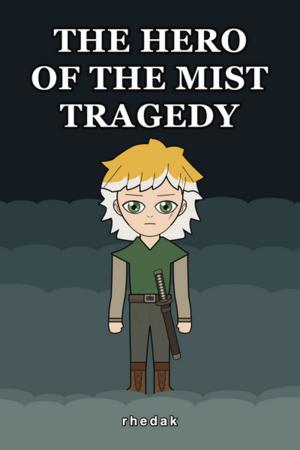
The Hero of the Mist Tragedy
*author's note: if you are enjoying the novel so far consider checking out the character reference sheet and maps in the showcase*
I told myself I dressed plainly for the garrison because plain was what an innkeeper’s boy had to offer. It was also the version of me least likely to invite a second look, and I did not examine that while I laced my boots. Chiyo watched me leave from the doorway and did not say anything else about it: from her, that silence already conceded the argument.
The garrison smelled of oiled leather and cold stone and the ink the Wodensreich used for everything official, sharp enough to sting the back of the throat. A young soldier took my name, misspelled it, corrected it without apologizing, and left me on a bench outside a door with no marking on it besides a number.
Two other candidates had been sent for and gone before me that morning, according to Dieter, who had appointed himself the garrison’s unofficial town crier for the week. Neither had lasted the length of time it takes to drink a cup of tea.
I lasted longer, though not, I would learn, because I gave better answers.
The room past the door was small, requisitioned rather than built for this, a supply clerk’s office with the ledgers pushed to one corner. A lone chair had been set out for me across the table from Reinhard von Falkenrath, who was already seated. He rose when I came in, which no officer in Nebelmark had ever bothered to do for a serving boy.
“Please, sit, Satoshi.” He waited until I had before he did the same. “You’re the one who came to volunteer rather than being sent for. That’s rarer than you’d think. Most of the other candidates were recommended by our local clerks.”
“Rare enough that you rose for it.” I gave him the same warm smile I gave homesick soldiers who wanted to talk about their mothers’ cooking. “Is that a mark in my favor, or against me?”
“Which would you like it to be?” He said it without any particular weight, the way another man might have commented on the weather. Then he opened a thin folder that, as far as I could tell, contained exactly one page with my name on it.
He asked about the roads first: which checkpoints I knew, which fords still held in spring flood, whether I had ever walked the old pilgrim path north of the valley’s mouth before it was closed. I answered plainly, and none of it cost me anything to give.
I gave him more than he’d asked for besides, the name of a farmer who knew the old fords better than I did, a warning about a bridge the district’s own ledgers probably still listed as sound. If he wanted a guide, I intended to be a good one well before he’d decided whether to hire me.
He listened to all of it with easy attention, no note-taking, no visible tally, as though he were simply enjoying being told something he had not already read somewhere else.
Then, between one road and the next, without any change in his voice at all: “And your family. Still in the district, or lost to it?”
“Lost.” I let the word sit exactly as long as an ordinary answer would sit, no longer. “Same as most of the district, one way or another.”
“Same as most.” He turned a page that did not need turning. “And the mark on your face. Recent?”
My hand did not move. I had thought, walking over, about this question, and had decided in advance precisely how still to hold my hands when it came. Perhaps that stillness was a tell all its own, to a man who noticed everything.
“Old enough that I’ve stopped counting the days for it. Touched by the Kiri, same as half this district carries in one shape or another. You’ll find worse on any road out past the checkpoints.”
“I expect I will.” He set the folder down, closed, as if the interview itself had ended some sentences earlier. “You understand what I’m actually asking for, guiding this expedition. Not a pleasant walking tour.”
“I understand the notice said guide personnel, and I’m applying to be one.”
“That’s not what I asked.”
“It’s the answer I have.” I let myself smile, a little, the kind of smile that had gotten me out of worse conversations than this one. “You’ll find I’m better at the roads than at guessing what an Oberst-Researcher actually wants from a guide, sir. I imagine that’s a separate skill.”
Something in his face moved that might, in a less careful man, have been the beginning of amusement. “Entirely separate.” He stood, which I understood to mean the interview was over, though nothing in his manner told me whether I had passed it. “Thank you for your time. Successful candidates will be sent for again, to finish the roster. By morning, if the district clerks keep to their own schedule for once.”
“And unsuccessful ones?”
“Won’t need telling. They’ll simply not hear anything at all.” There was no unkindness in it, which somehow made it land harder than cruelty would have. “Good day, Herr.”
I walked back through the garrison’s cold stone corridor, turning the whole conversation over. To my annoyance, I could not tell whether it had gone well. Every question he had asked was one any careful officer would ask a guide applicant with a visible mark and a dead family. That was what unsettled me. I had spent a year learning to read a room from behind a counter. I could not read this one at all.
I did not notice I had stopped walking until the corridor tilted a half-step under me and my stomach turned over hard enough to double me toward the wall. I got one hand against the cold stone before my knees found out what they meant to do without me.
What came up was small and gone almost before I registered it, a thin curl of gray vapor thinner than woodsmoke, dissolving into the corridor air before it had traveled the length of my own forearm. I straightened, breath already scraping back into the slow, counted pattern I had trained into myself a year ago and let slip somewhere back in that room. I held it until my stomach settled and the corridor stopped trying to move under me.
For a moment I hated the pattern. Then I let the hate go.
Only then did I go on walking, because nothing had happened that anyone in that garrison needed to see.
By evening the inn’s private room held a fuller table than I had yet seen it hold. Chiyo had put me on serving it whether I liked the assignment or not, which I did not entirely, given the company.
Lord Haruto Kisaragi held court at one end of the table with the easy confidence of someone who had never doubted a room would come around to him. “The Wodensreich cartographers had the old pilgrim road wrong by half a league,” he was saying, to no one in particular and everyone at once. “I only know because House Kisaragi paid to have it surveyed twice. Once for the King, and once, considerably more quietly, for a certain colonial office that shall remain nameless in present company.”
A joke on himself as much as on anyone else at the table, lightly made, and two of the Wodensreich officers laughed before they seemed to remember whose expense it had been made at.
Kurogane, farther down, did not look up from the wine he was pouring himself. “Surveyed twice, paid for twice, and only one of them on the record, Kisaragi. Someone will want to ask about that someday.” He said it lightly, and expected it to cost Kisaragi rather more than it cost him.
“Someday hasn’t come yet, merchant.” Kisaragi’s smile did not so much as flicker. “You’ll be the first to know when it does.”
“I usually am.”
A woman I had not yet let myself think of by name, only by where she sat, occupied the room’s far end. A stack of paper was arranged in front of her with the particular neatness of someone who had stopped reading it some time ago without wanting anyone to notice.
She wore fine wire spectacles over dusty rose-violet eyes and a white coat over her Okiri researcher’s robes like a second, more comfortable identity. Every line of her had arranged itself into something that looked, from across the room, entirely unbothered. I set a plate beside her papers, and she thanked me twice for it, warmly.
At the table’s head sat a woman in gray-and-white vestments trimmed with a crane-and-dragon motif I recognized from temple carvings more than from life. Pale lilac-gray eyes, and an expression settled into a serenity so complete it read, at a glance, as gentleness.
One of the Wodensreich mages grinned into his cup. “If Woden the All-Father really is sleeping under the mining district like the old stories claim, the least he could do is cover our Donarsblut bill himself.” She set her cup down with unhurried care and said nothing at all. The silence that followed did more work than a rebuke would have, though she had hardly moved her face to produce it.
Tenno sat where he always sat, near enough to the door to be useful and far enough from the center to be forgotten, and ate without comment, the way he did most things.
I refilled cups and cleared plates and said almost nothing, and learned, in the space of one meal, more about who actually sat at that table than I had in an entire day at the garrison.
Kisaragi’s charm had an edge under it, and Kurogane enjoyed testing it. The woman with the spectacles flinched from conflict the way some people flinch from cold. The priestess needed no volume to end a conversation.
None of them looked at me twice. That, more than anything Reinhard had asked me that morning, told me exactly how well I was still playing my part. It should have been a relief. It felt, briefly, like being erased.
I was banking the fire long after the private room had emptied when Chiyo came to stand in the doorway, arms folded. She did not ask me anything at all, which was worse than any question.
“They haven’t sent word.” I got it out before she could ask.
“They will.” She looked at me as she had every evening that week, waiting for an answer she had already decided she wasn’t going to like. “And you’ll go, whatever it says. I can see that much on you already.”
I did not answer her, because there was nothing I could say that would have been true and also kind. I had grown tired, somewhere in that room full of people performing versions of themselves for each other, of choosing between the two.
I climbed to my room once the hearth was low, and stood a moment in the doorway before I could say why. Nothing in the room sat where it shouldn’t have.
I could not have named a single object out of place, only a faint, general wrongness to the air of it, the sense of a room that had been stood in recently by someone who wasn’t me.
For one bad moment I let myself imagine losing the post over something I could not even point to, all of it undone before I had gotten anywhere near what I actually wanted from it. I put it down to nerves, or the same thin sickness that had caught me in the garrison corridor that morning, slower to clear out of my blood than it usually was. I let myself believe that long enough to sleep.











Please sign in to leave a comment.