Chapter 2:
The Expedition
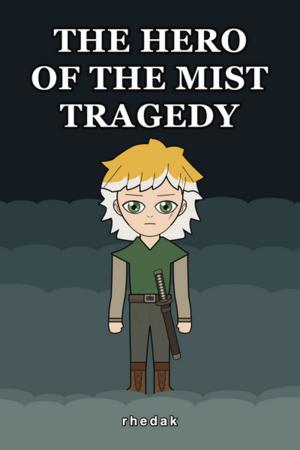
The Hero of the Mist Tragedy
Nine days after Kenzo reported the notice, the expedition arrived. I heard it before I saw it: heavier tread than carts, iron-shod wheels, and under everything a low steady hum I knew for Donarsblut carried in bulk.
By the time the column came into sight along the valley road, half of Kiriguchi had found a reason to be standing in the street. Old women who usually kept to the market stalls stood in their doorways with their arms folded, saying nothing. A pair of village boys ran alongside the supply wagons until a soldier waved them off without much heat.
A farmer I recognized by his bad knee spat once, deliberately, into the ditch, and did not look at anyone while he did it. Other faces in the crowd read differently. A woman near the well asked a soldier, in careful, hopeful Woden. “Will the garrison want extra hands, for the season?” She did not seem to mind who overheard.
The column itself was longer than I expected: supply wagons, a mounted escort, crates I did not need to be told held crystal stock given how carefully they rode apart from everything else.
Among them came one wagon unlike the rest: a squat iron-and-brass housing lashed down under its own canvas, larger than any crate, riding alone rather than stacked with the others. Dark and still, it gave off none of the low hum the crystal-stock wagons carried, and nobody walking past it so much as glanced at it twice. Whatever it was built for, it was not doing it yet.
Walking near the middle of it, neither soldier nor escort, were five figures in Okiri dress, close enough together to be a group and far enough apart that they plainly were not friends.
The old man drew my eye first, for reasons I did not stop to examine. He walked with a cane and a stoop, in clothes patched past the point of pride, carrying two soldiers’ travel cases as if that were simply his job in the world. But he set each case down at the checkpoint exactly where an officer’s eye would find it without having to ask twice.
Near him walked a younger man in dark court robes and a topknot, a katana still worn at his belt. One small enameled pin on his collar that did not belong to a major Okiri house. He was already talking to the soldier nearest him, easily, warmly, the sort of talk that made the soldier laugh before either of them reached the inn. I believed the warmth for exactly as long as it took me to notice he had also, without seeming to look, priced every building on the street. Something in the ease of it set my teeth on edge; I looked away before I could decide why.
Behind them both, apart from the escort entirely, walked an older man in a patterned house robe with his name worked into the collar in Kirimoji. He wore a belt hung with keys, and walked at an unhurried step that matched no one else’s. He caught me watching, gave a small nod, and kept walking.
Farther behind walked a pair of Okiri women, and I kept my eyes moving before either face could settle into more than a shape.
Kenzo watched all of it from the upstairs window without once coming down. When I brought his ale up to him afterward he didn’t ask for it, didn’t take his eyes off the road, and said only, “Well. Kiriguchi’s had worse walk through it than that, and lived.” It was the most he said to me all day.
Reinhard von Falkenrath I would not have needed introduced to me even if Dieter hadn’t done it twice before noon. He rode near the front, not the very front, in a slate-blue officer’s coat with silver rank tabs and a short, precisely groomed beard, and he did not call out orders or announce himself to anyone.
He simply looked, pale gray-blue eyes passing over the inn’s sign, Chiyo’s doorway, the old woman with her arms folded, then me, one unhurried second given to each in turn. My hand had stopped on the tray I was carrying, I noticed, some time before I told it to start moving again.
“Oberst-Researcher Falkenrath,” Dieter said, hurrying past me with a ledger under one arm and sweat already at his collar, “expects six rooms, the good stable for the horses, and a private room for meals separate from the common one. I have told him this inn can accommodate all three, and I would very much appreciate it if that turned out to be true.”
“It’ll be true,” Chiyo said, and I could tell she was already moving the furniture in her head, “for what he’s paying, it had better be.”
By early afternoon the inn had a different shape to it. The common room kept its regulars, but the private room off the kitchen now held Reinhard. Before long it held the noble I’d seen on the road too, sharp copper-orange eyes and quick to smile.
Lord Haruto Kisaragi, he called himself, and thanked her for the room as if she had done him a personal kindness rather than sold it to him. The old man with the cane carried Reinhard’s own trunk up the steps himself, over Chiyo’s protest, and gave his name to no one who asked.
I did not have a real conversation with any of them that day. I gave Kisaragi a room number and got a “thank you” warmer than the occasion required. I carried a jug of water up to Reinhard’s room and got a nod in return, and that was the whole of it.
Dieter, predictably, could not stop talking about the notice once his paperwork was done for the day and his second ale was in front of him. He had also picked up more names than I had thought to ask for myself. The merchant with the keys at his belt, he told me, was called Kurogane, of some trading house Dieter didn’t think worth the effort of remembering aloud.
“Posted proper, this time, not like the district board usually bothers,” he said. “Guides. They want local guides. As if any local in his right mind wants to walk into that.”
I was on my feet before he’d finished saying it, the chair scraping back louder than I meant it to.
I went to read it myself before the light went. The board stood at the edge of the square, fresh paper still faintly damp at the corners, the round Imperial seal pressed hard enough to leave a shadow of itself on the wood beneath. The wording was plainer than Dieter’s telling of it, and colder for being plain.
‘By order of the Wodensreich Colonial Authority, Nebelmark District. The Falkenrath Expedition, chartered by Imperial Research Command, departs for the interior on the first day of the fifth month, year four hundred ninety-three, carrying a secondary mandate to establish an accounting of the Valley’s fall and those answerable for it. Local persons with knowledge of the district’s approaches, terrain, or prior residence in the affected territory are invited to present themselves for consideration as guide personnel. Compensation and Imperial travel writ provided. Applicants to report to the district garrison for interview. By order, Oberst-Researcher R. von Falkenrath.’
Prior residence in the affected territory, as if a kingdom could be filed under a phrase like that and left to sort itself alphabetically. Four hundred ninety-three years into a count some long-dead Kaiser had started, and not one word in the whole notice cared what the valley had called itself before that count began.
An accounting, and those answerable for it. I read the phrase twice, the second time out of something closer to dread than curiosity. I made myself stop thinking about it before I could decide why.
In the reckoning I had grown up with, the date at the bottom fell early in the second month of the second year without a king. I did the conversion anyway, and put the thought away. I stood in the square longer than I had planned and understood, with no drama at all, that I was going to put my name on the list. The understanding did not feel like courage. It felt like finally going back for the part of me that had been stuck in that valley for a year.
The old man with the cane gave his name to Chiyo only when she asked him outright why he never offered one himself, sometime before the night was out. Tenno. Nothing more, no house, no title, said once and evenly, as though the question bored him more than it troubled him.
Chiyo was banking the fire when I came back, and did not look up right away. “You’ve got that face on,” she said.
“What face.”
She set the poker down with more precision than the fire strictly needed. “The one you get before you say something I’m not going to like. Go on, then.”
“I’m going to the garrison tomorrow. To put my name forward.”
She looked up at that, though not sharply, which somehow made it worse.
“For the guiding,” she said, and did not make it a question.
“Is that what you do when you run off, explore the mist wall?”
I held her eyes for a moment before replying.
“I know the roads out to the checkpoints. I know the villages the refugees came through. That’s more than most of the men they’ll get applying.” None of it was the whole reason. I was not in the habit of handing Chiyo the whole reason for anything, and told myself that was ordinary discretion rather than a decision I had already made some other way.
“You want to know what happened to you, Satoshi,” she said, not a question, and gestured with the poker at the side of my face without quite pointing at the scar itself, a delicacy I had not expected from her.
“I want to know what it was,” I said. That much I meant completely, whatever else I was not saying alongside it.
Chiyo was quiet long enough that I thought she had decided to let it go, which was not like her at all.
“I buried two boys from this village who were too daring and curious for their own good,” she said. “I am not burying you as well because you’ve got some notion that walking into that mist will hand you back an answer worth what it’ll cost.”
Two boys. Not a kingdom. The distinction landed harder than I wanted it to. I said nothing, because anything I said would have answered a question she had not asked.
“I’m not asking your permission.”
“No,” she agreed, “you’re not. I noticed.” She picked the poker back up, mostly, I thought, so she would have somewhere to put her hands. “Go to your garrison, then. Put your name on whatever list they’re keeping. But you tell me every single thing that man asks you, word for word, the day he asks it. That much you owe me.”
My shoulders came down from around my ears, the whole of the last nine days finally let out of them at once.
“That much I can promise,” I said, and meant it, and did not examine too closely how much easier that promise was to give than the one she actually wanted.
Outside, the valley’s mist sat where it always sat, patient and pale at the head of the road. For the first time in a year I found myself looking forward to walking closer to it instead of away.











Please sign in to leave a comment.