Chapter 0:
PROLOGUE — THE LAST VERSE
Psalm
Every war Tallis Vaunt had ever fought announced itself.
Artillery had manners. It whistled. Orbital lance-fire turned the sky white a full second before it turned anything else to slag, and inside that second a person could still choose — a doorway, a ditch, a prayer, one last look at somebody's face. Tallis had built an entire life inside seconds like that.
The Concordance came over the northern ridge at first light and made no sound at all.
She was sixty meters up the inner curve of the First's ribs when it happened, sitting on the gantry with her legs through the rail, eating cold rations out of the tin with her fingers because she'd lost her spoon in the spring.
Below her, Cradle was waking up. Ten thousand people living inside the bones of a dead god — one that had come down on its side two centuries ago, so large that its fall had made the valley, its head still buried four days east under the hills.
Laundry strung between vertebrae the size of freight barges, frozen stiff and bright as flags. Cook-smoke braiding up through the ribcage into a low grey sky. Somebody's radio three levels down, playing something with a bad beat. A kid singing along to it, badly, the way she had told him a hundred times not to.
Everything Tallis had ever loved lived in the dent.
Then the birds stopped.
Not all at once — that was the detail she would have kept, if she'd been allowed to keep anything. They stopped in a line, a hush rolling up the valley like a hand laid over a mouth, and by the time it reached the ridge the world had gone so quiet she could hear her own pulse ticking in the steel under her boots.
It had started to snow, lightly, as it did most mornings at that time of year.
Tallis set down the tin.
"Orme." Her collar-mic. "Look north."
A crackle. "I don't hear anything."
"That's the point."
Three seconds. Then the bone-horn went up across Cradle — the drill alarm, the one that meant get to the throat. That was the deep chamber behind the bone doors, the safest place in the valley. Every child in Cradle could find it in the dark.
The note rolled down the slope and died against a silence that swallowed it whole.
They came out of the treeline in a rank of forty. Twelve meters apiece. Grey. Seamless. Faceless. No banners, no colors, nothing to shout at. The Concordance called them Antiphons. Everyone else called them the Quiet, because they moved like a thought you couldn't finish. Somebody had opened up their heads and taken out the part that argues.
The Concordance had been eating the free valleys for sixty years, one at a time, and had never once needed to raise its voice.
They had come on foot. Whatever it wanted in Cradle, it wanted in one piece.
Forty of them.
Against Cradle, which had one.
Tallis was already running.
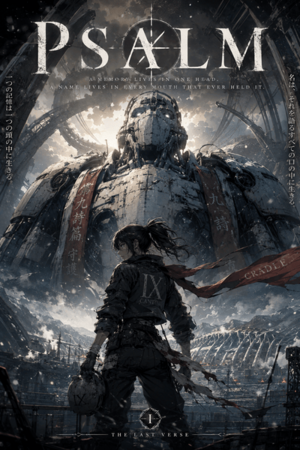
The Ninth Psalm knelt in the First's chest cavity, where the heart would have been, if gods had hearts. Eighteen meters of dull war-iron on one knee, hands open on its thighs, like something waiting to be forgiven.
It had a face. The old ones always did — not a helmet, a face, worn smooth at the cheekbones by two centuries of weather and hands.
There had been thirty-three Psalms once. Nobody living knew how to build another. That was the shape of the war in a sentence: every one you lost, you lost forever.
She went up its arm on the cable and dropped through the throat-hatch, and the harness took her the way it always did: too tight, too fast, six points of contact closing on her ribs and hips and the base of her skull like a fist deciding whether to squeeze.
"Nine," she said. "Wake up."
Nothing. Then, low in the floor of her skull, a hum. The instruments came up one at a time, unhurried, ancient, and the cockpit filled with the smell she'd never been able to name — hot copper and cut grass. The smell of the inside of a bell.
The Psalms did not run on fuel. They ran on people.
You sang, and the machine listened, and what it took as payment was whatever the singing cost you. A verse for a memory. A verse for a year off the back end of your life.
That was what a Cantor was. Not a driver, not a soldier exactly — a voice the machine would answer, and a body it could bill.
Cantors kept ledgers. What they'd spent, what they had left, itemized like a household budget, because the alternative was reaching for something one day and finding a hole where it used to be.
Tallis kept hers in a ration tin under her cot. She had not opened it in eleven months, which was its own kind of accounting.
Every ledger ended the same way: one line at the bottom, in a hand that always shook.
A memory lives in one head. A name lives in every mouth that ever held it.
Four verses. Not four memories — four more times a body could take it before it quit on her. She'd been told five once, by a woman who lied about most things.
Down in the valley, the Quiet reached the outer wall — Cradle's wall, strung across the gap between two ribs — and did not slow down.
Tallis put her hands on the grips and sang the first one.
The first verse was the cheap one. Everybody's was. She spent the taste of her mother's cooking — not the kitchen, not the woman's face, just the taste, a small thing, a thing she could live without — and eighteen meters of war-iron came off its knee with a sound the valley felt before it heard.
Cradle heard its Psalm stand up. Somewhere below her people started screaming, and it was the best sound she'd heard all morning, because screaming meant running, and running meant some of them would live.
She hit the first rank at a dead sprint.
The lead Antiphon she took at the shoulder with both hands and drove down through the rampart into the frozen ground. The impact came up through the grips and into her teeth. The second she caught mid-turn and put through a retaining wall.
The third got a shot away. A white lance opened Nine's flank from hip to floating rib, and the cockpit filled with the stink of scorched iron and one small red word: BREACH.
She took its head off with the back of her hand and kept moving.
"Orme. Get them into the throat."
"Working on it." Gunfire behind his voice, the useless small-arms kind. "Tallis, there's forty—"
"I can count."
She reached down, got a hand around one of the First's lower ribs, and pulled. Two centuries of calcified bone tore away from the spine with a crack that came off both walls of the valley — forty meters of it, curved like a scythe. She swung it two-handed into the second rank and folded three of them into each other like paper.
That was the thing about fighting inside a corpse. The corpse gives you things.
She sang the second verse and spent a winter — the whole winter she was nineteen, the one with the hunger and the bad boots and the boy whose name she was already losing anyway.
Nine came apart at the seams with light. Not glow. Light, hard and white, breaking out of every joint like something enormous trying to get out through the cracks. Above her, the sound shook snow off the First's ribs in a hundred small slides.
She went through them.
Seven minutes. That was all the forty of them took, though she lived a small complete lifetime inside it. She broke them against the wall and against the ground and against each other. She lost Nine's left hand and half the forearm to a mine and kept swinging with the stump.
Orme's channel went out between one word and the next.
She noted it the way you note a light going off in a house across the street, and did not stop swinging, because stopping was a thing you did afterward.
She saw the throat of the First fill with people. Saw the great bone doors begin to grind shut. She did not look for anyone in particular in that crowd. Looking for one face was how a Cantor got a city killed.
And she thought, with the flat calm that had kept her alive for a decade: I am going to win this.
Then the Concordance broke silence.
It came through every channel at once — the cockpit speakers, the collar-mic, the fillings in her back teeth — one voice speaking in perfect unison with a hundred thousand others.
CRADLE. YOU ARE HOLDING PROPERTY OF THE CONCORDANCE. SURRENDER THE CHILD AND THE ARRANGEMENT WILL PROCEED WITHOUT FURTHER DISSONANCE.
Tallis stood in a field of broken grey machines, breathing hard, blood in her mouth where she'd bitten through her cheek.
The Quiet did not talk. She had never heard one talk — not once, not in any war. Whatever she had broken out here was something they had not budgeted for.
"Which child," she said.
A pause. She would have sworn the pause was surprise.
THE ONE WHO SINGS.
And she thought: the radio. Three levels down. Bad beat, worse singer. Nine years old, all elbows, hums through every meal, hums in his sleep loud enough that the whole dormitory row wants him dead.
She had told him a hundred times to shut up.
Sen.
The ridge came apart.
The thing that walked out of it was not an Antiphon.
It came on four legs and stood forty meters at the shoulder, and where a Psalm had a face, this had a throne — an empty seat of grey iron, high up, with nobody in it. The Concordance called that class a Cathedra. She had only ever seen one in gun-camera footage, walking away from something that used to be a city.
It did not run. It did not need to.
She sang her third verse and spent her father. All of him, every last piece. And what she felt in the half-second before the light took her hands was not grief — there was nothing left to grieve with — but the sudden, absurd lightness of a debt she could no longer remember owing.
It bought her ninety seconds.
She was good. That was the horror of it.
She got inside its reach twice. She put the rib through its foreleg and snapped the joint and heard the whole valley ring like a struck pipe. She climbed the thing — actually climbed it, forty meters of grey iron — and got both of Nine's hands into the seam beneath the throne and pulled until her own shoulders tore against the harness.
It shrugged her off like weather.
The ground came up. She got Nine's remaining hand under her and started to push herself back up — and the light went out.
Not damage. Not a hit. The verse simply ended, the way a held note ends, and eighteen meters of war-iron went dead and heavy around her.
Ninety seconds. That was what a father was worth.
Nine's spine went with a sound she felt in her own. Then the Cathedra set one foot on the Psalm's chest and began, patiently, without malice, the way you press a splinter out of a thumb, to push down.
The harness did what harnesses do when the frame goes: it held. It held her ribs while the cockpit came in around them, and something along her left side gave with a crack she heard through her own jaw. The red word multiplied across every surface until it stopped meaning anything at all.
And through the cracked forward plate she could see the throat of the First — the bone doors three-quarters closed, and a small figure standing in the gap.
Not running. Standing.
"Sen," she said. "Run."
No channel was open. He could not hear her. He did not move.
He was singing. She couldn't hear that either. She could only see his mouth doing it — that small stubborn face, that awful tuneless humming — and she understood, far too late, what the Concordance had crossed a continent in silence to come and collect.
One verse left. And nothing left to spend that was big enough.
She had already sold the taste, the winter, the father. What remained was small change: a road, a song, a dog she'd had at six. Not enough. Not for this. Not for forty meters of grey iron with an empty chair on top of it.
Except.
She thought of the last line of the ledger.
A name lives in every mouth that ever held it.
You do not lose a name when you spend it. The world loses it — out of every throat, every letter, every stone. It is the one thing you own that was never kept inside you.
Sen was still standing in the gap. Still singing at a mountain.
Fine, she thought. Fine. It's only a word.
Tallis Vaunt opened her mouth, and the last thing she ever put into the world was her own name, at the top of her lungs, into the throat of a machine built to turn wanting into force.
It was the loudest thing that had ever happened.
Every window in Cradle went at once. The snow came off the northern ridge all at once, like a bedsheet pulled off a bed.
Then the valley went white.
The Cathedra came off her chest and went up — forty meters of it, turning slowly, almost gently, like a chair going over — and by the time it came down there was not enough left of it to make a sound when it landed.
The treeline went. The northern ridge went. Where it had stood there was a long clean scoop of glass, still cooling, ticking in the new silence like an engine after a long drive.
The Quiet did not come back. Not that day.
Sen found her twenty minutes later.
The Ninth Psalm knelt in a field of glass — one-handed, spine broken, face worn smooth, hands open on its thighs. Waiting to be forgiven.
He climbed the arm the way he'd been told never to, and dropped through the throat-hatch. She was still in the harness, her leg wrong, her mouth full of blood, her eyes open.
She knew him. That was the mercy of it, and the cruelty. She knew his face, and the sound of his terrible humming, and the fact that she had told him a hundred times to shut up and had never once meant it.
"I'm sorry." He was crying too hard to get it out cleanly. "I didn't run, I'm sorry, I'm sorry—"
She got a hand up. Put it on the side of his head. Held it there.
He asked her name.
She opened her mouth to answer — she wanted to, she was reaching for it, she could feel the exact shape of the hole where it should have been, the way your tongue finds the gap after a tooth comes out — and nothing came. Not because she wouldn't. Because there was no longer anything in there to come.
She tried three times. He watched her try all three.
Then she laughed, which frightened him more than anything else that had happened that morning, and said the only true thing she had left.
"Doesn't matter. Keep singing."
She was breathing when they carried her out of the wreck. Everyone agreed on that much.
After that the accounts came apart in people's hands. She went east. She died in the night. She was never there at all. A story needs a name to hang on, and this one had a hole where the hook should have been — so within a year Cradle could describe the battle perfectly, down to the weather, and could not tell you who had fought it.
Sen remembered everything.
He remembered the cold, and the glass, and the smell of hot copper and cut grass. He remembered the weight of her hand on the side of his head, and the exact number of times she tried — three — and the sound of her laughing at the end. He remembered that somebody had stood between him and forty of them, spent everything she had, and never once asked him for anything back.
He remembered that somebody had saved him.
He never, in all the years after, remembered who.
And eleven years later, the Concordance came back. It always comes back. It is very patient, it has all the time in the world, and only one voice to spend it on.
It would find a young man standing in the throat of a dead god, in front of a broken machine that had knelt there the whole time with its hands open, waiting for somebody to say the right thing to it.
He still hummed. He had never learned to stop.
He had spent those years learning every language he could find, hunting through all of them for a single word.
And he had a question saved up, and it was this:
What was her name?











Please sign in to leave a comment.