Chapter 1:
REST
Psalm
Sen had been told to shut up roughly four thousand times in his life and had never once managed it for longer than a minute.
"You're doing it," Bel said.
"I know."
"You're still doing it."
"I know." He set the wire and leaned on it and did not stop doing it.
They were eleven days into the north face, which meant they were cutting the deep stuff — black glass that came out in sheets so clear you could read a hand through a foot of it. The wire went through with a sound like a long breath held too long. Water and grit ran down the cut and froze on the way to the bottom.
Everybody worked wrapped to the eyes. The dust got into your chest and settled there and stayed, and the old cutters in Cradle could be identified at fifty paces by the way they stopped talking to breathe.
The Scoop ran a mile and a half east to west, a clean bite out of the valley floor where the northern ridge used to be.
Nobody in Cradle could tell you what had taken the ridge. There were four stories about it and they contradicted each other, and the town had long since settled into the comfortable position that it was a very long time ago and it didn't matter now. Anyway, the glass paid better than anything else in the valley.
It went downriver in crates. Lenses, mostly. Half the good windows in three provinces had come out of the hole in the ground where Sen ate his lunch.
The war was four valleys west and had been there all his life. Cradle's settled opinion on the subject was that four valleys was a comfortable distance and there was nothing to be gained by making it any shorter.
He hummed all the way through the shift.
There was a sound in the Scoop that nobody else could hear.
It had been there Sen's whole life. Loud was the wrong shape for it — it wasn't loud, it was continuous, the way a room is warm. An enormous held chord, low down under everything, made of more things at once than he had ever been able to count.
If he stopped and paid attention he could pull a thread out of it. Not often, and never for long. A kitchen with too much rosemary in it. A stretch of road in summer with the tar going soft. A winter — one specific winter, hungry, with bad boots in it — that he had never lived and could describe better than his own.
They weren't his. He'd worked that out early. They came from the same direction as everything else in the chord, which was west along the Scoop, past the cut faces, out to where the ground stopped being worth digging.
He had been about twelve when he understood that nobody else could hear it. He'd mentioned it. It had not gone well — not cruelly, just badly, in the specific way that being nine and then twelve in the dormitory rows taught you to avoid — and he had not mentioned it since.
He hummed because it was there. He'd been humming along to it since before he could talk, the way you tap a foot without deciding to, and in twenty years it had never once occurred to him that it was anything other than a habit that annoyed people.
The horn went at the fourth hour and the crew packed up and started back along the cut towards the ribs, and Sen went the other way.
Nobody said anything. They had, once. For about two years after he'd started they'd said plenty, and then it had gone quiet and become the sort of thing people mentioned to strangers — don't mind Sen, he goes out to the wreck, he's all right — and then eventually it wasn't even that. It was just a fact about him, like Bel's bad shoulder.
"Don't be out past dark," Bel called, not turning round.
"I'm never out past dark."
"You're always out past dark. There's stew at mine after. There won't be any left by the time you come in, but there's stew."
"I'll be there."
"You won't."
He waved without looking and kept walking west.
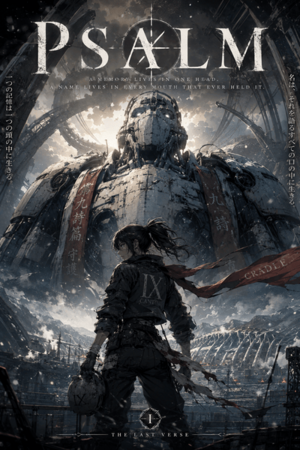
The Ninth Psalm knelt at the far end of the Scoop where the glass gave out into rubble, and it had knelt there for eleven years.
Eighteen meters of dull war-iron on one knee. Spine broken, so that the shoulders had slumped forward over the years into something almost apologetic. Left arm gone below the elbow. Right hand open, palm up, resting on the thigh, the way a person sits when they have been asked to wait and have decided to be patient about it.
Weather had got into the seams. Somebody had tarped the head one winter, out of a feeling nobody could name, and the tarp had come off in the spring and been left where it fell and was now part of the ground. There were birds in the crook of the ruined elbow, four or five generations of them by now, and their noise was the only noise out here.
It had a face. Sen had never seen another machine with a face. Worn smooth at the cheekbones, eyes closed, chin down — and up close you could see that the smoothness wasn't only weather. It was hands. Two hundred years of somebody or other reaching up and touching the same two places.
He climbed the arm the way he'd been told never to.
He dropped through the hatch in the throat and the harness closed on him, six points, too tight, too fast. He was twenty years old and it had been built for somebody bigger. It was iron and it had been sitting outside for eleven years and it took the warmth out of him in about four seconds.
"Hey," he said. "It's me."
And the machine woke up.
The hum came first, up through the floor and into the base of his skull. Then the instruments, lighting one after another, unhurried, ancient, in an order he knew by heart. The cockpit filled with a smell like hot copper and cut grass.
And the chord — the enormous chord, the one that filled the whole valley — came up around him from every direction at once, so loud in here that for the first few seconds it was hard to think.
It always did.
That was the part nobody in Cradle knew. The part Sen had never once been able to make himself say out loud, because there was no sentence for it that didn't sound like the sentence a mad person says.
The machine was listening. It had been listening for eleven years. It leaned in the way a person leans in.
All he had to do was sing.
Sen sat in the harness with his hands on his knees and did not sing.
He knew what it cost. Everyone knew what it cost — it was the one thing about the Psalms that had survived into common knowledge, the way people know that fire is hot without knowing anything else about fire. You sang, and it took. It took the largest thing you were willing to lose.
And it chose. Not you.
That was the part people got wrong. They thought you paid like at a stall, this for that. You didn't. You opened the drawer and something reached in.
Sen was twenty and he owned almost nothing. A bed in the third row. A book. Six years of standing next to Bel in the cold. A hundred small warm ordinary things.
And one morning when he was nine.
He had the cold of it, and the smell of hot copper, and the weight of a hand on the side of his head, and the exact number of times she had tried to say a word — three — and the sound of somebody laughing at the end of it.
That was the largest thing he owned. By a distance so enormous it wasn't worth measuring.
So the price of asking would be her. Almost certainly. The machine would open the drawer and reach in and take the only part of her that was left anywhere in the world, and hand him back a word, and he would be a man holding a name with nothing attached to it.
And the worst of it — the thing that had kept him sitting in this harness with his mouth shut for eleven years — was that he wouldn't know. That was what losing it meant. He'd climb down the arm afterwards holding a name, perfectly content, wondering vaguely why he'd bothered.
"Not today," he said.
The chord went on. It didn't seem to mind. It never did.
So he did the small thing instead.
He got the book out of his coat. It was a bad book, water-swollen, rebound twice, and the first forty pages were in the handwriting of a nine-year-old copying out of ledgers he wasn't supposed to be in.
He'd started with Cradle's muster rolls, because that was obvious and because Mr Marn at the registry left the office unlocked.
The year he wanted had a gap in it. Not a missing page — a page where the sentences stopped making sense about halfway across, the way a road stops at a river. He'd asked about it once, when he was ten. He'd been told the damp got into everything.
Then the rolls from Ferran and Ost and the drowned valley whose name he could never keep hold of. Then anything. Names off gravestones. Names off crates. Names out of four languages he'd taught himself badly for no reason except that a name has to be in a language and he didn't know which one.
He read them out. That was the whole of it. That was eleven years.
"Vessa Torn," he said. "Marit Kell. Adeline Roe. Ysolde Bray. Cathal Ferrin. Ilse. Just Ilse, no second name, from the stone by the east gate."
Nothing. The chord went on underneath, enormous and indifferent, and none of it moved.
"Ana Vaunt. Thera Vaunt. Corrin Vaunt." He'd found a family of Vaunts in the Ferran rolls two years ago and had gone through all nineteen of them like a man going through a drawer, and nothing had happened then either, and he still read them out every time because he could not make himself stop.
He got to the end of the book.
Then he turned back to the first page and started again.
By the time he came down the arm the light had gone long and orange across the Scoop and the cold had turned from a thing outside him into a thing he was carrying.
There was a man standing at the foot of the machine.
"How long have you been doing that?"
Sen's boot went out from under him on the glass and he caught the elbow joint and swore.
Sixty-odd, narrow, in a good coat gone shabby at the cuffs, with a satchel across him and his hands in his pockets against the cold. Sen knew him the way everybody in Cradle knew him. Ivo Marn kept the rolls. Births, deaths, rations, everything. He had signed Sen's dormitory papers when Sen was nine, in handwriting Sen had spent four years copying out of.
He was also, and this was the thing people said about him with their voices lowered, not entirely well.
"Mr Marn." Sen's face went hot. "I wasn't—"
"How long."
"A while."
"How long is a while."
Sen looked at him. There was something wrong with the way the man was standing. Too still, and slightly too upright, like somebody bracing for a blow they had decided in advance to take without complaining.
"Eleven years," Sen said.
Ivo Marn sat down.
He did it very suddenly and without any dignity at all, on a slab of glass at the base of the machine, and he put one hand flat on the ground beside him as though checking that it was there.
"Are you all right?"
"Yes." He didn't sound all right. "Yes. Give me — yes."
Sen stood a little way off and did not know what to do with his hands.
"I come out here on the eighth day," Ivo said, to the glass. "In the mornings. For eleven years." He laughed, once, without any pleasure in it. "We've been missing each other by about six hours."
"Why do you come out here?"
And Ivo Marn looked up at him with an expression Sen would think about for the rest of his life, and said:
"Who are you looking for?"
Sen opened his mouth.
The wind came across the Scoop. Down at the far end the birds were making their noise in the elbow of the machine, and somewhere behind them a mile of glass was ticking as it gave up the last of the day's warmth.
"I don't know," Sen said.
Ivo nodded slowly, like a man having a diagnosis confirmed.
"No," he said. "Neither do I."
Neither of them said anything for a while.
"I'm going to tell you something," Ivo said eventually, "that I have never said out loud to another person, and when I've finished you can decide what you think of me. Everyone else already has."
"All right."
"There was somebody in my rooms for eleven years." He was looking at the machine, not at Sen. "I know the shape of it. I know which side of the bed is worn and it isn't mine. I know we had an argument about a window that wouldn't shut, and I know how it ended, and I do not know who I was arguing with." His jaw moved. "I can get to her hands. I've always been able to get to her hands. Everything above that slides."
Sen didn't say anything. There didn't seem to be air enough in the valley to say anything with.
"They've been very kind about it," Ivo said. "That's the part I'd warn you about, if you're at the beginning of this. They're kind. Nobody's ever laughed at me. They just look at me the way you'd look at a man grieving a dog that was never in the house." He turned his head. "Do you understand what I'm telling you?"
"Yes."
"Do you."
"I was nine," Sen said. "Somebody put me behind the bone doors and then went out and didn't come back for twenty minutes, and when I found her she was still alive, and I asked her name, and she couldn't say it." His voice did something he hadn't given it permission to do. "I've got everything else. I've got all of it. The cold. The smell. Her hand." He stopped. "I've got everything except the only thing I went out there to get."
Ivo Marn stood up.
He did it carefully, the way a man does at sixty on cold ground, and he came across the glass and stopped in front of Sen and looked at him for a long moment.
"She laughed wrong," he said.
Sen went cold from the scalp down.
"At things that weren't funny," Ivo said. "At the worst possible moment. She'd do it in the middle of an argument and it would take the legs out from under you. It frightened people. I don't know how I know that. I've written it down four hundred times and it's the only thing I've never been able to make myself doubt."
Sen could not get a breath in.
"She laughed," he said. "At the end. When she couldn't say it. She just — laughed."
Something happened to Ivo Marn's face that Sen had never seen happen to anybody's face before, and hoped never to see again, and would in fact see twice more before the winter was finished.
"I've never told anyone that," Sen said. "Not once. Not in eleven years. Who would I—"
"No," said Ivo. "No. Neither have I."
They stood there in the middle of a mile of glass, two men who had just found out they were not mad, or were mad in exactly the same shape, which from the inside is very hard to tell apart.
And the birds stopped.
Not all at once. Sen noticed it the way you notice a clock you'd stopped hearing — a small subtraction, from the far end of the Scoop first and then nearer, a hush rolling up the valley towards them like a hand laid over a mouth.
He turned his head, mildly interested. "Huh. Something's got them—"
Ivo Marn had gone absolutely still.
Sen had been nine years old, and behind the bone doors, and he did not know what the silence meant.
Ivo had been three levels down with a pen in his hand, and he did.
"Sen," he said, very quietly. "Get to the throat."









Please sign in to leave a comment.