Chapter 0:
Prologue: The Wrong Kind of Useful
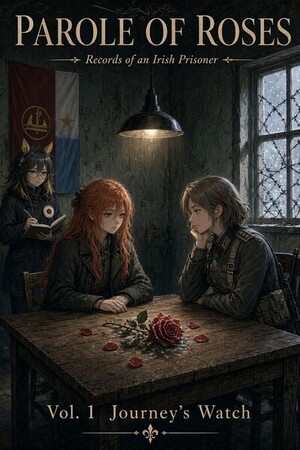
Parole of Roses: Records of an Irish Prisoner Vol 1.: Journey's Watch
Unknown Junction
Russia
11/10/1945
The rail junction had a name on the map and none that anyone used twice.
It sat where three lines tried to become one and failed in a tangle of switches, coal heaps, and a water tower punched full of holes the size of teacups. The town attached to it had been a town last week. Now it was a set of walls that still remembered windows. Smoke hung in the low places. First snow lay in the ditches like a rumor that had not yet decided to stay
Aodhán Fitzwilliam was not supposed to be here.
That sentence had been said to him in three languages before he left Dublin, and again in a heated tent forty kilometers west, and again by a British captain who looked at his hair and face and asked, with the exhausted courtesy of a man who had seen too many uniforms, whether the Irish mission had sent a daughter by mistake.
“Son,” Aodhán had said, and smiled as if the mistake was a joke they could share. “Aodhán Firtzwilliam. Observer. Neutral. I have letters.”
He still had the letters. They were in the inner pocket of a coat that had been respectable when the train was still running on a timetable. The coast was no longer respectable. Neither was the timetable.
The observer party had been seven that morning: a Western major who spoke in paragraphs; two Coalition Dolls watching the tree line as if trees were a kind of lie; a German-speaking liaison who was not supposed to be on this road; a beastkin translator with horse ears flattened under a knit cap, her papers stamped in four offices and respected in none; a driver who had stopped introducing himself; and Aodhán, seventeen, copper-haired, carrying a notebook in which he had written village names as if that could keep them from disappearing.
By the time the first shell walked up the embankment, the major’s paragraphs were finished.
Aodhán remembered the sound as a door slammed in a house that did not belong to him. The ground lifted. Gravel became weather. Someone shouted in English for the ditch, someone else in German for the far side of the water tower, and the translator—Nia, her name was Nia, he had written it down twice because she had flinched when the major called her auxiliary—went over the edge of the road as if the road had decided she was extra.
He went after her.
It was not a decision with steps. It was the same motion as reaching for a dropped glove. His father would have called it transmission. His tutors would have called it a failure to calculate. Aodhán, if asked in that instant, would have said only that she had been speaking for all of them since breakfast and that leaving her in a ditch felt like bad manners.
The ditch was half ice and half last week’s rain. Nia was small in the way horse-kin often were when the winter had already started taking its share. Blood on her cap. One ear torn at the tip. Her mouth moved around a word that might have been a language or only air.
“I’ve got you,” he said, in English first, then again in Russian because her papers had been Russian-stamped and people in pain reached for the stamp that hurt them last. “I’ve got you. Don’t you dare apologize. You haven’t done anything that requires it. Я тебя понял. Не смей извиняться. Вы не сделали ничего, что этого требовало бы.”
She tried, of course. Beastkin on this front apologized for bleeding. He got an arm under her shoulders and found that a seventeen-year-old noble son was not as strong as the stories told to children, only stubborn enough to pretend. The second shell found the water tower. Water and rust came down together. One of the Coalition Dolls was firing from behind a switch box with the flat, economical anger of a person who had been built for this and still resented the efficiency.
Aodhán did not see the party break. He felt it go, the way one feels a conversation end in another room. The major’s voice stopped. The German liaison’s profanity stopped. The driver’s engine, which had never sounded healthy, became a fire with ambitions.
He dragged Nia as far as a culvert that still had a roof. Her weight was not the problem. The problem was that the world had narrowed to a circle of mud and the knowledge that he had left the letters in a coat that was now as wet as the ditch.
Boots on gravel. Not running. The unhurried rhythm of people who had already won the piece of ground they wanted.
Aodhán put Nia behind him because that was what one did, and rose out of the culvert with both hands visible, because that was also what one did if one had been raised on rules.
The first rifle was a Doll’s.
She was a Russian kit from collar to boot, gun-type, serial marks pale against the synthetic skin of her throat. Her hair was cropped. Her eyes were the color of cheap tea. The rifle was not cheap. It rested on him with the patience of a tool that had been told what a person was worth and was waiting for the number.
Behind her, more Dolls. Two humans in winter coats that had seen better supply. A ship-type silhouette further back, taller, the suggestion of rigging like a shadow that refused to lie down. Red banner on a truck. The junction, it turned out, had not been empty.
Aodhán swallowed snowmelt and said, because his mouth had always been faster than his fear:
“I am Aodhán Fitzwilliam, Irish observer, civilian status under the Neutral Missions Accord. There is a wounded translator in the culvert. She is a noncombatant. She requires dressing and a stove. I will come with you if you allow her the same.”
The tea-colored eyes flicked to his hair.
It was a look he knew. Copper and honey in a winter ditch did not read as son of a peer. It read as girl, or mistake, or someone’s expensive problem. He had been living inside that look since he was twelve and had grown, if not used to it, then practiced at standing still while passed.
He repeated himself in Russian.
The grammar was clean. His tutor in Dublin had been a woman from Smolensk who rapped his knuckled when he romanticized case endings. He did not romanticize them now. He put words down like plates.
The Doll’s head titlted. Not quite surprise. Something adjacent, the way a ledger tilts when a column does not add.
“Ирландский (Irish),” she said, in Russian. The word sat oddly in the cold. “Нейтральный (Neutral).”
“Да (Yes).”
“Ты побежал к вспомогательному (You ran toward the auxiliary).”
“Её зовут Ниа (Her name is Nia).”
“Это не ответ (That is not an answer).”
“Это единственный вариант, который у меня не грубый (It is the only one I have that isn’t rude).”
A human officer came up through the steam of the broken tower. He had the face of a man who filled forms in the dark. He looked at Aodhán, at the hair, at the empty hands, at the culvert.
“Проверьте канаву (Check the ditch),” he said to the Doll. “Если звероподобная может ходить, она ходит. Если она не может этого сделать, ее направляют на медицинское обследование во время родов. Мальчик— (If the beastkin can walk, she walks. If she cannot, she is tagged for labor medical. The boy—)” He stopped. Reconsidered. “Наблюдатель подходит к фургону. Живой. Он говорил. Это уже больше, чем удалось остальной части его партии (The observer comes to the wagon. Alive. He spoke. That is already more than the rest of his party managed).”
Aodhán did not look back at the road.
He said, still in Russian, still with the manners his mother had put into him like starch,
“Пожалуйста. Сначала заправка (Please. The dressing first).”
The Doll regarded him for a second longer than policy required. Then she jerked her chin at the culvert, and two of the others pulled Nia out with the impersonal care of people unloading sacks that still be useful.
Nia’s eyes found him. She tried to speak. He shook his head once, gently, as if they were in a drawing room and she had been about to mention a scandal.
“You did your work,” he told her. “That’s enough for the day.”
They put him in the wagon between a crate of captured radios and a ship-Doll’s spare coat that smelled of oil and the sea, which was a joke this far from any honest water. His notebook was gone. The letters were a wet brick against his ribs. Through the slats he watched the junction recede: the water tower still raining rust, the switch box still smoking, the place where seven people had tried to be official.
He thought, with a brightness that would have been stupid if it were not the only warmth left in him, At least I can still talk. Talking is a kind of remaining.
The Doll with tea-colored eyes sat opposite and watched his mouth as if words were a mechanism she might have to shut off later.
“Тебе следовало бежать (You should have run),” she said.
“Я так и сделал (I did),” Aodhán said. “Просто не в полезном направлении (Just not in the useful direction).”
Redacted
Tokyo
11/12/1945
The Navy Doll who headed the branch had already taken her gloves off. In this building that meant they were past the part where anyone pretended this was only a briefing. Tall, even for a capital hull. Winter put into the hair on purpose. Jacket still correct. The tea at her elbow had gone cold, and she had not noticed until it had.
The Army Doll across from her had not removed her gloves and would not. She had brought one file, set it square to the table edge, and then looked at the clock as if it owed her an explanation.
Between them, a photograph.
It had come through three offices that would later insist they had not hurried. Snow grit on a coat. A ditch. A boy — the caption said boy; the face made clerks hesitate; the hair made the hesitation expensive — hands raised, body still placed in front of a smaller shape in a knit cap. Copper hair gone dark with water. A mouth that had been in the middle of a sentence when the shutter fell.
The Army Doll turned the print around with one finger so they were both looking at it the same way.
“Fitzwilliam,” she said. “Irish. Neutral observer. Father still has paper in London and a little in Paris. Son speaks English, German, Russian. The Russian is good. Captured six hours ago near the junction. He’s alive because he stood up and introduced himself.”
“He didn’t have a rifle,” the Navy Doll said.
“I know he didn’t have a rifle. That isn’t the part that worries me.”
“What part does?”
“The part where he kept talking.” The Army Doll tapped the smaller shape in the cap. “And this. He went into the ditch for the translator. Beastkin. Horse-kin. Papers in four offices. They’ll list her as auxiliary. He’ll list her as a name. That’s going to be a habit.”
Outside, a courier with fox ears waited at the desk like anyone else. In this country that was still the law, and the law was still proud of itself.
The Navy Doll drew the photograph a little closer. She did not pretend she was only reading the caption.
“London will call him a humanitarian case and not spend a hull on it,” she said. “Dublin will send a note they can print. Moscow will hear the languages before they look twice at the hair. If he dies in the wagon, we get a paragraph. If he lives—”
“He becomes someone else’s tool. Yes. I can finish that sentence.” The Army Doll slid the file an inch forward. “I don’t want his name in a Russian register with nobody of ours standing next to it.”
“Then we put someone next to it.”
“A diplomat gets turned around at the wire. You know that.”
“I’m not sending a diplomat.” The Navy Doll’s mouth moved, almost a smile and not quite. “They can count diplomats. They have more trouble sending a procedure home without making a noise. We send a watcher.”
The Army Doll’s glove flexed once, the way it did when she had already reached the same place and hated being second.
“You want the horse-girl.”
“I want someone they cannot call an argument. If we send a human officer, Moscow calls it interference. If we send one of ours who is already a soldier and already a citizen, we send the standard. They’ll dislike her. They’ll have a harder time putting her on a labor list.”
“She packs too carefully,” the Army Doll said, but she opened the file anyway. Two scripts on the tab. Height written as if someone expected the world to be badly measured. The assignment history was clean in the way that made other officers nervous. “And she will try to keep him comfortable. That’s the leak. Not the Russian. Him. He thanks people.”
“She can keep him alive.”
“She can keep him on the page.” The Army Doll did not look up. “Alive is included. If he’s stupid, she stops the kind of stupid that becomes an incident. If he’s kind, she stops the kind of kind that becomes a story we didn’t authorize. If they try to hang a banner on him, we have a witness who writes in our grammar.”
On the photograph, Aodhán Fitzwilliam was still speaking to a rifle.
The Navy Doll looked at that longer than a branch head needed to.
“He stopped for the translator,” she said.
“I said that.”
“I know. I am saying it again.” A small breath. “That will either save him or get him killed.”
“On that front those are the same column until someone files the distinction.” The Army Doll closed the file with her palm. “Joint authority. Your seal and mine. If this turns into a scandal it is ours, not a present for the cabinet. She watches. She does not take him home in her head. She does not bargain with her own name.”
“And if he thanks her?”
The Army Doll glanced at the copper hair as if it were a weather report.
“Then she writes it down,” she said, “and we decide later whether the thanks is worth anything.”
A clerk was already in the doorway. The Navy Doll reached for the tea, found it cold, and signed anyway.
The orders would leave before anyone reheated the pot.





Please sign in to leave a comment.