Chapter 1:
Chapter 1: Gentleman Behind the Wire
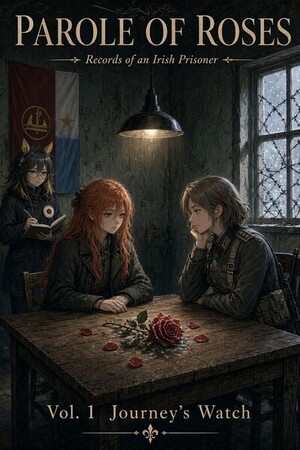
Parole of Roses: Records of an Irish Prisoner Vol 1.: Journey's Watch
The camp had a number and a season and very little else that wanted to be remembered.
It sat behind a rail spur that still pretended to be useful: one siding, two watchtowers, a parade ground that was mostly ice and cigarette ends. The wire was new enough to shine. The buildings were not. Someone had painted a Winter Union banner on the gatehouse and then given up before the gold ship-on-rails was finished, so the hull floated on a smear of ochre like a joke that had lost its nerve.
Aodhán was taken down from the wagon with the radios.
His legs had gone stupid in the cold. He thanked the Doll who caught his elbow anyway, because his mother had not raised to treat a hand as an insult. The Doll looked at him in the way one looks at a coin with the wrong mint: interesting, not spendable.
“Name,” said a human sergeant with a board.
“Aodhán Fitzwilliam. Irish observer. Neutral mission. I’ve letters, if you want them.”
He produced them. They were a wet brick that had begun to freeze into a shape. The sergeant took the packet with two fingers, as if paper could bite, and handed it to a clerk who was already shaking her head at the ink.
The clerk was a Doll. Gun-type, younger in the face than the sergeant, serial marks pale at the throat where a scarf did not quite hide them. She read the first line, looked at Aodhán’s hair, and made a mark that was not the one he had expected.
“Women’s barracks are left,” she said, in Russian, not unkindly. “Beastkin labor’s the low block. Men and officers—”
“I’m a man,” Aodhán said, also in Russian, and smiled as if they were fixing a seating card together. “Aodhán. It throws people when they’ve only seen it written. The letters say son. I can say it again if the ink’s run.”
The sergeant looked at the hair. Then at the throat. Then at the Doll clerk, who had the grace to pause.
“Photo said boy,” the clerk murmured.
“There’s a photograph?” Aodhán asked, before he could make the surprise sound polite.
Nobody answered that. The sergeant wrote male over the first mark hard enough to tear the fiber, then added a question in the margin that Aodhán could read upside down: verify.
“Pockets.”
He emptied them. A handkerchief that had been white in Dublin. A pencil stub. A saint’s medal his aunt had pressed on him and that he had kept out of manners more than faith. The wet letters, already gone. No notebook. He said so, in case they thought he was hiding one.
“No knife?” the sergeant said.
“I was only observing.”
“Observers come with knives often enough.”
“Not this one.” He offered his wrists before anyone asked. “There was a translator taken with me. Nia. Horse-kin. She was hurt. They said she’d go to labor medical. Did she get a stove, at least?”
The sergeant’s mouth did a small, tired thing.
“You don’t ask questions. You answer them. Sleeve.”
A Doll with a kit painted a number on the inside of his forearm in something that stank of spirits and would not wash. The number was not large. That, Aodhán thought, was either a mercy or an accounting decision. He thanked her too. She did not look up.
They moved him along a covered walk where the wind came in under the boards. Through the gaps he saw the three layers of the place, laid out with the honesty of a diagram.
Nearest the gatehouse: a timber office with glass still in most of the windows. Humans went in and out of it with folders. Their coats were better. Their boots were not. A stove pipe leaked smoke that smelled like real coal.
Beyond that: Dolls. Guard posts, the armory door, the tower ladders. They stood in the cold as if the cold were a rumor about other people’s joints. Some wore winter kit cut for the body they had been given. Some wore men’s greatcoats taken in from a pile. All of them had the same economy of motion. When a human officer spoke, they listened. When the officer left, they kept doing the work.
Furthest from the gate, down a slight slope that collected melt: a low block with paper windows and a chimney that produced almost nothing. Beastkin in layered scraps moved between a woodpile and a cookhouse. Horse ears. A pair of wolf-kin with their tails bound out of the way of the door. Someone smaller, fox or cat, carrying water that slopped onto her boots. They did not look at the walk.
Aodhán stopped. The Doll behind him did not shove. She only waited, which was worse.
“The low block,” he said. “That’s where the wounded ones go?”
“That’s where the lists stay short,” she said.
He filed the sentence. He did not yet know what to do with it.
The processing hut was warm in the way a closed mouth was warm.
Two tables. One stove. A poster of the Winter Union flag that had been hung straight. A human lieutenant with ink on his fingers and the expression of a man who had been promised a different war. Beside him, a Doll with a ledge twice as thick as the lieutenant’s. She did the actual writing.
“Fitzwilliam,” the lieutenant said, in German first, then in Russian when Aodhán answered the German. He blinked. “You actually speak it.”
“I was taught the language since I was young. They were meant to help everybody. Which usually means they help nobody.”
“Sit.”
He sat. His coat steamed. Copper hair dripped onto the table in a way that made the lieutenant’s eyes do the same journey the sergeant’s had done: hair, mouth, hands, the uncomfortable arithmetic of a face that did not settle where forms liked faces to settle.
“Sex,” the lieutenant said, as if asking for a hometown.
“Male.”
The Doll with the ledger wrote it, then glanced at Aodhán’s ribbon and wrote a second line underneath that he could not see.
“Nationality.”
“Irish. Neutral.”
“There’s no Irish army on this front.”
“That was rather the idea.”
The lieutenant’s pen hovered. “Status.”
“Observer. Civilian. If the Accord doesn’t hold here, I’ll take prisoner protections. I’m not going to pretend I was a soldier.”
The Doll spoke without looking up. “Anyone picked in a fight zone sits as a detainee until Front Command picks a box. You’re not a soldier. You’re also not walking out.”
“I understand.” He folded his hands so they would not shake from the thaw. “Could I hear the rules? I’d rather keep them than break them by accident.”
That earned him a look from both of them, the human’s skeptical, the Doll’s almost interested.
The lieutenant talked like a man reading a card he was tired of.
Humans signed. Dolls made the signatures mean something. Beastkin did not work that wore bodies out: wood, water, latrines, snow. Officer-class prisoners — or whoever passed for that on paper — slept in the middle huts and ate from the second pot. Labor and auxiliaries slept in the low block and ate from the third. Nobody in the wire saw the first pot.
“Casualty lists stay split,” the Doll added, still writing. “Human. Doll. Auxiliary. Don’t mix the names. It slows the count.”
Aodhán’s smile thinned and did not quite go.
“I see.”
“Do you?” the lieutenant said.
“I see you’re very fond of paper. I grew up around people who were fond of land. Same habit. Different thing being counted.”
“No speeches.”
“I’ll try,” Aodhán said, and meant it, and already suspected he would fail.
They took his coat. They gave him a padded jacket that had belonged to someone with longer arms and a different war. They gave him a blanket that smelled of soap and smoke. They told him the wire bit after dark in the places where it was not simply cold. They told him he could speak to a Doll on duty if he was answering. They told him he was not to speak to beastkin labor without cause.
“What’s cause?” he asked.
“We’ll know it when we see it,” the lieutenant said.
The Doll closed the ledger.
“Hut Three. Middle row. You’ll be on your own until Command decides what do with you.”
Hut Three had a stove that looked like it was used in moderation.
Two bunks. One occupied by a British greatcoat slung over a nail and a tin cup that still held the ghost of tea. The owner was not in. Aodhán stood on the threshold with the manners of a man entering someone else’s parlor and said, to the empty room, “Sorry. I think I’ve been put in storage.”
No one answered. He set the blanket on the lower bunk because taking the upper without asking felt like theft. He sat. The thaw reached his fingers and made them hurt.
Through the small window he could see a corner of the low block. A horse-kin woman was splitting kindling with a short axe. Her ears were flat. She worked as if the wood had offended her and she was too tired to make a speech about it. When a Doll guard passed, the axe did not pause. When a human officer passed, it did.
Aodhán watched until the watching felt like a kind of theft as well. Then he looked at his painted number and wondered whether Nia had been given one, and whether hers had gone on a shorter list.
The door opened.
The woman who came in was a ship-Doll, British-cut coat over interned kit, hair the color of old ale pulled back with a pin that had once been decorative. She took in Aodhán, the ribbon, the burrowed jacker, the careful way he had not touched the upper bunk, and made a sound that might have been a laugh if it had money behind it.
“They’re putting the pretty ones in my hut now,” she said, in English. “Promotion or a warning. Haven’t decided. Bitter Pint. Don’t salute. I’m nobody’s navy today.”
“Aodhán Fitzwilliam. Irish. I hope that’s not your bunk.”
“You took the one with the draft. That’s either manners or you’re an idiot. We’ll find out.” She hung the cup on its nail. “They call you a girl at the gate?”
He did not blush. He had used that up years ago.
“They started to. I told them I wasn’t.”
“Keep telling them. First form sticks. Second form copies it. Then you’re a different kind of problem.” She sat on the upper bunk without asking, which established the room. “Observer?”
“Yes.”
“Neutral.”
“Yes.”
“They like that word here. They like chewing it.” Bitter Pint tipped her head toward the window. “Rules, the useful ones. Humans sign things. Dolls decide if the signature mattered. Beastkin carry whatever both of them drop. Middle row means somebody thinks you might be worth a talk later. Don’t go down that slope to be kind. Kindness down there gets written up as interference. Interference gets you moved.”
Aodhán looked at his hands.
“There was a translator,” he said. “At the junction. I asked about her.”
“Of course you did.” It was not quite unkind. “If she can work, she’s in the low block. If she can’t, she’s on the auxiliary medical list, and that list hated being long. Nobody’s going to walk you down there because you asked nicely.”
“I see.”
“You keep saying that.” Bitter Pint closed one eye, considering him. “Try seeing with your mouth shut for five minutes. Commandant’s a human called Vlasov. Tired. Wants his books clean. Dolls run the hours. There’s a gun-type who walks the yard and asks things that aren’t on any form. German destroyer who looks at Irish neutrals like a crate with no stamp. You’ll meet them when they decide you’re a use and not a mess.”
“I’d settle for being a well-behaved mess.”
“That’s the spirit. Second pot for you. People who wanted you on the third will hate you for it.” She reached down, unexpectedly, and flicked the dark ribbon in his hair with one finger. “Leave that. You cut it to like a soldier, they’ll just get confused some other way. Confusion’s already doing half your work.”
Aodhán almost thanked her for the touch and decided, for once, that silence might be the better manners.
Evening roll was held in the parade ground because the camp believed in seeing what it owned.
Humans first: officers, then the few human prisoners who had ranks the Winter Union was willing to pronounce. Dolls second, by unit and serial, a roll that sounded like a foundry reading its own inventory. Beastkin last, by work gang, names that were often not names, but numbers. The three lists did not share a page. When horse-kin woman coughed through her count and had to begin again, the human officer with the board did not look up until a Doll said, mildly, that the gang was short one if they did not wait.
Aodhán stood in the middle row in his borrowed jacket and answered when the Irish observer was called, which took two tries because the sergeant still wanted to put a feminine ending on the name. He corrected it without heat.
“Here,” he said. “Thank you.”
“Don’t thank roll,” Bitter Pint muttered. “They get ideas.”
Afterward they were given the second pot: thin soup, black bread, tea that had been near leaves once. Aodhán carried his tin to the hut steps because the hut felt, already, like a borrowed room one ought not to stain. A Doll guard watched him sit. He lifter the tin a fraction, an old reflex, an offer.
“I don’t suppose you —”
“No.”
“Right. Sorry.”
He ate. The bread was honest. The soup not so much. When he had finished he looked, against advice, down the slope.
The third pot was being emptied in the low block doorway. Steam. Hands. The horse-kin with the axe took her share last and sat on the threshold to eat it, which meant she could still see the wire. Aodhán could not tell if Nia was among them. Distance and dusk made ears into a single dark line.
He stood.
The Doll guard’s attention sharpened.
Aodhán sat again. The sitting felt like a small betrayal and also like the first rule he had managed to keep. He set the empty tin beside him, aligned with the step.
A human captain came along the walk with a folder and the walk of a man who had found a task that would make him visible. He stopped at Hut Three. He looked at Aodhán’s hair in the last of the light and smiled with too many teeth.
“So you’re the girl from the junction.”
Aodhán rose. It was not a military rise. It was a drawing-room rise.
“Aodhán Fitzwilliam. I’m not a girl. If you need something, I’m here.”
The captain’s smile did not move. “It can wait. Pretty prisoners to keep. You’ll learn the order. Humans talk. Dolls point. The animals haul. You —” his gaze flicked to the ribbon “—you can which list you fancy when the Command gets bored.”
“I’m already on a list,” Aodhán said. “I’d rather not collect another for the sport of it.”
Bitter Pint’s voice came from the doorway, lazy but precise.
“Captain. Vlasov likes his new ones unbruised till he’s read the file. You want a chat, put it on tomorrow’s paper.”
The captain looked at her, at the interned ship-cut of her coat, and found a calculation he did not like. He left. The folder under his arm was too thin to be anyone’s fate. That, Aodhán thought, was the only mercy in the man.
“See?” Bitter Pint said. “Middle row. Interesting, but not safe.”
“I didn’t choose to come here.”
“Nobody does. That’s not the same as handing yourself to every idiot with a folder.” She nodded at the empty tin. “Wash that. Don’t offer it down the slope. Sleep on the draft bunk. If you pray, keep it quiet. If you don’t, don’t start tonight. First night’s for counting the ways you’re still a person.”
Aodhán washed the tin at the barrel because she had told him to. Ice had a skin on the water. He broke it with the tine and apologized to the barrel, which was stupid, and then he did not apologize again.
On the way back he passed the processing hut. The Doll with the thick ledger was still at the table. Separate stacks: human, Doll, auxiliary. She moved a slip from one pile to another, frowned, and put it back. The slip was small. It might have been a name. It might have been a number that had briefly wanted to be a name.
Aodhán did not knock.
In Hut Three he lay on the lower bunk in his clothes and watched the stove being a stove. Bitter Pint smoked something that was not quite tobacco and did not offer it.
“They’ll come get you tomorrow. Day after, maybe. Questions. Languages. Whether Ireland’s a country or a rumor. Answer what you can stand to say twice. Forget the rest.”
“I’m not much good at forgetting.”
“I know. I heard you thank roll call.”
He closed his eyes. The painted number on his arm pulled when he flexed his hand. Somewhere down the slope a beastkin coughed and was told to take it outside. Somewhere in the timber office a human officer signed a page that would outlive the person it described. Somewhere a photograph of copper hair was already in a case that was traveling farther than kindness.
Aodhán Fitzwilliam, who had been raised to stand when a lady entered and to speak when silence would be cruel, lay behind the wire and practiced the only etiquette the camp had so far allowed him.
In the morning, he knew, he would correct the forms again. That, too, was manners. The camp could keep its three lists. He would keep his name. For the first night, that would have to be enough.







Please sign in to leave a comment.