Chapter 1:
Chapter 1 A Good Procession
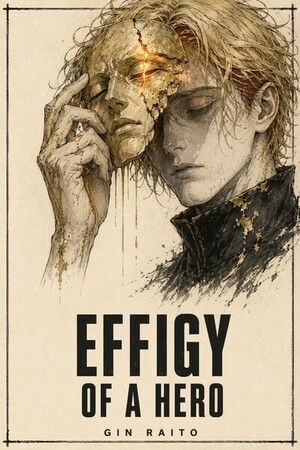
Effigy Of A Hero
⚜ ─── ✦ ─── ❮ ─── ✦ ─── ⚜
The bells of Canora had been ringing for him an hour before he woke, and by the time he stepped out into the light they had worn themselves smooth.
He lifted his hand, because the hand was expected to lift, and the square answered. A sound went up out of the crowd the way water leaps to meet a dropped stone, outward and helpless and obeying something it had not chosen, and he held the gesture at the exact height the Choir had taught him. No higher. Higher was hunger, and the Hero did not hunger. He let the hand fall, and the sound came down with it, and he had never once seen it fail to.
Canora was a city built to be looked up at: white stone, gold leaf, towers that caught the morning and would not give it back. Beneath them lay the square, packed to its edges with people who had walked through the night to stand in it. The gold of him caught the light and threw it down at them. That was what the gold was for. Pale as a wick, the priests said, radiance made flesh, and the crowd strained at the rope-lines to be nearer it, mothers hoisting children onto their shoulders, old men with their hats already crushed in their fists.
The chain at his hip swung once and knocked the bone of his wrist. A plain thing, dark iron, its links worn smooth at the grip and ugly against all that brightness. It had no business on the body of a Hero, and no one had ever managed to take it off him. His fingers found it and stilled it without being told. He never had to look down to know where it was.
Castor walked a pace behind him, weeping. He did it without shame and without sound, the tears finding the deep seams of his face and running down them the way rain runs the cracks in stone, and the gold of his vestments shivered with the small shaking of his shoulders. The tears were real. Aurelian knew the difference. The old man’s faith came off him like heat off a sun-warmed wall, and to stand in it was the warmest thing the morning held, and he stood in it and let it warm him and did not ask why a man could weep for him twenty years and still, somehow…
The thought reached.
It did not arrive. Something in him caught it by the wrist before it could stand, the same grip he kept on the chain, and set it back down where it had lain. He went on smiling at the square, because the square was waiting to be smiled at.
A woman near the front had brought a sick child. He saw it from up there as he saw everything, as weather, as something occurring in the middle distance to people he would never meet, and he raised his hand, and this time he reached down for the fire on purpose. It came up clean and quick, a column of heat climbing his arm and out through his fingers, contained, public, leashed to the gesture; and the gold spilled into the air between him and the child, and the fever broke under it all at once and without a sound. The mother folded over the child and shook. The crowd made the sound again, louder now, and here and there along the front a face turned away. He had decided long ago that they turned from the light because it was too much to look at. He had never gone looking for another reason. The warmth of the burning moved in him still, lovely, and he smiled into it and thought, because the Choir had taught him to think it, this is what I am for.
It was a good procession. The reports would say so.
He had nearly reached the steps when he saw the boy.
Not a saved boy, not a lifted one. A small one, off to the side, pinned at the hip of a man too busy shouting praise to feel him pulling away. Four, perhaps five. Wide-eyed in the din. The crowd-roar was a wall coming down on him and he had the look of a thing going under it, and no one saw, because there was gold to look at instead.
Aurelian stopped.
He did not decide to. The procession had a rhythm and his body knew every beat of it, and the rhythm did not have this in it, and yet his feet had already stepped off the measured line and were carrying him toward the boy. There was no thought in front of the motion. No plan. Only the motion, and the same wordless thing in it that had reached for Castor a breath ago and been set down. This time nothing reached it in time.
He had crossed the rope-line, crossed the Hero’s permitted distance, and the gap between where he should have stood and where he stood now was a small nakedness he could not feel yet. The boy looked up. The noise still came down around him in pieces, his fingers locked into the cloth of his father’s coat, and he was not crying. That was the thing that held Aurelian where he stood. The boy was not crying. He had gone somewhere under the sound that the tears had not found yet.
Aurelian knelt.
It was nowhere in the liturgy. His knee struck the stone and the chain swung and rapped the same wrist-bone, one small true pain in the middle of all the performance. The boy’s eyes were very dark. There was snot drying on his lip. He had the look of a small animal gone still in a fence, and Aurelian did not know what to do with that look, because he had never once been that small and had someone see it. He had never been seen at all, not in the way that counts, and it was the not-knowing that moved his hand before the rest of him could stop it.
His palm opened toward the boy. Not the blessing. The hand simply opened, empty, and hung in the air between them like a question neither of them had the words for.
The boy did not take it.
Aurelian stayed kneeling. The roar went on, but a seam had opened in it, a thin wrongness where the rhythm had skipped a beat, and he could feel it spreading at his back. The procession was a machine and the machine had lost its timing. Behind him, Castor’s weeping had stopped. That was how he knew.
He looked at the boy and the boy looked back, and he reached for something to say. The Choir had given him words for every station of the year, every wound and gratitude and death. It had given him nothing for a child frightened by the shape of his own devotion. The gold was still warm in him from the blessing, and the warmth did not reach this far. It was the wrong coin.
He touched the boy’s hair.
Too brief, too light, the touch of a man anointing rather than comforting. His fingers barely grazed the dark strands, and they were shaking, and he did not know why. The boy blinked. The noise had not stopped, but the boy had found a still place somewhere inside it, and Aurelian had made that still place without the first idea how, and the not-knowing was worse than any burning.
Then the hand came down on his shoulder.
Castor’s hand. Soft, warm, trembling with the tail of old tears or the front of new ones. The old man did not pull. He did not need to. His touch carried the weight of twenty years of processions, and it settled Aurelian back down into his own bones with a gentleness that felt like going under water.
“The steps, my sun,” Castor whispered. “The steps are waiting.”
Aurelian rose.
It was the correct motion, exactly: the knee lifted, the spine came straight, the hand fell to his side and found the chain and stilled it. The father had turned at last. He had the boy by the shoulder and his mouth was still going with praise and he had seen none of it, not the kneeling, not the empty hand, not the still place. He saw only the gold beginning to move away, and his voice climbed to follow it. The boy looked back once. Aurelian had already turned, and did not see him do it.
He turned back to the square, and the sound that rose this time was the right one. It poured into the seam he had made and smoothed it flat, and the crowd surged forward again with their faces lifted, and the gold of him caught the morning and threw it back exactly as it was meant to. He went on through the lane they opened for him. He did not stop again.
Castor walked a pace behind and wept, as he always did.
Aurelian held the smile at the height the Choir had taught him. No higher. He let it rest on his face, and felt the warmth of the burning still moving in him, lovely, and thought, this is what I am for.
The thought arrived whole. It did not reach and sever. It stood there, polished and well-fitted, and he let it stay.
He had forgotten the boy by the time he reached the steps.
The reports would call it a good procession. They would set down the blessing, the light, the fever broken under the gold, the mother’s shaking gratitude. They would set down the radiance, the pale wick, the unconquered sun moving through the square. They would not set down the small dark gap where a boy had stood, or the hand that opened on nothing, or the knee that struck the stone with a sound too small for any hymn.
Aurelian did not set them down either. He climbed the steps. The doors of the Soterian Choir opened before him and he passed into the shadow they held out, and the gold came with him, and the day went on the way his days had always gone. The chain at his hip was still. The wrist-bone no longer hurt. The square was behind him, and the square had already forgotten, and he was the Hero, and the Hero did not look back.
But something in him had not yet stood up off the stone.





Please sign in to leave a comment.