Chapter 2:
Chapter 2 Celaeno
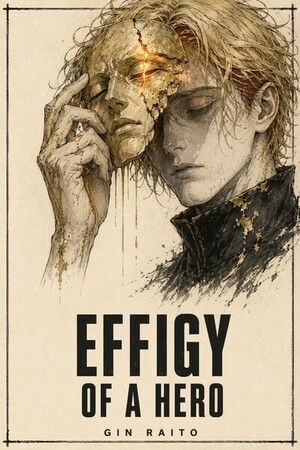
Effigy Of A Hero
⚜ ─── ✦ ─── ❮ ─── ✦ ─── ⚜
Inside, the Choir was always winter.
The great doors swallowed the square behind him, the bells, the weeping, the nine thousand voices and gave back nothing but the sound of his own boots on stone. The cold came up to meet him the way it always did, polite and complete, like a host who has been expecting you for years and is not especially glad you came.
By the time he reached the long gallery the gold had gone out of his skin. It always went, indoors. The radiance was a thing for squares and high windows, and here in the corridors where no pilgrim was allowed it drained quietly out of him, a tide going out, until what walked the gallery was only a pale young man in a cold building. That was the truest thing he ever was, and almost no one had ever seen it.
The Aureate dead watched him from the walls.
Generations of them, gold-framed, the varnish gone amber-dark, each one a Hero who had stood where he stood and burned what he burned and been hung here when it was done. Pilgrims wept in this gallery. They came on feast days and walked it end to end with their hands pressed to their mouths, reading the unbroken line of the chosen the way the devout read scripture, and they never noticed, why would they? That the faces shared a certain sameness. Not in the bones. In the eyes. Every painted Hero on that wall was looking at something the painter had set a little above the frame, something brighter and better than whoever stood beneath it, so that not one of them ever quite looked at you. He had learned that trick of the eyes without being told it was a trick. He looked past people too.
At the end of the gallery, alone, beneath candles that were never allowed to die, hung his mother.
He stopped under her because stopping was part of the rite, and looked up because looking was part of it too. Celaeno Aureate. She was beautiful in exactly the way the painting required, gold at her throat, her face lifted and turned toward the same far light all the others watched, radiant, serene, entirely occupied with something outside the frame. Her arms were folded across her breast. They held nothing. No painter in a hundred years had thought to put a child in them, and no pilgrim in a hundred years had thought to ask why the mother of the chosen had been painted with her arms empty, and he had stood beneath her every day of his life and never once found it strange. You do not find your own mother strange. You learn her. And she had taught him, wordlessly, gazing at her light above his head, precisely what a mother was: a beautiful face, turned away, that does not answer.
Today he caught himself looking at the crook of her painted arm, at the fold of gold where a child would have been held if anyone had thought to hold one, and something in him rose toward it, as if there might still be warmth in a place that had never once been warm…
He put it down. He was good at putting it down; after burning, it was the thing he did best. He gave the empty arms a last look, and walked on, and the candle-flames bowed and stood back up in the small wind of his leaving. That was his visit with his mother. It was the same visit he paid her every day.
⚜ ─── ❖ ─── ⚜
The west annex was the one room in the Choir that admitted it was a workplace.
Everywhere else existed to be seen in. The annex existed to get things done, and it looked it: long, plain, north-lit, colder than the rest of a cold building, the walls climbing with boxed records and the great table down its spine buried under the paper that ran the most sacred institution in the realm. Genealogies. Provisioning accounts. The patient correspondence that kept three hundred years of prophecy from contradicting itself. None of it was holy. All of it was necessary, and Tacenda sat in the middle of the necessary thing with her back to the door, and did not turn around when he came in.
She never did. In all his life he could not recall her crossing a room to him, or standing when he entered, or paying his body any of the hundred small homages that everyone else paid it without thinking. She registered his arrival the way she registered the hour, and kept writing.
She was a small woman in the grey she always wore, plain on purpose in a city that gilded its doorknobs, the grey, the close-pinned hair, the absence of any ornament at all. You would take the hair for black until she leaned into the north light and it gave itself away, a deep wine-dark, the colour of old blood in a bottle, a thing she kept and chose not to advertise. Her hands never stopped and never wasted a motion. They turned pages, weighed pens, made small exact marks. They did not bless, and they did not shake. He had watched those hands his whole life. They were the only hands that came near him that had never once reached for his face.
“Sit,” she said, before he had decided whether to. “You’re swaying.”
He had not noticed he was swaying and sat.
“The square.” She did not look up. “Tell me.”
“The procession went well. The child’s fever broke.”
“I know the fever broke. I have it here.” She tapped the page without reading it. “What I have here also says you held the blessing four times longer than the form asks for, and went grey at the end of it, in front of nine thousand people.” She set the pen down, which she did so seldom that the small click of it was its own event, turned in her chair and looked at him and her looking always landed like a flat hand laid on the back of the neck. “So. Tell me what you spent it on.”
He did not have the answer she wanted. The truth was that he did not know. The blessing had asked for a candle and he had given it a pyre and could not have said why. But under the not-knowing there was a thing, the way there was always a thing now, just below the place his reach ran out, and before he could stop it the thing came up and out of him.
“There was a child,” he said. “Not the sick one. A different one. In the crowd.”
It was not an answer. It had nothing to do with anything she had asked. He heard how strange it sounded the instant it was out, and could not take it back.
Tacenda’s hand, halfway back to the page, stopped.
It was nothing. Half a second. The pen stood still above the paper and a bead of ink gathered at its nib and swelled and fell and bloomed on the page, and she watched it bloom, and for that half-second the cold room held something it had not held before, not accounting, something older than accounting, the face of a person reminded against her will of a thing she had decided, long ago and at some cost, not to feel. Then it was gone. Her thumb pressed the blot flat. The ledger was only a ledger again.
“Go and rest,” she said. “You’re no use to anyone grey.”
It was the kind of thing she always said, blunt and practical and concerned with his usefulness, and he had heard a thousand like it and never once heard anything underneath. He stood. He was nearly at the door when she spoke again, not turning, her pen already moving.
“The child,” she said. “Was it frightened of the noise. Or of you.”
He stopped. He did not know. It had not occurred to him there could be a difference. “I don’t know,” he said.
“No,” she said. “You wouldn’t.”
And that was all. He went out. He did not see her set the pen down a second time, and put her grey-dark head into her ledger-keeping hands, and sit like that a moment in the north light, like a woman running a sum that would not come right however many times she ran it.
⚜ ─── ❖ ─── ⚜
His chambers were cool and smelled of stone and the cold ash of last night’s incense. He shut the door. The last of the gold left him at the threshold, the way it always did, and he stood in the grey afternoon and was, for the first time since the square, entirely unwatched.
He did not like the unwatched hours, though he could not have told you that; he had no words for it to be told in. He knew only that when the eyes went away, something in him went away with them, quietly, the way the gold went, until there was a man standing in a room and no one in particular inside the man. The light crossed the floor. The body breathed. Time went by in the chamber, and afterward he could not have said how much of it, or quite who had been there to spend it.
He did not wonder about the child. Wondering was a thing other people did; it had never been issued to him. He thought, because he had been taught to think it, that the warmth in his chest was lovely, and that he was tired, and that the tiredness would lift by morning. He reached down without looking and stilled the chain at his hip, out of a habit he had never examined, and the motion did what it always did.
The day had been good and the reports would say so.






Please sign in to leave a comment.