Chapter 5:
Ghostis
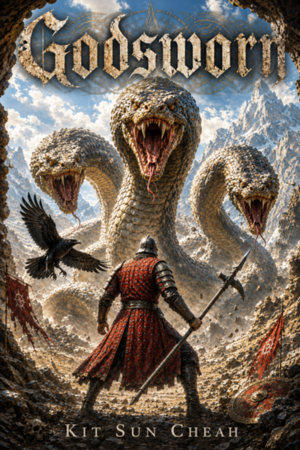
Godsworn
Two days and nights I tore through the forest. I found the brook on the morning of the second day. The waters were sweet but shallow, too shallow for fish. No animals came within reach of my steel. For food I had only what nuts and berries and greens I could forage.
Arta was silent in the day. After we made camp, she showed herself to me. Then she bade me speak to her of the sekwesa I knew.
“Why?” I asked.
“Stories are the weave of the One,” she replied.
She would say no more.
I sang the sekwesa as the clergy had sung them to me. I began with those Selya the priestess had passed to me of the One. Then I recounted the ones Amor the priest had told me, as well as the new sekwesa composed to honor Perkaus’ latest deeds.
She scoffed at the last.
“How many sekwesa are there of the Striker and the Hallower?”
“Endless.”
“How many of them are true?”
“I know not.”
“There is hope for you yet.”
“What do you mean?”
“Every sekwos weaves a new pattern into the All. Patterns weave into others. Yet not every pattern is helpful.”
“What do you mean?”
“Your brain is still mash. You need a healer.”
“I will find one in Verdwer.”
“You will find your doom there.”
“Nowhere else in these lands can you find a healer capable of healing such a hurt. And all men must come to their doom.”
She sighed and covered her face and said no more.
In the middle of the third day, I stumbled out of the woods at last. There, standing in the middle of a meadow, was a ghortos.
The fence was a sturdy wall of wooden posts and wattles. Eight small ward-stones topped the fence, one for every direction. There was but a single gate, as stoutly built as the wall. Three bow-shots away from the ghortos, a herd of cattle grazed on the tender grass. There were thirty-five heads in all, a goodly number for such a small settlement.
I held my Verdwer striker low and fared for the ghortos. A weight lifted from my shoulders. My feet lightened with every step.
When I reached the gate, I drew a lungful of breath and shouted.
“ALA!”
Crows scattered. A dog barked. Chickens clucked and flapped and waddled away. Farmhands looked up from their fields. They looked at me, at each other, then at me again.
“I wish to speak to your ghortospotim,” I said. “I ask for ghostis.”
Men barked at boys. Boys rushed deeper into the ghortos. The eldest of the farmers came to me.
White hair tousled in long locks down his shoulder. Mud and sweat caked his hands and face. His back was bent, but there was strength in his thews still. He held himself up with his hoe, and rested both hands on the handle.
“My name is Leison, ghortospotis of Leisonghortos.” He looked up and up. “You’re a big one, aren’t you?”
I tried a smile. “Men have said that.”
His eyes roamed over my Stormforged plate, Verdwer striker, and damaged helmet. “You have seen better days also.”
“Yes. I ask for food, fire, a healer if you have one.”
“This we have. This we offer you. Enter and be welcome.”
Men swung the gate open. They locked it behind me. Leison took me by the arm and led me deeper into the ghortos.
To my left and right were fields of crops. Young stalks of yellow wheat burst from the soil. Farmhands sowed summer vegetables and uprooted weeds. Chickens scratched and pecked at the dirt.
I glanced at Leison and sensed his Breath. Numbers burst into view.
Body 2
Mind 1
Spirit 1
A common man, I decided. The kind of man I had sworn to protect.
A large gray dog rushed over, barking loudly, baring its teeth.
“Lepa! Heel!”
She sat. Her tail thumped back and forth. Black eyes narrowed. A growl rumbled from the deeps of her chest.
“She is not good with ghosteyes,” Leison said apologetically.
“She is fierce,” I said.
“Too fierce sometimes.”
The heart of the ghortos was the longhouse. Strong and sturdy, with a roof of old thatch, it stood two stories tall, stretching from one end of the ghortos to the other. The right half of the longhouse was a byre. The wide doors and wooden gates betrayed its purpose.
Sheds flanked the longhouse. Here the dwellers stored tools and grain and dried foods. Crows lurked on the roofs, seeking a way inside. A boy tossed a stone half-heartedly at the crows. They mocked him as they winged away.
“Put your hips into it!” Leison called.
“I’m trying, grandfather!”
“Trying is not enough!”
The boy had seen only eight summers. I remember being that young. After my eighth summer, I did not recall any more years of youth.
Inside the hall, the longfires smoldered. Rush-lights chased away the gloom. A blanket of rushes covered the floor. Seated on the benches were the women of the house. They chatted, sang, sewed, mended, swept, churned butter, spun threads, ground grain, and otherwise did all manner of the indoor work. All sixteen of them looked up as we entered.
“We have a ghostis,” Leison said. “Clear a bench by the fire. Reusa, he needs your help.”
The women made way, whispering and giggling as they went. One in three wore the veil of a wife, spun from rough linen. A wide space opened before the hearth. When I sat down, the pains and aches and weariness of recent days came rushing back.
A large chest sat in a corner. A graying woman, her hair tied up in a bun under a white cloth, strode to it. She drew her keyring from her belt and unlocked the chest. She reached in, gathered up an object, and took care to close and lock the chest. When she came to me, I saw that cradled to her chest was a Life-stone.
The size of a man’s fist, it glowed like a rush-light. Even from this far away, I sensed the Breath gathered within.
Such a rich treasure, for so small a ghortos. Most frontier ghortoes would never see a Life-stone, never mind own one. Yet this close to the Sky-pillar, no ghortos could afford to do without one.
“I am Reusa Ghortospotih,” she said. “I have some small talent in the Life arts. You must be a Godsworn of Perkaus.”
“Reusa, he is our ghostis,” Leison scolded. “Do not pry into his business.”
“His gear speaks for him.”
“Yes,” I said. “I am.”
“I will tend to him,” Reusa said. “The farms need you.”
With a grunt, Leison shuffled outside. As Reusa drew close, I checked her Breath.
Body 2
Mind 2
Spirit 3
Either she was a minor cultivator, or she had the lucky to be born with more Breath than most. Those who lived on the frontier did not live by luck alone.
Reusa crouched before me. Holding up the Life-stone to my face, she studied me in its glow.
“Where do you hurt?” she asked.
“I was struck in the head, and bitten in the left leg. The wounds are sealed. Yet I have lost some blood, and my head swims still.”
“Does your head hurt?”
“A little. Less than it did.”
“Do you see double?”
“No. And before you ask, my sight is clear, and so is my hearing.”
She nodded. “Do you feel unusually tired?”
“Always.”
Except when fighting, but I saw no need to tell her that.
“Does it hurt to look at fire or hear loud sounds?”
“No.”
“Do you feel like vomiting?”
“No.”
“Did you black out?”
“Yes. For how long, I do not know.”
“Any difficulties with memory?”
“…I do not think so.”
She held up the Life-stone to my face.
“Look at the light,” she said.
I did.
“Follow it.”
She swung it left, right, up and down. I followed it where it went.
“Your right eye is too large for my liking,” she said. “Take off your gloves, boots and armor, and lie down.”
I doffed my gloves easily enough. Peeling off my boots took little more effort. I rolled up my breeches to expose the wounds, so a married woman would not needlessly touch an unwedded man. Then, piece by piece, I unbuckled my armor.
My helmet was the first to go, followed by the arming cap. Reusa looked at the dent, then the scar. She clucked her tongue and shook her head.
I removed my waterskin and neck plate. Reusa took the chance to feel my heartbeat. Her fingers were strong and warm and leathery. Beneath them my pulse was strong and fast and thready.
My belt was next, then the shoulder and the arm plates. Last to go was the cuirass, breastplate and backplate mated by leather straps. I had to stretch and twist about to reach the straps. The women carefully collected my arms and armor and piled them in a corner.
Finally, I lay down on the hard wooden bench. My arming jacket and overtunic offered a small measure of padding.
“The work on your wounds was rough. There will be scars,” Reusa said.
“I am no stranger to scars.”
She snorted. “The bleeding has ended, but there’s a deep hurt in you still. I will do what I can.”
“I place myself in your hands.”
She sat on the rushes, placed the Life-stone by my head and Breathed. Life flowed into me, a shining river of liquid light. My head pounded once more. So did my feet, knees, and back. There was a pain, a pleasant pain, the kind that promised the release of small poisons.
I saw myself as a broken stone, surrounded by little fragments. Black smoke poured from my head. Chips lifted off the ground, flew back into place, and melted seamlessly into the stone.
Warmth settled into my bones. I Breathed as Life Breathed into me, drinking it down, bringing it to where it was needed most. I relaxed into the bench, and sank into the Breath.
Darkness came.
When I awoke, the benches around me buzzed with life. I sensed a presence by my head and feet, but the Life-stone was gone. Men and women and children spoke and laughed and sang.
Slowly, gingerly, I hauled myself upright.
“Our ghostis awakes,” Leison said.
I rubbed the sleep from my eyes. My head felt clear and light. I realized that for the past three days, my brain had been fogged over. It was so thick I had not sensed it until it was gone.
As my eyes sharpened, I looked about the hall. The two longfires roared high. Leison sat across the hearth from me, facing the door. His was the seat of honor. Reusa was at his left hand. To his right was a man that wore a mix of both their faces. All three sat on thick furs, the only furs in sight.
Grown men and women sat around the longfires. The elderly had the corner seats. Children tousled about at their parents’ feet. Wives sat with their husbands, unwed daughters with their fathers and brothers. A pair of boys, perhaps thirteen or fourteen, clambered up on the free space beside me. Altogether, there were six families, numbering sixty-three people in all.
Bubbling kettles hung over the fires. The rich smell of boiled meat wafted throughout the hall. There was a bowl and a beaker in every hand.
My mouth watered. My belly growled. Still I cast my eyes about.
Where was my gear?
“How are you feeling?” Reusa asked.
“Much better, thank you,” I replied.
“You are our ghosti. Think nothing of it. Yet your head was cracked open. It is barely glued back together. There is a deep hurt in your brain that is beyond my art. It is stable, but you ought to seek a more skilled healer than I.”
She held her Life-stone in her lap. It had gone completely dull. Kweinos swam within it.
As it Breathed, the stone would purify the black cloud. It could be days or weeks or months. Sun and fire would speed it along, but until then, it could not be used for healing again.
“You saved my life,” I said, and louted low.
She laughed and waved her hand.
“Sealing the wounds saved your life. I merely ensured you would not bleed inside or fall prey to some disease-demon.”
There was a beaker in every hand. My bench-mate passed another into mine. It was heavy with cloudy ale. I lifted it to Leison and Reusa, and sang.
Ghosti staggers in
Broken and bleeding
Ghosti holds ghosti
Closing flesh and bone
Weaving Breath to Breath
Reusa clapped her hands in delight. “You know the High Meter!”
“A five-count song is poor payment,” I said, “but it is the first of what I offer you.”
All around the fire, we drank to the song. The ale cleared my throat and sparked my belly, but I barely tasted it. Once more I looked about.
“Are you looking for something?” Leison asked.
“My gear,” I admitted.
He gestured at a chest in the corner. “Over there. Your striker hangs on the wall behind you.”
I turned around. There, within easy reach, the polearm lay on a rack. Spears and axes, bows and shields also rested on the walls near the men of the ghortos.
They were being careful. Ghosteyes we may be, but this was the frontier. For this reason, I ween, neither Leison nor Reusa had given me the names of their fathers.
My belt was still on me. My knives were still sheathed. I pressed my hands against the pouches. They felt full.
Rage kindled within me. You do not touch a warrior’s gear without his permission. Yet my ghosteyes had meant well. They had not broken the law.
I choked down the flames with a sip of ale.
Leison clasped his hands together.
“Ghosti, I invite you to join us for the evening meal. It must be poor food for one such as you, but there is fresh beef and cheese and greens.”
“Leison Ghosti, I am used to harder and simpler fare. Truly your hands and hearts are open,” I replied.
Fresh beef meant that they had slaughtered a precious cow just for me. They had spent an even more precious Life-stone on the least of the koryos. How could a man repay such generosity?
I could not. Not now.
The women served the meal. They scooped thick, gray gruel into wooden bowls and passed them around. A large cut of meat floated in mine, along with onions and carrots and cabbages.
A wheel of cheese went from hand to hand. Man and woman and child alike cut off wedges to suit their appetites. I made sure mine was not the largest. The wheel returned to the kettles, much smaller, yet ready for another round.
When everyone had a bowl and beaker, Leison accepted his own food and drink. Then he brought his hands together and lowered his head.
“Weaver, we thank you for the gift of this night, and for the presence of our ghostis. Bless this food and drink. May it bring life and strength to us.”
As he spoke, Arta appeared between the two longfires, wings outstretched.
[Watch,] she said.
White sparks danced within the flames. More flashed in the bowls and beakers. They lived for a moment, and vanished just as fast.
Men and women and children alike dove into the meat and drink. None spoke of the three-legged raven standing in the hall. None must have seen her.
She was a ghost to them, I realized. It was best not to speak of her.
[You are learning,] she replied. [At last.]
[My head is healing.]
[Taste your food.]
I brought a spoonful of gruel to my mouth. It tasted exactly as gruel did. But beneath that flat nothingness, there was a deeper taste. It was like the noonday sun shining on black earth after the rain.
[That is the Breath of the Weaver,] Arta said.
[Is the Breath the white sparks?]
[That is how you see it, yes. Leison’s Breath is small. Most people cannot sense what he did. Now that I am with you, you can.]
[…Thank you.]
She made a sound.
[Learn the Breaths of the Faces of the One. This is the first step to wearing them.]
“Mother, what is that?” a child asked.
“What is what?”
The child pointed. “That bird.”
“What bird? There is no bird.”
Arta hid her head and disappeared into the shadows.
“Eh? I thought there was a bird!”
“Your eyes are playing tricks on you.”
I smiled. Children, people say, are closest to the One.
“Would you like to share a story with us, ghosti?” Leison asked.
“What would you like, Leison Ghosti?” I replied.
“You’re a warrior, yes?” a boy cut in. “They say you came from the Pillar-Woods! What’s your name?”
“Iem! That is rude!” Leison scolded. “Apologize!”
“But—”
“We do not ask ghosteyes what they do not wish to share.”
Iem bowed to me. “Sorry.”
“You have done me no wrong,” I said.
I downed a mouthful of ale, looked at every eye in the hall, and spoke.
“Taran is my name. Perkausyo Godsworn I am, of Perkausyo Verdwer.”
The sacred register silenced every tongue and bent every ear.
“A Kwei-serpent has spawned in the Sky-Pillar. My nesuiros was sent to hunt it. We were defeated. I, alone, remain.”
Silence hung in the air.
Then came a barrage of questions from every direction.
“Are we in danger?”
“Is the Kwei-serpent coming down?”
“You are Godsworn! How could you be defeated?”
The last question stung. Thunder boomed in my chest. My hand gripped the beaker. The wood flexed under my fingers.
“Silence!” Leison said. “Let Taran Ghosti speak as he will.”
I drained my beaker to the dregs, and spoke.
I spoke of how we had tracked the great serpent. I spoke of how we had been ambushed. I spoke of the long walk down the mountains.
I did not speak of Arta.
At the end of the speaking, a woman refilled my beaker. I emptied it also.
“These are terrible tidings,” Leison said.
“A poor gift for what you have given me, yet it is all I have,” I replied.
“Yours was a hard faring.”
“Harder in the telling.”
Leison’s lips wound back and forth.
“Will Kwei-beasts raid our ghortos?” Reusa asked.
I rubbed my chin.
“Where the Law is broken, where the world is warped, Kweinos comes forth. Everything it Breathes into, it changes into more of itself.
“A great wrong was done somewhere in the lands of Verdan. From it rose a great Kwei-serpent. The serpent will Breathe Kweinos into all it touches, and spawn more Kwei-beasts thereby.
“I fare to Verdwer. I will return with the rest of the Godsworn. We will slay the serpent. Until then, it is best that you ward your ghortos however you can.”
As we ate and drank, I shared what I knew of fighting Kwei-beasts without the use of Breath. I had spent six years in the king’s koryos before joining the Godsworn. What I had learned there, I passed on to them.
“Should we buy more ward-stones?” Reusa asked.
“Yes,” I replied.
“We are not wealthy,” Leison said. “The cost would ruin us.”
“If the Kwei-serpent comes, it would be our bane.”
“Fire helps,” I added. “There is plenty of wood around here, and a hallowed fire serves as a ward.”
“We shall kindle a need-fire on the morrow,” Leison said. “It will burn until the serpent is slain.”
When my bowl emptied, the women poured more gruel and meat. I finished it, and they poured even more.
“Eat! Drink!” Reusa urged. “You must regain your strength!”
I obeyed.
As the meal drew to its end, I judged it time for my ghosteyes to share more of what they had.
“How long have you lived here?” I asked.
“Eighteen winters,” Leison replied.
“So long? This place is quite far from anywhere. Twice I have fared to the Sky-Pillar, but I have never seen your ghortos until now.”
“We chose to settle as far from Verdwer as we can.”
“The Sky-Pillar is known to all as a place both perilous and sacred. Why did you build your ghortos here?”
“It is perilous everywhere. Among the plains there are bandits and Kwei-beasts. In Verdwer there are bandits and Kwei-beasts and grubby merchants also. Here there are only Kwei-beasts.”
“The most dangerous beasts prowl the Sky-Pillar and the surrounding lands.”
“We know how to handle them. More than a few of us have served in the koryos.”
“Have you any neighbors?”
“The nearest ghortos is a day and a night away.”
“You are quite strong-hearted to live so near the Sky-Pillar and so far from men,” I said. “Yet surely you did not forge your own iron, or mine your own stones.”
“Traders come by once or twice every moon. It is enough for us.”
I stuffed myself near to bursting, and so did the others. Yet much stew remained still. The women covered the kettles and kept the fires going. The men drew a bath and bade me join them.
The tub could sit eight ordinary men. After I sat down, there was barely room enough for five more. Still, seven men and four sons squeezed themselves into the tub. As we soaked and scrubbed with ash and lye, we shared more stories of life on the road and in the ghortos.
My ghosteyes took away my clothes for washing, and gave me fresh garments. They were the largest they had, and also far too small.
At evening’s end, the married couples stole upstairs to the sleeping rooms. The children and the unmarried adults splayed themselves along the benches on the ground floor. I sat upright against the wall, as I had learned in the koryos, and closed my eyes.
Sleep came easily.
Come the morning, I awoke to the crowing of a rooster. The women went about preparing the morning meal. The men rousted the children and tended to the livestock.
I wanted to help the ghosteyes, but they bade me rest. Reusa sat beside me and checked my leg and head and eyes.
“You are healing well,” she said. “Still you must see a healer as swiftly as you can. Until then, you must guard your head against hard knocks.”
The women cooked large slabs of flatbread on the hot hearthstones. They soaked the breads into the stew and served them with more cheese. My portion was the largest, overflowing with beef. We washed the food down with fresh milk.
At last it was time to go. I changed back into my still-damp clothes, strapped on my armor, and took down my Verdwer striker from the wall. Reusa gifted me a bag filled with twice-baked bread and curds. I made my farewells, then followed Leison and Reusa to the gate.
“Follow the stream that brought you out of the woods,” Leison said. “It leads to the Abver. The river will take you to Verdwer.”
“Thank you. You have been most excellent ghosteyes.”
“We were only helping a man in need,” Reusa said.
“You have gifted me so much. This is my last gift before I go.”
I untied my purse from my belt and handed it to Leison.
“It’s too much!” he cried.
“You gave me my life.”
“You saved yourself. I only pulled you up on your feet,” Reusa said.
“It is still fair payment for all you have given me.”
It was too little. It was all I had. Reluctantly Leison tied on the purse. Instantly his belt sagged.
“May the Striker and the Hallower ward you,” I said.
“May the Weaver watch over you also,” Leison replied.
Armed and armored, I fared forth alone.


Please sign in to leave a comment.