Chapter 9:
Verdwer
Godsworn
I walked the middle of the High Road.
Ordered by the Striker, blessed by the Hallower, the High Road was a sword-blade thrusting through Verdwer. When it was clear, which was not often, thirty men could march abreast from the Northern Gate to the Southern Gate.
Oak trees, sacred to Perkaus, grew strongly along the sides of the road. Flowering shrubs and lush vines were woven between them in salute to his wife, Hagra. Horse- and ox-drawn carts and carriages clopped along the cobblestones, laden with barrels of ale, mounds of leather, sacks of cheese, chests of goods. Lesser peddlers and travelers bore carrying poles on their shoulders, laden with baskets, bundles, and buckets. Laughing children darted between them. Passers-by slipped in and out of gaps, clutching their worldly belongings close. Here and there Breath-wagons hummed along in silence.
The middle lane was empty.
This was the Sacred Way, set aside for the gods and their sworn men. By long custom, outside of feast days, no other man nor beast may tread on this holiest of roads. It was for one business only: the business of gods.
I served the will of Perkaus.
[You seem so certain, for one who sees so little,] Arta remarked.
She was wearing thin on me. Yet it was true that was so much I did not know. Soon there would be a reckoning with her. But first I had my duty.
[You only think you do.]
[I am Godsworn.]
She fell silent.
I brought my Verdwer striker to my shoulders. People craned their necks as I passed. Children waved in greeting, and I waved back. Many adults gaped. Others whispered among themselves.
“Where are the rest of your fellows?” someone asked.
I chose not to hear.
Verdwer was a threefold city. The outer ghortos was the home of the common folk. Some lived by the old ways, in a ghortos within a ghortos within a ghortos. Many opened their front halls to the world, where they sold what wares they made. The scents of fresh-baked bread and strong cheese and cooked food and animal waste muddied as one.
More and more folk adopted the new style, living in the many-floored buildings that were beginning to be called aglanda. Each agland was a block of brick and mortar, within which were homes joined to homes and homes stacked upon homes. The aglandpotis lived in the grandest of these homes, and all others paid rent to him. Only those who lived on the ground could trade with passers-by, and often they were the aglandpotes also.
I did not know what it was like to live in an agland, only that this was how Verdwer crammed fifteen thousand people between its walls, and that number grew year on year.
The High Road cut through the market also. To my left and right, peoples and animals grew thicker. There came a great roar, like the roar of a winter gale, the roar of men and women and children warring with lips and tongues over goods and silver.
Through the roar I heard the native accent of Verdan, the rustic tongue of frontiersmen, the strange speech of southlanders. All men knew the True Speech, of course, but every tewteh had woven onto it new words and sounds in its own way.
Branded men with heavy shackles bent under the staggering weight of heavy goods. Others drove horses and donkeys and wagons of livestock through the thickening crowd. Those who crossed the High Road dared not tarry, least of all on the Sacred Way. One and all, they walked behind and around me, far outside the reach of my hands, if not my weapon. Those who caught my eye louted low or looked down.
Past the market was the middle ghortos. The great families of Verdwer lived here. Not for them were the aglanda of the masses or the cramped longhouses I had passed. Here were true ghortoes, spaced widely apart, each a town unto itself. Yet there were neither farms nor livestock here. Instead there were grand gardens and costly fountains, or else forges and kilns and granaries so large they could not be placed anywhere else.
The noise of the market fell away behind a wall of stone. In the sudden peace I heard the singing of caged songbirds and the strumming of lyres.
Off to my right, a road branched off from the High Road to feed a pleasure garden. Men and women and children in rich dress strolled under the shelter of fruit trees. Others in rags and irons trimmed the hedges and swept the ground and cleared away the refuse. In a pavilion, a group of old men dressed in furs and velvet lounged on long marble benches, sipping from golden beakers. Slender young women in filmy silks and bells locked around their necks and limbs clung to them.
I was glad I was not any of them.
Few noticed me. Those who did whispered and giggled as I passed. I chose not to see them.
I had business still.
[Turn back now,] Arta said.
[I cannot.]
[Your doom lies beyond.]
[You think and speak too much.]
She said no more.
I came at last to the innermost ghortos. It was a perfect circle, divided into two wings. The first was granted to the king, and all who served him. The other was the domain of the gods, and those who served them.
I went to the second.
The Temple of Perkaus stood thrice as tall as a man. His hall was made of oak. Oak were the walls, oak were the doors, oak was the roof also. The gables soared high like arrows, and the eaves were carved into thunderbolts. Old bloodstains soaked through the ancient wood. The soil around the entrance was stained brown from the morning’s sacrifice.
Nearby stood the Temple of Hagra. Her hall was made of rammed earth, held together with lime and blood. Turf covered the roof and walls. Only the windows and doors were made of wood. All around the building was a garden of sweet and blooming flowers, and a selection of roots and vegetables and grains found in Verdan.
Tucked away in a corner was the Temple of the One. In the days when I lived there as an orbhos, it was no less grand than the other two. After Selya the priestess passed and her followers dispersed, it had been knocked down twice. What remained was an altar of stones heaped upon stones, and a small ramshackle hut for the sole remaining priest. The priest himself, bent nearly double, his long hair gone to white, clad in patched gray tunic, was not long for this world. Still he went about his work, tenderly wiping down the altar.
Behind the Temple of Perkaus was the training field. Countless years of drills, contests and mock wars had blasted the land barren. Soaked into the earth was endless blood and sweat, no small amount of it mine.
At one end, Godsworn in gleaming plates and shining strikers formed ranks and drilled fighting in the wall. At the other, bare-chested men gripped and threw and pinned each other. In the middle, men paired off and fought each other with wasters under the watchful eye of the weaponmasters. Off to the side, other Godsworn hefted logs and stones and other heavy weights.
The clash of metal rang loud in the air. Someone fell with a heavy thud. Another man faked a blow with a wooden sword, then snaked around to land a blow at a tricky angle. His partner clapped his back and laughed. Off to the side, a man who came up to my chest crouched low, wrapped his arms around a stone as large as his body, roared at the top of his lungs, and heaved.
The stone lifted off the earth.
It stayed there for three counts.
He slammed it down to the earth. He arched his back and clenched his fists and shouted triumph into the heavens. The Godsworn around him cheered with him, speaking as one voice, one that the gods could not help but witness.
Here was the world I knew.
I walked around the edge of the training field. It was sacred ground, and those who were not training had no right to walk on it. The men lifting the stones and weights greeted me. I greeted them also. The rest were too busy.
“Why are you alone?” a man asked.
I could not answer. Not here.
I came at last to the longhouse of the Perkausyo koryos. Like the temple, it was made of oak. Smaller outbuildings ringed it, the smithy and the storehouses and the stables and the huts for the orbha.
I entered the great hall. The longfires spat and crackled. Spare gear hung on the walls. Branded orbha sat on the benches, wiping and oiling Stormforged plate, stitching torn clothes, doing the work their potes could not. When I stepped inside, all looked up, and all bowed.
“Where is the koryonos?” I asked.
“In his room, poti,” the closest mumbled.
“Very good. Return to your labors. And stoke the fire before I return.”
“At once, poti!”
The orbha set their work aside and rushed to gather more wood. By the time I crossed the hall, the longfires blazed high once more.
The men of the koryos dwelt in the hall. The ranking men lived in the rooms overlooking the hall. The greatest room belonged to Uraghos Koryonos, a house unto itself.
I knocked on the door. The sound thundered in the small space. A greater thunder answered.
“Come!”
I entered.
War gear hung from the walls: a Verdwer striker, a spear, a sword, a shield. There were three frames, each draped with a different set of armor: an arming jacket, a mail shirt, a plate harness with helmet. Tapestries and banners marked the long and storied history of the koryos. Stretched across the floor were rugs woven from the fur and hides of great beasts. Nooks held burning rush-lights. At the far end was that rarest of furniture, a bed.
A table of smoked and scarred oak stood in the center of the room. Scrolls were piled high in an unsteady mound. Nearby was a collection of styluses, quills and ink pots.
The man himself sat on a high chair behind the table. Elbows on the desk, he leaned towards me. Long locks of dark, braided hair ran down to his shoulders. His beard and mustache flowed together in a black forest. Beneath his thickset brow, he frowned.
I stood before him and came to attention.
“Taran Barak-sonu, Perkausyo koryos, reporting!”
He waved his hand.
“You were under Vindos Duks, yes? Where is the rest of your nesuiros?”
“Dead.”
He jerked upright. “Dead? What happened?”
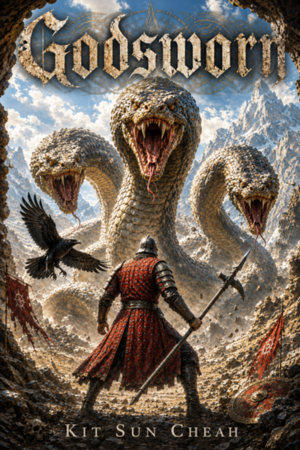
I told him everything I could remember. I spoke of the march up the mountain, the ambush by the three-headed Kwei-serpent, my long faring back to the Verdwer.
I did not speak of Arta.
No man had seen her. Arta herself had not gone out of her way to reveal herself to others. Until I better understood who and what she was, and why she was lodged inside me, I saw it best to keep silent.
[Your only wise decision today,] she said.
I ignored her and continued the telling.
At the end of the tale, Uraghos sucked in a breath and ran his fingers through his hair.
“This… is a disaster,” he muttered. “Never in the history of Verdwer have we lost so many Godsworn at once to a single Kwei-beast.”
“It was a mighty serpent. Its powers were beyond ordinary Kwei-beasts. We must destroy it before it falls on Verdwer.”
“The moment the Striker gives the word, the koryos will march to war.” Uraghos looked sharply at me. “Have you retrieved the name-stones of the fallen?”
I patted my pouch. “Here they are.”
One by one, I handed them over. One by one, names and memories flashed through my head.
Orinos Lukos-sonu.
Vindos Rigan-sonu.
Kerson Menas-sonu.
These, and nineteen more, echoed in the hall of my head. Uraghos handled the name-stones with care, arranging them neatly on the table. When he held Vindos’ name-stone, he stared at it for a moment, closed his fist around it, and placed it in line with the others.
“I sung an eight-count death-sekwa for them in the High Meter,” I said.
Uraghos arched an eyebrow and pursed his lips.
“Good. We will hold the Rite of Remembrance as well.”
“We must have a sekwon. They have earned klewos unto the ages.”
“That remains to be seen,” Uraghos said. “Meanwhile, I must report to the king and the Striker. You will report to the Hands of Hagra.”
“Let me come with you.”
“No. You took a blow heavy enough to dent your helmet and knock you out. Then a Kwei-wolf tried to gnaw off your leg, and a lepahos almost tore away your arms. A lesser man would be dead by now.”
“I am still fit to see and to speak. Surely they will ask questions only I can answer.”
“You cannot present yourself to the king in your state, much less the Striker. One look at you and Perkaus will order you to the Hands.”
“But—”
“I will go to the royal ghortos. You will go to the Hands. Am I clear?”
I nodded.
“Yes, Koryonos.”


Please sign in to leave a comment.