Chapter 25:
Ahead of Schedule
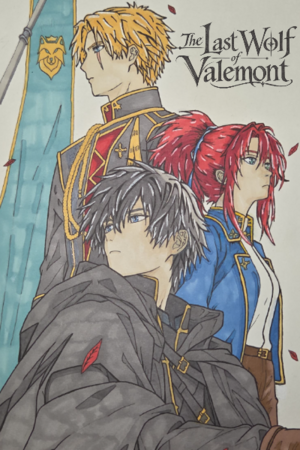
The Last Wolf of Valemont
Isabelle didn’t slow down until we reached the rooftops.
That was unfortunate, because I had several questions and she had clearly decided that explanations worked better at a high altitude.
We crossed the western district above the streets, using balconies, low roofs and the narrow gaps between buildings, none of which seemed designed with rooftop travel in mind.
Below us, evening had settled across the capital. Lanterns burned beneath striped awnings. Carriages moved through intersections in lines of yellow light. Somewhere near the river, music drifted from an open tavern window before vanishing beneath the sound of our boots.
Usually, I would have appreciated the lack of crowds at this height.
Right now, I had too many questions to enjoy it.
“What did you read?” I asked.
Isabelle jumped the next gap.
“I’ll tell you when we get there.”
I jumped after her.
“That barely counts as an answer.”
“Maybe not, but for now, it’s the only one you’re getting.”
I caught up to her.
“We’re already out of the estate.”
“We’re also carrying enough evidence to bring down half the Imperial court.”
“If anything, that sounds like a reason to tell me now.”
She stopped long enough to look at me, her expression completely serious.
“Leon. We don’t know who is watching the streets, who Cedric has already spoken to, or how long it will take him to realise these documents are missing.”
Those are all valid points.
I hated that she was right.
The dockyard came into view beyond the lower rooftops, dark water reflecting the lamps along the piers in broken gold lines. Fresh timber framed one warehouse wall while stacks of stone and covered supplies occupied spaces that had once looked abandoned.
The guards at the outer approach recognised Isabelle immediately. One opened the side gate before we reached it. She did not stop to explain. Instead, we crossed the yard at a pace that made several workers look up.
The administrative building stood near the central pier. Isabelle pushed through the door to find Alexander inside with Rafael.
Publicly, the Second Prince was somewhere south of the capital on Imperial business and would remain there for another three days.
He had found a remarkably efficient route back.
His deep-blue hair made the disguise of an ordinary dark coat considerably less convincing than whoever arranged it had hoped for.
The lamplight caught gold in his eyes as he turned towards us.
Gideon sat at the long table beside him, a familiar set of procurement papers open beneath his hands: Wrenford, the forest routes and iron quantities.
Our carriage had reached the town, delivered everything and returned without another ambush.
I had been present for the delivery.
Gideon receiving the resulting agreements now was a reminder that the operation had continued without me.
Alexander stood when he saw his daughter.
“What happened?”
Isabelle placed the first bundle of documents on the table.
“We found it.”
The room changed instantly. Gideon closed the procurement ledger, Rafael moved closer, and Alexander looked from the papers to Isabelle’s face.
“Found what?”
She swallowed once.
“Proof.”
We spent the next half hour laying thirteen years of lies across a wooden table, beginning with Valemont, Falkenberg and Brankovic.
There were failed attempts that had never become public enough to earn names, alongside payments, orders, copied signatures, Cedric’s annotations and the Crown’s instructions. Rafael read more quickly than any of us.
Not because he understood everything immediately.
But because he recognised things that we did not.
“This seal is internal,” he said, holding one page closer to the lamp. “It never appears on public military orders.”
He turned another page.
“This office reports directly to the Emperor’s private council.”
He turned another.
“I know this designation.”
His expression tightened.
“I thought it was border intelligence.”
“It wasn’t?” I asked.
“No,” Alexander said quietly.
He had barely spoken. He stood at the end of the table as he read the Rochefort papers Isabelle had kept separate.
Her mother’s papers.
His wife’s.
He reached the line concerning the physician, stopped and read it again.
One hand tightened around the edge of the page.
“She was getting better,” he said, his voice shaking.
The authority I had come to associate with Alexander was gone. He sounded less like the head of House Rochefort and more like a man who had just had something taken from him all over again.
“S-She had been sitting up that morning.”
“I remember,” Isabelle said, looking down.
Alexander’s eyes moved over the substituted tonic, the payment and the confirmation of death. For several seconds, he didn’t seem to breathe. Then, he placed the page flat on the table with extraordinary care.
“Cedric?”
I nodded.
“His designation is on the confirmation.”
Alexander closed his eyes.
When he opened them again, the grief had gone nowhere, but his shoulders were straight once more. He looked like himself again, or at least the version of himself the rest of us were used to seeing.
“Keep going,” he said.
Isabelle took out the documents Cedric had brought from the palace. Rafael reached for them, but she didn’t let go immediately.
“You need to read all of it.”
His eyes lifted towards hers.
“I intend to.”
“No. I mean all of it.”
Something in her voice made him stop.
She released the pages, and Rafael read the first sheet without a hint of concern.
He read the second, and that changed.
“What?” Gideon asked.
Rafael ignored him, turned the page back, checked the seal and read the section again.
“That isn’t possible.”
“What isn’t?” Alexander asked, moving beside him.
“These are mobilisation plans.”
“Mobilisation plans?” I asked.
He spread several sheets across the table.
“Troop movements. Reserve levies. Grain seizure estimates. Iron requisitions.”
His finger stopped on a line halfway down the page.
“Campaign projections for the northern and eastern borders.”
“War,” Gideon said.
Rafael shook his head once, almost to himself.
“Not defence.”
He looked at the remaining pages.
“No. Expansion.”
I remembered the missing imports: grain, medical supplies and iron fittings disappearing from ordinary markets. The Crown had blamed distribution problems.
But they weren’t disappearing.
They were being accumulated.
“Why would Cedric have these?” Isabelle asked.
Rafael let the question go unanswered and pulled another sheet free.
At the top sat the four Founding House names.
Three had been crossed through, leaving only Rochefort.
The documents did not describe the old Houses as enemies.
That would have been simpler.
They described them as constraints: independent military authority, land rights, council influence and the legal ability to oppose extraordinary levies and prolonged war mobilisation.
They were checks written into the Empire at its founding, not decorative titles, and the Crown had spent years removing them.
In their place came new titles and estates held by nobles whose wealth and authority existed because the Imperial family had granted it.
People like Cedric.
Beside several of those names sat references to evidence retained by the Crown—crimes, debts, affairs, and anything useful enough to make gratitude worthless.
Isabelle’s eyes moved back to the crossed-out names.
“They don’t want loyal families. They want people they can control.”
Cedric had understood that perfectly, which explained the copies hidden beneath his estate. The Crown had kept dirt on him, and he had done the same for them.
Neither side mistook control for trust.
They had simply made sure that their fates were intertwined.
Alexander looked at the page bearing Rochefort’s name.
“What do they intend to do?”
Rafael found the relevant section. He did not read it aloud immediately, and that told us what we needed to know.
“Removal of the remaining independent authority before general mobilisation begins.”
Isabelle’s hand closed around the back of a chair.
“How long?”
Rafael checked the dates.
“Six weeks at the earliest.”
Gideon stood.
“And the latest?”
“Eight.”
The room went quiet.
The resistance had planned carefully because revolutions conducted entirely on enthusiasm tended to become funerals.
We had expected months.
Now we had six to eight weeks before the Crown moved against the final Founding House and cleared the last obstacle in their way.
Possibly less, once Cedric discovered what was missing.
Gideon opened the Wrenford papers again.
“We have timber commitments from four villages. Iron from two mining settlements, with another deciding by the end of the week.”
Alexander looked at him.
“Is that enough?”
“No.”
“Can it become enough?”
Gideon glanced down at the figures.
“Yes.”
That was the first hopeful word anyone had said since we entered.
Rafael pulled the capital map towards him.
“I can delay some of the internal preparations.”
“For how long?” Isabelle asked.
“A week, perhaps two.”
“Then make it two.”
He looked at her, and a tired smile appeared for half a second.
“I’ll do what I can.”
Alexander unfolded a second map over the first. Nico and Marlo were called in, followed by two messengers. Questions began arriving faster than answers.
How many sympathetic knights could move without alerting their officers? Which gates could Rafael influence? How quickly could Wrenford increase deliveries? How many people could the dockyard house? What had the rat already leaked, and what could they now feed him instead?
Nothing we had already planned needed to be abandoned.
It had simply stopped being large enough.
Markers shifted, dates were crossed out, and another map appeared while I stood near the edge of the table.
For years, the revolution had been something waiting for the right moment.
Now, the moment had arrived early.
Alexander looked around the table.
“Start again,” he said. “From the very beginning.”
And everyone moved in closer.







Please sign in to leave a comment.