Chapter 3:
Once You've Finished Your Coursework
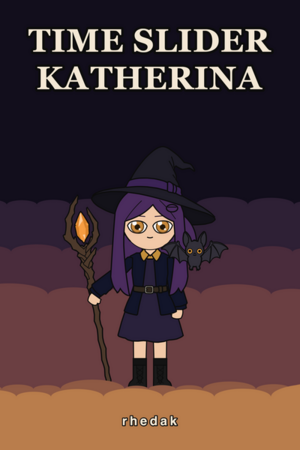
Time Slider Katherina
The Vesperine opening ceremony was, by design, three hours longer than it strictly needed to be, a fact the program notes dressed up as tradition and I privately filed as inefficiency with very good marketing.
The student rows sat in full formal dress, robes and pointed hats, and by the second hour the brim of mine had begun to feel like a small, stiff opinion about the schedule.
The faculty gallery sat apart from the student rows, and the research staff sat apart again from the teaching staff within it, a hierarchy nobody had explained to me and that I’d worked out anyway by the second row. My mother was in the third, lab coat still on under her formal robes, like she hadn’t quite committed to the ceremony being worth changing for. Dark hair pulled back tightly enough that it read less like a style than a decision, the same decision, I realized somewhere in the second hour, that I made every morning without ever having noticed I was making it. Her fast carriage had gotten her here early enough to put in a day at the lab first.
I found her before I found my own seat. I hadn’t been looking. That was somehow worse.
***
The mingling afterward filled the courtyard with robes and punch and the specific noise of several hundred people pretending to remember each other’s names. I found her again near the faculty tables, mid-conversation with someone I didn’t recognize, and waited exactly as long as good manners required, which was not very long.
“Mother.”
She turned, and for as long as it took her to place me in a context that wasn’t a hallway or a dinner table, her professional expression held perfectly still.
“Katherina.” A fraction of warmth, filed away almost as fast as it surfaced. “I heard your application went through.”
“I wanted to tell you myself. I start in your lab as soon as—”
“Not here.” She didn’t raise her voice. She didn’t need to; it was already pitched for a lab, not a family. “And not ‘Mother.’ Dr. Beaumont, or nothing, while we’re both on this campus. I have three postdocs who already don’t take me seriously enough as it is.”
“I wasn’t going to say it in the lab.”
“You said it four seconds ago.”
I didn’t have anything ready for that.
“Finish your coursework first,” she said, already half-turned back toward the conversation I’d interrupted. “Come find me once you have. Not before.”
Not before.
It was, I told myself, walking back toward my own row, an entirely reasonable policy, the kind any competently run lab would have in place regardless of who was asking, and I would have recommended it myself, unprompted, if anyone had thought to put me in charge of the decision instead of just living under it.
Kou, on my shoulder, didn’t say anything, which was, this once, the correct response, and I found myself wishing, briefly, that he’d gotten it wrong.
***
Classes started two days later and turned out to be, on the whole, barely more difficult than Dornstadt’s had been in my final year, which was either a compliment to my old teachers or an insult to Vesperine’s admissions standards, and I hadn’t yet decided which.
Most of the lecture hall had graduated at eighteen, which meant most of the lecture hall had four years of shared context I didn’t have and no particular interest in explaining to me. I wasn’t unwelcome, exactly. I was catalogued: the girl who’d broken the sliding barrier at fourteen, worth a glance and a lowered voice, not worth an actual introduction. I told myself that suited me. I had work to do, and no time for people who needed things explained twice.
I went to the lab every day that first week, coursework or not, on the theory that “finish your coursework first” was a starting position to be negotiated down from, not an instruction.
She wasn’t there the first three times. A postdoc I never learned the name of let me in anyway, handed me a stack of specimen logs, and said, without looking up, “Alphabetical, and try not to editorialize in the margins,” which I did, competently and without complaint, because competence was the argument I was actually making.
She was there the fourth time, at the far bench, mid-conversation with two researchers about a resonance signature I recognized from my own coursework and said nothing about, because volunteering an opinion felt, suddenly, like the wrong kind of visible. She nodded at me over their shoulders. Not unkindly. The exact nod she’d have given any assistant who’d shown up on schedule.
See me.
I stayed four hours and catalogued eleven boxes of logs, and she said nine words to me directly, all of them about sorting order.
I went four times the second week, twice the third, and by the fourth I’d stopped telling Kou when I was going at all, on the grounds that it had simply stopped being noteworthy. He stopped asking where I’d been around the same time, and I didn’t let myself wonder why.
***
The rifts started sometime in that same stretch, though I couldn’t have said exactly when, because for the first two weeks Kou was the only one who noticed them at all.
“There.” A flicker at the edge of the reading room, gone before I’d turned my head. “And there.” Behind the dormitory, the third night in a row.
“Draft,” I said, the first time, out of habit more than conviction.
He stopped arguing the point somewhere around the fifth or sixth flicker, which I decided meant he’d finally learned there was nothing worth arguing about, rather than that he’d learned exactly how much arguing with me was worth.
***
Professor Sikorska asked me to stay after the first real practical exam, the kind that used up an entire double period and left most of the room looking faintly ill by the end of it. I’d finished in eleven minutes, and could have shaved off another three if I’d actually tried.
She was the kind of tall that made doorways look like they’d been built for someone else, hair cropped close enough that no gust of Academy weather was ever going to disarrange it. She graded with a stylus that never seemed to leave ink on her, only on the parchment.
“Sit,” she said, once the hall had emptied. I didn’t sit. “I prefer to stand for conversations under five minutes.”
“Then let’s not waste it.”
She didn’t smile. She had the kind of face that made you suspect it could, theoretically, and had simply decided against it for the semester.
“Eleven minutes,” she said, “on an exam built to run ninety.”
“The material didn’t require ninety.”
“For you.”
“Isn’t that the only version of the material that matters, from where I’m standing?”
Something in her expression didn’t quite settle. I decided it was reluctant respect, the same easy read I’d been giving everything that week.
“You’re going to find,” she said, “that a great many people are willing to indulge a fourteen-year-old who’s right. Fewer indulge a twenty-year-old who still thinks that’s the same thing as being liked.”
“I’m not attempting to be liked.”
“I’m aware.” She capped her stylus. “You’ll get away with this exactly as long as you’re young, cute, and promising, Katherina. Not one day longer. I’d start planning for the day after that, if I were you.”
I opened my mouth to tell her that planning for a hypothetical day I didn’t believe in seemed like a poor use of the time I did have. The air behind her did the thing it had been doing at the edges of my life for two weeks, except this time it didn’t flicker and vanish.
It tore, slow and deliberate, directly above the examiner’s podium, wide enough that I could see straight through it into somewhere that wasn’t the exam hall at all.
Sikorska turned, and whatever she saw on the other side of it stopped her mid-turn.
I had not, in all the time I’d known her, seen her face do anything but hold precisely still. It didn’t hold still now. Something crossed it I didn’t have time to name before she’d already put it away again, reaching for something at her belt I hadn’t clocked as a tool until that exact moment.
“Seam.” Her voice had gone flat, flatter than the exam itself had gotten out of her, and flat, I was starting to realize, meant something closer to trying very hard not to sound like anything at all. “Now. With me, not around me.”
I found it the way I’d found Master Wenzel’s, leaning rather than forcing, except this one didn’t want to be leaned toward. It wanted to be held shut, actively, my staff, still in my fist from the exam, and the slim tool she’d drawn from her belt both raised and the space between us humming with something that felt, distantly, like resistance.
It closed. Fast, and then all at once, like a fist closing once you stop thinking about closing it.
Sikorska lowered her tool first. Her hand wasn’t quite steady, and for the first time since I’d met her, neither was anything else about her.
“That’s not supposed to happen here,” she said, to the space where it had been rather than to me. “Not like that. Not this term.”
“You’ve seen others.”
“I’ve heard about others.” She said it like a correction she resented making. “Nobody I know has stood this close to one.”
That was the first time all day something actually made the back of my neck go cold.
She looked at me a second too long before she said, “That’s not typically how a first-year closes one, either.”
“I’ve had practice.”
“Not on record, you haven’t.”
I didn’t have an answer ready for that, and this time I didn’t bother inventing one. Sikorska didn’t say anything else. She wrote something down instead, unhurried, and didn’t let me see what.










Please sign in to leave a comment.