Chapter 6:
Time to Take Out a Warlock
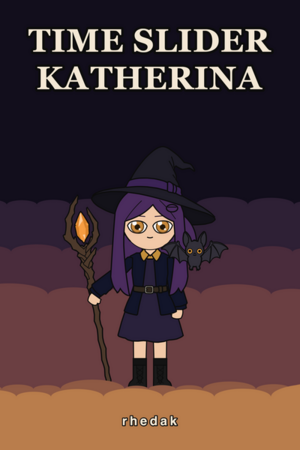
Time Slider Katherina
Mori fell asleep before either of us decided he should, mid-sentence practically, folded up on the end of my bed, whatever had kept him upright through the crossing finally given permission to stop.
Kou and I stayed up considerably longer than that, in case anyone came.
I had assumed, reasonably, that a rift wide enough to require four professors and an actual physical altercation with monsters might merit at least a knock on the door before morning. A question. An acknowledgment that something worth discussing had, in fact, occurred. Nothing came.
I had started calling it, privately, discussing the incident to death, since that was, structurally, what always seemed to happen instead of anything else. They would convene eventually. Possibly as early as next week.
Nobody had asked about Mori specifically, either, and I noticed myself checking the door for him more than I checked it for anyone else. Either nobody in that clearing had noticed a second creature come through amid all that black and chaos, mistaking him for one more thing to drive back toward the rift, or someone had noticed exactly what he was and was choosing, carefully, not to say so yet. Sikorska was the only person I could imagine managing that particular kind of carefulness. It didn’t fit what I thought I knew about her, and I filed the contradiction away instead of deciding what to do with it.
***
I slept eventually. By the time I woke again, well into the next morning, Kou and Mori were already deep in a conversation I couldn’t follow half of, something about wing strain and altitude and how unfairly the Academy’s rafters were spaced for anything with a wingspan over a foot. Two creatures who had spent their whole lives being someone’s familiar first and themselves a distant second, comparing notes on the actual experience of flying, for once, rather than being read as one.
I stood in the doorway for a while before either of them noticed me, oddly aware of being the one who didn’t belong in the conversation.
“You’re doing the thing again,” I said, mostly to break it up.
Kou didn’t even look over. “What thing, Kathi?”
“Whatever this is. The two of you, being unbearably pleased with each other.”
“We were discussing wing strain,” Mori said, careful, already bracing for it to be a problem.
“It’s a legitimate topic,” Kou said. “You wouldn’t understand. You don’t fly.”
“I built a working window into a parallel timeline at fourteen.”
“Different disciplines entirely,” Mori said, and Kou made a sound that might, from a creature capable of more range, have been a laugh.
Kou didn’t correct him, which was unusual, since Kou corrected everyone, about everything, on principle. I decided not to spend too long wondering what that meant, and went to find breakfast instead.
***
Mori asked what the date was somewhere in the middle of breakfast, offhand, and then went very quiet when I told him.
“That’s not possible,” he said.
“It’s the date. I didn’t invent it specifically to inconvenience you.”
“Two years.” He checked the math out loud, a second time, hoping for a different answer. “I crossed into a world two years behind mine.”
“Is that unusual?”
“Adjacent worlds run months apart. A handful, at most, not years. Whatever I found on the other side of that rift wasn’t the world next door.”
“You didn’t cross the ordinary way, though,” I said. “Resonance, you said. Not force. Maybe the rule about adjacent worlds only applies to the ordinary kind.”
“That’s a generous amount of theory built on one data point.”
“It’s my data point. I’m allowed to be generous with it.”
Kou, from the windowsill: “If ordinary sliding is limited and yours isn’t, what’s actually different about it? Besides the number.”
Mori considered this longer than the question seemed to require. “Force pushes through whatever’s in the way. Resonance goes toward something specific, someone specific. It doesn’t care how far that is. It only cares whether there’s actually something on the other end to land on.”
“A person.”
“A person, in the right place, feeling something close enough to match.” He said it carefully, the words already rehearsed, something he’d worked out alone, with no one to check his answer against. “I found the point in your world closest to Kou. He was the closest thing to what I already knew.”
I sat with that for exactly as long as it took the actual shape of it to arrive.
“That’s the paradox,” I said. “The old one. The one every serious treatise on chronomancy spends its introduction politely refusing to solve.”
Kou didn’t look up. “Which one?”
“If time travel is real, why hasn’t anyone gone back and unmade themselves. Every philosopher who’s ever touched chronomancy for longer than an afternoon eventually writes a chapter about it and then quietly stops writing.”
“And?”
“And the answer is that you can’t go back. Not really. You go sideways, into a world that’s behind yours, instead of your own world’s own past, and nothing you do there was ever going to touch the timeline you left, because you were never in it to begin with. It was never your history. It just looks like it, if you don’t check closely enough.”
Nobody said anything for a moment, which I decided, generously, was everyone recognizing the size of what I’d just said.
***
“So the two years,” Mori said slowly, “wasn’t the sliding breaking a rule. It was resonance not caring about the rule other sliding runs on.”
“Which should mean you could resonance-slide anywhere. Any world, any distance, as long as the anchor’s strong enough.”
“In theory.”
“In practice?”
He hesitated. The honest answer, I could already tell, was smaller than the one I wanted. “In practice I nearly didn’t make it across a gap that size, and I’ve had longer to get good at this than you’ve had to learn my name. I don’t think what happened to me is a technique so much as a thing that happened to me, once, that I got lucky enough to survive.”
Kou’s ears angled toward him. “So it’s safer with less distance.”
“Considerably. A neighboring world, someone you can actually stand next to and read clearly, that should work close to every time. Further than that, you’re asking the resonance to do more work than it’s built for, and it does the work anyway. It just does it badly.”
“So the theory holds,” I said. “Which means I’ve just resolved a philosophical problem chronomancers have failed to resolve for three centuries, before lunch.”
“You’ve resolved it for us,” Kou said. “Whether it’s resolved for the actual field of chronomancy depends on whether anyone believes a fourteen-year-old.”
“They didn’t believe me about the first window either, until I made them watch it happen.”
Mori, for the first time since he’d arrived, looked something close to amused.
“And the last one,” Kou said, sobering. “Whichever world actually has the warlock in it. That’s not going to be a neighbor. That’s the end of a very long line of neighbors.”
“One slide at a time, then. World to world, however many it takes.”
“Attuning to a stranger every single time.”
“A stranger who happens to share my face. That should count for something.”
Kou didn’t answer right away, which still didn’t mean what it used to. “And if the last one isn’t there to attune to,” he said. “If whatever’s left of her by the time we arrive isn’t someone you can still read. If she’s already—”
He didn’t finish it. He didn’t have to.
Nobody wanted to be the one to finish that sentence, and the room went quiet around it instead.
“We’ll figure it out when we get there,” I said.
***
I stood up.
“Well,” I said. “What are we waiting for? Time to take out a warlock.”
Kou and Mori looked at me with the exact same expression, which was, I supposed, one more thing they now had in common.
“That was a theoretical discussion,” Mori said carefully. “About mechanisms. I hadn’t gotten to the part where I ask you to come with me. I was going to suggest we tell someone. The committee. Sikorska, at least.”
“Sikorska already believes rifts are real, and nobody in a position to do anything about it is listening to her. Adding ‘also there is a warlock, also they may be dangerous to reality itself’ to a case that already isn’t landing seems like a poor use of everyone’s remaining patience.”
“That’s not a reason. That’s a justification you built to sound like one.”
“I’m aware of the difference. I’ve simply decided it doesn’t apply here.”
Neither of them said anything else, which was, I was beginning to suspect, going to have to be answer enough.
I did not examine, closely, why standing up and deciding something felt so much better than the alternative had. I had done quite enough sitting still lately. I intended to keep it that way.







Please sign in to leave a comment.