Chapter 5:
You're Mori Now
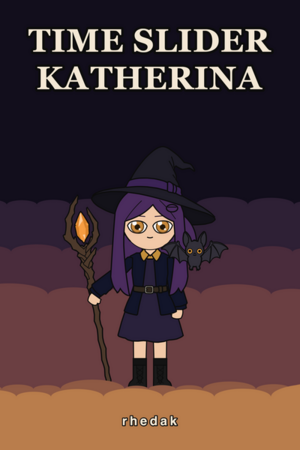
Time Slider Katherina
The monsters didn’t have faces, which made them easier to fight and harder to stop flinching from, an asymmetry I had about one second to notice before Sikorska was shouting names toward the old astronomy tower, and three more professors came around its far side at a dead run, one of them still pulling a boot on as she moved.
I didn’t join them.
I want that distinguished clearly, for the record. I did not run. I retrieved a disoriented, quite possibly injured familiar from an active combat zone. If anything, that was the responsible course of action. If my legs were moving considerably faster than a purely responsible retrieval strictly required, that was a detail nobody present was in any position to examine.
He weighed almost nothing. White where Kou was gray, wings tucked so tight against himself he might have been trying to disappear. When I scooped him up off the frozen grass he didn’t so much as twitch. His stillness sat wrong against everything else moving in that clearing, wronger than any of the four professors currently driving the black, faceless things back toward the rift.
“Katherina—” Sikorska, somewhere behind me, not quite a question.
“I’m taking him inside.”
I didn’t wait to hear whether that qualified as permission.
***
Getting off the grounds took longer than getting back to my room did. One of the arriving professors, a stranger to me, said something sharp about students and combat zones. I didn’t fully hear it over the sound of my own pulse, and I didn’t stop to answer.
I made it back to my room before I let myself feel anything about the fact that my hands were shaking, which I decided was efficient rather than delayed.
I laid him across the end of my bed, set Kou on the windowsill like a sentry, and went to the glass myself, close enough to fog it.
Below, in the last of the torchlight, the monsters were losing. Sikorska had a seam narrowing under her hands, the same technique ours had used, and I watched it collapse in on itself, folding smaller and smaller until there was nothing left but scorched grass and four exhausted professors standing in a loose circle, deciding, presumably, what they were going to tell the director.
I enjoyed that for exactly as long as it lasted, which was considerably longer than the view itself.
They would have to admit it now. Not overdramatizing. Not attention-seeking. A real fight, four professors, and a rift that size told a different story than the one my father had been giving the committee, and I intended to be nowhere in the room when someone finally had to say so out loud.
***
Behind me, a small, cracked voice: “…longer.”
I turned.
He was already sitting up, unsteady, one wing splayed at an angle that didn’t look intentional. His eyes were silver where Kou’s were amber, and didn’t quite focus on anything for the first few seconds, though something underneath the daze held very still, waiting, the way a person does when they’ve already decided, in advance, not to react to whatever comes next. When he spoke, his voice had Kou’s exact register underneath it, dry and a little worn, stretched thinner than exhaustion alone should have made it.
“Longer,” he said, to no one in particular. “It took longer than I thought it would, to cross.”
Kou, from the windowsill, went very still. He didn’t fly down for a closer look, and he didn’t ask me what it was, either. Both were things I’d have expected from him. Neither happened.
“Who are you?” he said. Not a question so much as a demand wearing a question’s punctuation.
“Kou.” The white one said it plainly, no performance in it at all. “I mean — I’m you. Or I was, wherever you’re from. I’m Kou, from—”
“That’s going to be enormously confusing,” I said, because it was, and because someone needed to say so before we built an entire sentence structure around a mistake. “You’re Mori now.”
The room went quiet in a way that made it clear everyone had expected more of a reaction than the one I’d given them.
“…Mori,” he tried, quietly, checking whether it fit.
“It’s decided.” I sat on the edge of the bed, close enough that Kou’s wings twitched. Whether at me or at him, I genuinely couldn’t say. “Now. What happened to you. All of it, quickly. I have several more urgent questions once you’re finished with this one.”
He told it slowly, in pieces, weighing each one before he let it go.
His Katherina had been getting worse for a long while before any of this started, he said. Sharper-tempered. Harder to reach. Tired in a way that didn’t recover overnight. He didn’t say how long “a while” was, and I didn’t ask.
Then, a few weeks ago by his count, the cracks started.
A warlock, nobody had a name for them, combining sliding and chronomancy into something that didn’t glimpse or repair anything, only tore. Objects first. Then buildings. Then, eventually, whole stretches of a city that simply weren’t there anymore, replaced by nothing, not even rubble.
“She tried to stop them,” he said. “More than once. She wasn’t strong enough. Not by then.”
I decided, privately, that whatever else was true, a warlock capable of unraveling a timeline hadn’t beaten his Katherina so much as found her already weak enough to fall. I filed the thought away before I had to feel anything about how easily I’d reached it.
“It doesn’t stay where it starts,” he went on. “That’s the part nobody understood in time. Whatever they’re doing, it doesn’t stop at the edge of their own world. It leaks.”
“Into ours.”
“Into whichever one happens to be closest, I think. I don’t fully understand the mechanism.” A pause that felt chosen, not exhausted out of. “I don’t think anyone does. Not even them.”
Kou’s wings had gone flat against his back. “And your Katherina.”
The silence went on long enough that I’d started composing a second question to fill it, and then he spoke before I finished.
“She died in battle.” He said it to the floor, not to either of us. “I tried to stop it. I didn’t get there in time, and I was thrown into a rift instead. It took longer than it should have to find one that led anywhere at all.”
Kou didn’t say anything. I didn’t either, for once not because I’d already decided what his silence meant, but because I hadn’t decided anything yet. It took me a moment to notice that the not-deciding was its own unfamiliar thing.
Mori kept his eyes on the floor the whole time he said it. I read that, generously, as grief too fresh to know how to look at anyone while it talks.









Please sign in to leave a comment.