Chapter 7:
The Things We Inherit
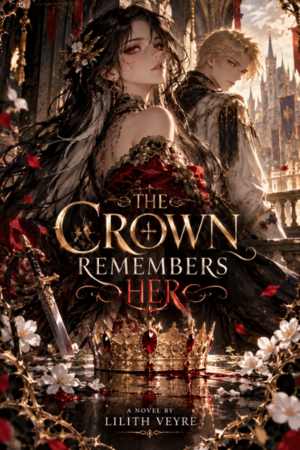
THE CROWN REMEMBERS HER
For several seconds, Aurelia forgot how to speak.
That was becoming an unpleasantly common experience.
The wine cellar had fallen completely silent. Lucien stood beside the displaced shelf, Theron remained near the hidden passage, and Seraphine had moved to Alaric’s side. On the floor between them lay the black book, its pages blank beneath the candlelight.
Aurelia looked at her father.
“We inherit memory.”
“Yes.”
“That’s impossible.”
Alaric’s expression barely changed. “You’ve had an unusual two days to become selective about impossibility.”
He had a point.
Aurelia picked up the book. Minutes ago, words had covered these pages.
Seven would forget. The eighth would be forgotten.
Veyne would remember.
“Witness shows intention carried through blood,” she said. “I’ve used it for years.”
“You remember using it for years.”
Her gaze snapped toward him.
“Choose your next sentence carefully.”
Lucien looked between them. “Should we perhaps continue this somewhere with chairs?”
“No,” Aurelia and Alaric said together.
“Of course not.”
Seraphine closed the cellar door. “Then everyone stops shouting.”
“We aren’t shouting.”
“You’re about three questions away.”
Mother was probably correct.
Aurelia faced her father. “Explain.”
Alaric hesitated, then looked toward his sons. “Leave us.”
“No,” Theron said.
“This doesn’t concern you.”
“It concerns Aurelia.”
“If something beneath our house is speaking to my sister, it concerns me.”
Lucien stepped beside him. “Unfortunately, I’m with him.”
“Unfortunately?” Theron asked.
“You’re unpleasant when you’re right.”
“And you’re unpleasant constantly.”
“Children.”
Seraphine didn’t raise her voice. She didn’t need to.
She looked at her husband. “They stay.”
Something passed between her parents that Aurelia couldn’t quite read.
Finally, Alaric sighed.
“Upstairs.”
They moved to the old family library.
It occupied the oldest section of the western wing, with shelves climbing two floors beneath a painted ceiling. Unlike Alaric’s study, there was almost no military history here.
Genealogies. Marriage contracts. Birth records. Funeral books.
Oaths.
Aurelia noticed that now.
Her father locked the door, then checked it again.
Mira would appreciate the irony.
Alaric placed the black book on the table.
“What I’m about to tell you was told to me by my father, who heard it from his. I don’t know how much is true.”
“Encouraging.”
“It isn’t meant to be.”
He looked toward the Veyne crest above the fireplace.
“Most noble Inheritances are simple in principle. An ancestor swore something significant. Blood witnessed it. The oath endured through their descendants.”
“We know that,” Theron said.
“You know the version taught publicly.”
Alaric tapped two fingers against his chest.
“An Inheritance isn’t merely power created by an oath. It’s also a record of the oath. Blood remembers what created it.”
The words settled unpleasantly.
“Most families never experience anything beyond the ability itself,” he continued. “House Mareth raises barriers because their ancestor swore no enemy would cross his border. His descendants don’t remember the battlefield where he made that promise.”
“But Veynes do,” Aurelia said.
“Sometimes.”
Her thoughts immediately went to her grandfather.
“The voices.”
Alaric nodded. “My father began hearing them when he was fifty-eight. Places he’d never visited. Conversations held centuries before his birth. Names belonging to people long dead. Some days he knew who he was. Other days, he answered to names that weren’t his.”
Aurelia remembered trembling hands around hers.
Seven crowns for seven graves…
“Why didn’t you tell us?”
“Because I hoped none of you would ever need to know.”
Lucien sighed. “That strategy is performing wonderfully.”
Seraphine looked at him.
He became interested in the carpet.
Aurelia remained focused on Alaric. “Why our family?”
“Our oath.”
“We witness what others refuse to see.”
“That is the shortened version.”
Her heartbeat changed.
Alaric looked directly at her.
“We shall witness what others refuse to see, and when the world forgets us–”
He stopped.
Aurelia waited.
Nothing.
“You don’t know the rest.”
“No.”
“But Grandfather did.”
“I believe so.”
She opened the black book again.
Blank.
“You’ve never seen the writing?”
“Never.”
“So it showed itself only to me.”
Alaric didn’t answer.
“What did Grandfather tell you about the sealed chamber?”
“Almost nothing. He made me swear never to open it.”
“By blood?”
“Yes.”
Again.
Blood. Oaths. Memory.
“He said there were things House Veyne was created to remember,” Alaric continued, “and things we were created to prevent from being remembered.”
Aurelia frowned. “Those are opposites.”
“I noticed.”
“And you never opened it?”
“Unlike you, I occasionally recognize that warnings written in blood across several centuries may deserve consideration.”
Theron coughed into his hand.
Aurelia looked at him. “Something in your throat?”
“No.”
“Good.”
“The chamber predates this manor,” Alaric continued. “The house was built over it.”
Lucien straightened. “How much older?”
“We don’t know.”
“Older than the empire?” Aurelia asked.
Her father hesitated.
She caught it immediately.
“It is.”
“We don’t know that.”
“You hesitated.”
“I hate that you’ve started doing this to me.”
“You taught me.”
“I regret many things.”
Seraphine almost smiled.
Then Aurelia asked, “What happened at my execution?”
Theron frowned.
“Your what?”
Aurelia went still.
Right.
She hadn’t told them that part.
Lucien slowly turned toward her. “You were executed?”
“Eventually.”
“Eventually?”
There were moments when tactical withdrawal was wise.
This was probably one of them.
“At twenty-six,” Aurelia said. “I was convicted of murdering Crown Prince Caelan.”
Nobody spoke.
Lucien sat down.
Theron looked as though she’d struck him. Seraphine’s expression emptied completely, while Alaric closed his eyes.
Aurelia continued before anyone could stop her.
“I was executed in Concord Square. My blood touched the Crown of Concord. One of its gemstones opened.”
Lucien blinked. “Opened?”
“Like an eye.”
“That seems like something you might have mentioned.”
“I’ve been busy.”
Theron’s voice had gone quiet. “Why did you kill him?”
Aurelia saw the observatory.
Caelan’s blood.
His hand around hers.
When the Crown opens its eyes, don’t look away.
“I don’t know.”
Theron stood. “Don’t.”
“I don’t have another answer.”
“You remember killing him.”
“Yes.”
“You remember being executed.”
“Yes.”
“But not why?”
That was the problem.
She remembered Caelan asking. She remembered agreeing. She remembered believing there was no other choice.
But the reason itself was missing.
Not forgotten.
Removed.
“I remember pieces.”
Alaric stepped closer. “Which pieces?”
Aurelia looked at him.
“Caelan asked me to kill him.”
Lucien’s head lifted.
“He asked?” Seraphine said.
“Yes.”
“Why?”
Aurelia hated the answer.
“I don’t remember.”
Her future memories had always felt absolute. She remembered battles, casualty lists, conversations held years apart. She remembered Lucien’s body in the snow down to the broken clasp on his coat.
Yet when she reached for the reason she’d killed Caelan, she found only the shape of something missing.
Aurelia looked at the black book.
“If these aren’t ordinary memories…”
“They may not be complete,” Alaric finished.
Lucien frowned. “Wait. If Aurelia didn’t physically travel into the past, then where did twenty-six-year-old Aurelia go?”
Alaric answered carefully.
“Nowhere.”
“That isn’t an answer.”
“It may be.”
He crossed to one of the locked cabinets and opened it with a key from beneath his collar. Inside was a narrow wooden box bearing the Veyne eye.
Alaric brought it to the table.
Inside lay a strip of cloth stained black with ancient blood.
“Whose?” Aurelia asked.
“My grandfather’s. He died before my father was born.”
Alaric unfolded a brittle note.
“During a royal coronation, he collapsed. When he woke, he remembered a rebellion that hadn’t happened yet.”
Aurelia’s skin prickled.
“Did it happen?” Theron asked.
“Eleven years later.”
Lucien stared at the cloth. “So he saw the future.”
“No.”
Alaric looked at Aurelia.
“He remembered it.”
That was worse.
“What did he do?”
“He spent eleven years trying to prevent the rebellion.”
“And?”
“He succeeded.”
Hope came so quickly Aurelia almost hated it.
“Then the future can be changed.”
Alaric said nothing.
Her hope faltered.
“The rebellion never happened,” he finally said. “The capital burned anyway. Different cause. Different people. Same district. Almost the same number of dead.”
Vale.
Different weapon. Different death.
Same final words.
“History corrected itself,” Aurelia whispered.
“That’s what he believed.”
“And you?”
“I believe people become dangerous when they mistake patterns for laws.”
That sounded like her father.
“Perhaps the events were connected in ways he never understood,” Alaric continued. “Perhaps changing one cause created another. Perhaps his knowledge influenced what followed. Or perhaps there are forces involved that House Veyne never understood.”
Aurelia thought of the voice.
You asked us to remember. You will.
“Did his memories come through the Crown?”
Alaric hesitated.
“Yes.”
Aurelia stood.
“The Crown causes it.”
“We don’t know that.”
“It happened to him during a coronation. It happened to me when my blood touched it.”
“That establishes a relationship, not a cause.”
Lucien looked at his father. “This is a strange moment to become scientifically responsible.”
Before Aurelia could press further, someone knocked.
“Your Grace? A palace messenger.”
The servant delivered a black envelope sealed in gold.
It was addressed to Aurelia.
Lucien leaned over her shoulder. “Perhaps your blossom has written.”
“Say that again and I’ll kill you.”
“See? Romance.”
She broke the seal.
Lady Aurelia Veyne is requested at the Imperial Palace tomorrow at the tenth bell.
Beneath it, in familiar handwriting:
Try not to predict any murders before then. It makes the paperwork unbearable.
C.
Theron read over her shoulder.
“I dislike him.”
“You barely know him.”
“I’ve decided efficiently.”
Lucien took the note. “I like him.”
“You like everyone who annoys me.”
“Not everyone.”
“Name one.”
Lucien thought about it.
“Father.”
Alaric looked offended.
Seraphine laughed.
For several seconds, the room almost felt normal.
Then Aurelia saw the imperial seal.
A golden crown surrounded by thorns.
She remembered Caelan’s handkerchief.
Eight thorns.
She counted the seal.
Seven.
“What’s wrong?” Theron asked.
“Caelan’s handkerchief had eight.”
Alaric’s head snapped toward her.
Too quickly.
Aurelia saw it.
“Father?”
“Show me.”
He counted the thorns himself.
Seven.
“Imperial heraldry has always used seven.”
“I know.”
“Are you certain?”
“Yes.”
Alaric returned the envelope.
“Ask the Prince.”
Aurelia stared at him. “That was surprisingly straightforward.”
“If it’s decorative, he’ll tell you.”
“And if it isn’t?”
Her father’s eyes darkened.
“Then perhaps His Highness has been asking questions of his own.”
That night, Aurelia remembered Caelan dying.
Not the young man she’d seen yesterday.
The man he would become.
Twenty-seven years old. White ceremonial robes. Blood at the corner of his mouth.
The Crown of Concord stood behind him.
Aurelia held a sword.
“No.”
Caelan gave her an exhausted smile.
“You always say that before doing exactly what I ask.”
“Tell me another way.”
“If I knew one, do you think I’d be standing here?”
Smoke filled the observatory. Fighting echoed somewhere below.
“Once you see it,” Caelan said, “it’ll see you too.”
“See what?”
“The promise.”
“What promise?”
He looked toward the Crown.
“The first one.”
A gemstone opened.
Ruby light swallowed everything.
Aurelia woke violently.
She reached for the notebook beside her bed and wrote the words before they disappeared.
The first promise.
Then another fragment returned.
Caelan’s hand.
The night she killed him, there had been a cut across his thumb.
Exactly where the cut was now.
Aurelia stared at the page.
Blood.
Oaths required blood.
“What did you do?”
At ten the following morning, Crown Prince Caelan waited for her in the palace library.
Of course he had chosen a library. His thumb was still bandaged. Aurelia noticed immediately.
So did he.
“Good morning.”
“What did you cut your hand on?”
Caelan blinked. “Good morning to you too.”
“Your hand.”
“An envelope attacked me.”
“Caelan.”
His expression changed slightly at his name.
“Show me.”
“Usually someone buys me dinner before making demands like that.”
“Your hand.”
He extended it.
Aurelia took it.
That shut him up.
She examined the bandage.
“Where is the handkerchief?”
His smile faded slightly.
“The one from yesterday,” she continued. “It had eight thorns.”
Caelan went still.
“You noticed.”
Not You’re mistaken.
Not What are you talking about?
Aurelia released his hand.
“Where did you get it?”
Caelan walked to the doors and locked them.
When he returned, he removed the folded handkerchief from his coat and placed it between them.
Silver crown.
Eight black thorns.
“Where?”
“Under the palace.”
Of course.
“Three months ago, renovations uncovered a passage that wasn’t on any architectural plan,” he explained. “I went down before the engineers sealed it.”
“What did you find?”
“A room older than the palace foundations. No furniture. One stone pedestal with a metal box.”
“And this was inside?”
“Yes.”
“What was on the walls?”
Caelan looked at her.
“Eight crowns.”
Aurelia forgot to breathe.
Real evidence.
Not memory. Not a voice. Not something only a Veyne could see.
Eight.
“And your hand?”
“I didn’t cut it.”
She looked at the bandage.
“The wound appeared yesterday morning after I handled the cloth.”
Cold settled in her stomach.
“Why bring it to Veyne Manor?”
“I wanted to see whether anyone reacted.”
“You used breakfast as an experiment?”
“I was hoping your father would notice.”
“And instead?”
Caelan’s mouth curved.
“You nearly killed a man with an apple, caught a crossbow bolt with a sign, and your eyes turned red.”
Aurelia’s expression froze.
He had seen.
For once, Caelan didn’t smile.
“Why didn’t you tell me?” she asked.
“Why didn’t you tell me you remember my death?”
Silence.
There it was.
“What makes you think–”
“Don’t.”
The charming prince disappeared.
“You know things before they happen. You look relieved every time I continue breathing. You knew something was wrong in the observatory before you had any reason to know.”
He stepped closer.
“So either you’ve developed an extraordinarily specific form of madness, or you know a version of me I haven’t become yet.”
Aurelia could lie.
She should lie.
Instead she said, “I remember you.”
Something changed in his eyes.
“How old am I when I die?”
“Twenty-seven.”
“When?”
“Nine years from now.”
“How?”
Aurelia met his gaze.
“I kill you.”
The library became very quiet.
Caelan considered that.
“Hm.”
Aurelia’s eye twitched.
“Hm?”
“I was thinking.”
“I just told you I murder you.”
“Yes.”
“And your response is hm?”
“Would screaming improve matters?”
“Possibly mine.”
A faint smile appeared, then disappeared.
“Why do you kill me?”
“I don’t remember.”
She told him what she could. His request. The Crown. The missing reason.
Caelan looked toward the handkerchief.
“Convenient.”
“For whom?”
“Exactly.”
That silenced her.
He unfolded the cloth completely.
Tiny letters had been embroidered beneath the crown.
UNTIL THE DEBT–
Everything after those words had been deliberately cut away.
“The book beneath my house said the Seven would forget,” Aurelia said quietly.
Caelan looked at her.
“And the Eighth would be forgotten.”
For once, he had nothing clever to say.
Then someone knocked.
“Your Highness? Urgent dispatch from the eastern provinces.”
An officer entered with a sealed message from Governor Asterholt.
Caelan read it.
His expression changed.
He handed it to Aurelia.
Thousands of acres of crops had blackened across three eastern agricultural districts within forty-eight hours.
Aurelia read it twice.
“No.”
Caelan watched her. “You know this.”
“The eastern famine.”
The officer frowned. “What famine?”
Aurelia stared at the report.
“This isn’t supposed to happen until next year.”
Silence.
“So the future changed,” Caelan said.
Aurelia thought of Vale.
Different method.
Same result.
Now a disaster had arrived months early.
Her memories were no longer a map. Every choice she made changed the terrain beneath her feet.
Perhaps history wasn’t correcting itself.
Perhaps she had simply never understood the causes.
“What happens during the famine?” Caelan asked.
“Thousands die.”
The officer went pale.
Caelan’s answer was immediate.
“Then we stop it.”
Aurelia almost laughed.
“I tried that with Vale.”
“And Vale died.”
“Yes.”
“Then yesterday’s method failed.”
She looked at him.
“That doesn’t mean prevention is impossible,” Caelan said. “It means we don’t understand the problem.”
He took the dispatch from her.
“You know what happened once.”
“Once?”
“One future.”
Aurelia remembered her father’s words.
Blood remembers.
Caelan held her gaze.
“That makes your memories evidence, Aurelia. Not prophecy.”
Something shifted inside her.
For nine years, those memories had been certainty. Now they were incomplete information. Perhaps even manipulated information.
Dangerous.
But useful.
Aurelia looked toward the eight-thorn handkerchief.
“Then we find out what the famine actually is.”
Caelan smiled faintly.
“We?”
“You did just confess to murdering me. I feel invested.”
“You’re impossible.”
“And currently alive.”
She hated the way those words struck her.
But he was alive.
This time, she intended to keep him that way.
Aurelia folded the eastern dispatch.
“When does the next carriage leave for Asterholt?”
“Tomorrow morning,” the officer said.
“Too late.”
Caelan raised an eyebrow. “You have a faster suggestion?”
“Yes.”
“What?”
Aurelia looked at him.
“We ride.”
Three hundred miles east, beneath fields that had fed the empire for six hundred years, roots blackened in perfectly straight lines.
Seven enormous circles of dead wheat spread across the valley while farmers stood at their edges and prayed.
None of them noticed the eighth circle forming beneath the soil.
Far below, roots twisted around stone older than the Septarch Empire.
Words carved into its surface began to glow.
WE SWORE THEY WOULD NEVER HUNGER.
For six hundred years, the oath had been a blessing.
Now it had begun collecting its price.



Please sign in to leave a comment.