Chapter 9:
The Maid
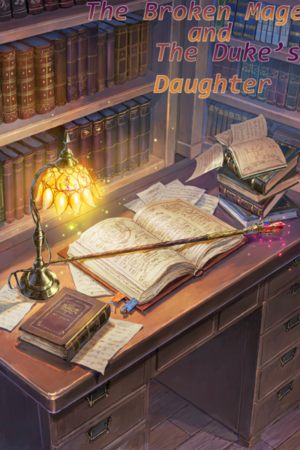
The Broken Mage and The Duke's Daughter
Mia comes to collect me at half past six, and she’s got a lamp, and she doesn’t knock so much as announce herself through the door.
“Library, sir. Then dinner, which is you eating it in your room like his Grace asked.”
“You don’t sound happy about that.”
“I think it’s mad,” she says. “You’re going to be in this house for a year and we’re hiding you in a bedroom on your first night like a wedding present.” She sets off down the corridor without waiting. “But his Grace is right that she’d never sleep, so I’ve stopped arguing.”
The library at Ashveil is on the west side of the old range, which means it’s two rooms knocked into one, which means the ceiling changes height halfway down and nobody’s ever done anything about it.
It’s not a capital library. There’s no ladder on a rail, no gallery, no busts of anyone. It’s four hundred years of a border house buying whatever it needed and never throwing anything away: engineering on the left, a whole wall of it, bridges and culverts and load tables. Beast taxonomy. Border law. Twelve feet of ledgers. A shelf of novels that somebody’s clearly read to death and somebody else has clearly disapproved of.
And then, at the far end, past the reading table, three cases of magical theory that stop me where I stand.
They’re organised.
Not alphabetically. Not by author, not by publisher, not by size, which is how nine houses in ten shelve their theory. They’re in sequence. Foundations, then circle mechanics, then flow and pathway work, then applications, and inside each section they run oldest to newest so you can watch the field change its mind.
There are paper markers in about a third of them.
“She did that,” Mia says, from the doorway.
“I assumed.”
“Took her a fortnight. She wouldn’t let anyone help, and then she made me listen while she explained the system.” A pause. “Twice.”
I pull one down. Foundations of Circle Theory, Vellman, the eleventh edition, and it falls open in my hand because it’s been held open a great many times at the same place, and there’s a note in the margin in small, extremely neat handwriting.
Vellman assumes flow. Everyone assumes flow. WHY does everyone assume flow?
And underneath, in the same hand, a good deal smaller:
Because for everyone else it does.
I stand there for a moment.
“Oh no,” she says, from somewhere up near the high shelves. “Oh, you poor thing. You’re going to like her.”
“Sir?”
“How long has she been reading this?”
“That one? Years.” Mia comes a little further in. “The doctors and examiners all brought their own books and she’d ask to look at them, and then she’d order her own copies after they left. His Grace stopped asking about the bills.” She looks at the shelves, not at me. “She knows more about magic than anybody in this house. Probably more than half of the people who came to test her. It’s the one thing nobody puts in their reports.”
I put Vellman back exactly where he came from.
“I’ll need four or five of these,” I say.
“You can have all of them. That’s what his Grace said.”
“Four or five is enough for now.”
I take the pathway volumes - three of them, all heavily marked - and a beast taxonomy for reasons I can’t justify, and a slim thing on mana density from about ninety years ago that nobody’s opened in a decade, judging by the state of the spine.
That last one Mia notices.
“That last one’s not marked,” she says.
“No.”
“She’s marked everything else on that shelf.”
“I know,” I say. “That’s why I’m taking it.”
Dinner comes up on a tray and it’s better than anything I’ve eaten in three years, and there’s too much of it, which is apparently a thing that follows me around.
Mia stays. Not hovering. She puts the tray down, then takes up a position by the door with her hands folded, and it takes me about a minute and a half to work out that she’s standing post.
“You can sit down,” I say.
“I’m alright, sir.”
“It’s a big room. There are three chairs.”
“I know how many chairs there are.” Beat. “I put them there.”
So I eat, and she stands by the door, and I look at her again, which makes six, and this time I make myself do it properly instead of stealing glances like a man trying not to stare at a stranger’s scar.
The thread’s still up. Still running, still shaped, still costing her something so small most people would never find it.
And now that I’m looking properly, there’s something else, and I feel deeply stupid for not having caught it at the gate.
She’s not standing like a servant.
Servants stand for comfort, weight on one hip, shoulders down, because they’re going to be there a while. Mia’s standing with her weight through the middle of both feet and her knees soft, three feet clear of the door frame so nothing can pin her against it, and both hands folded loosely in front of her at exactly the height where they’d have the least distance to travel.
To the outside of her thighs. Under her skirt. Two of them, one each side, high enough that they don’t swing when she walks and the handles don’t print through the fabric, which means somebody had that dress made, which means this is not a thing she does on her own initiative.
I’ve stood like that. I stood like that for two years.
“You’re not the maid,” I say.
Something in the room changes ever so slightly.
“I’m her ladyship’s maid,” Mia says.
“You’re her ladyship’s maid.”
“Yes, sir.”
“Who stands three feet off a doorway with her hands at her hips and her knees loose.”
She doesn’t move at all for about two seconds. Then her chin comes up, a fraction, and she looks straight at me for the first time since the gate, properly at me, not the once-over, not the sideways assessment.
“That’s a very strange thing for a magic tutor to notice,” she says.
“It is.”
“Most people don’t.”
“Most people don’t notice most things.”
And that’s the end of that road, because neither of us is going any further down it tonight, and we both know it, and there’s something almost restful about two people agreeing to stop at the same place.
“Six,” she says instead.
“Sorry?”
“That’s six times. You’ve looked at me six times since I brought the tray up, and eleven since the gate, and I’d like to know what it is, because I’ve had a year of clever men looking at my lady like she’s a puzzle and I’ve got no patience left for being looked at myself.”
She says it perfectly levelly. Her hands don’t move.
“Alright,” I say. “Who taught you the concealment?”
Mia blinks.
It’s a small thing. It’s the first involuntary movement I’ve seen out of her.
“...What?”
“That spell you’ve had running since before I arrived.” I put my fork down. “One circle. Continuously. Shaped, and held steady, for, what, nine hours? Ten? With a seam so tight that I only caught it because I was standing next to you in an open courtyard with nothing else to look at.” I shrug. “That’s not a maid’s trick. That’s not even a good academy trick. So who taught you?”
She stares at me.
“You think it’s good,” she says.
“I think it’s exceptional. I’d like to know where it came from.”
“Nobody taught me.” Her voice has gone somewhere slightly different. “There was a book. In there.” She gestures vaguely at the door, at the library beyond it. “It’s about theatre. Glamours for the stage, for capital houses, forty years old and completely useless because it’s all six hour castings for one performance. I took the shape of it and made it hold instead.”
“You adapted a stagecraft glamour to run that long on one circle.”
“I was eleven,” she says, like this is an excuse.
“Right,” she says, to no one, from the window. “Well. This house is just going to be like this, then.”
“Nobody’s ever asked,” Mia says. Then, more carefully: “You haven’t asked the other thing.”
“Which other thing?”
“Why.”
“None of my business.”
“You’ll hear it from the kitchen tomorrow.”
“I’m meant to hear a lot from the kitchen, apparently.”
“Then you can hear it from me.” She squares up, and she says it the way you say something you’ve said a hundred times and stopped feeling four years ago. “Lord Halvard doesn’t care for beastkin. He doesn’t like to look at us and he doesn’t like to be in a room with us, and he’s never once said so out loud, because he’s far too clever for that. So when he comes, I put it up. And when he goes, I take it down. It’s two or three days a month and it’s easier than the alternative.”
“Which is?”
“His Grace having a screaming row with his own brother about me.” She says it flatly. “Which he’s had. Twice. And which I’ve asked him not to have again, because I’m not having the house talk about me in the kitchen for a fortnight every time that man visits.”
I don’t say anything for a moment, because there are about four things I could say and three of them would be about Halvard, and I have been in this house for six hours and I am a twenty-year-old nobody with a nice coat and three days to prove myself.
“Say something,” she hisses. “Say something kind, you horrible plank of wood.”
“That’s a lot of work,” I say, “to make somebody else comfortable.”
Mia looks at the floor.
“It’s a spell,” she says. “It’s nothing.”
“It’s ten hours of continuous casting, every day he’s here, for years.” I pick my fork back up. “It’s not nothing. That’s all I’m saying about it.”
The silence goes on slightly too long.
“His carriage is leaving at eight,” she says eventually, to the wall. “In the morning.”
“Right.”
“Her Ladyship’s lesson is at half nine. I’ll come and get you.”
“Thank you.”
She picks up the tray, and gets as far as the door, and stops.
“She’s going to ask you a great many questions tomorrow,” Mia says. “About theory. Hard ones. Not to catch you out - she isn’t like that, she’s just interested, and she’s got nobody to be interested at.” She turns around. “But she’ll have read more than you have on nine subjects out of ten, and about half the men who’ve come here decided that meant she was showing off, and they were unpleasant to her about it.”
“I’ll bear it in mind.”
“They were unpleasant to her in a polite way,” Mia says. “Which is worse. She doesn’t cry in front of them. She waits.”
And then she looks at me for a second longer, and there’s nothing servile in it at all. It’s the look a soldier gives a new man on a wall.
“Goodnight, sir,” says Mia.
“Goodnight.”
The door shuts. I sit with the pathway books and the thin one on density and I don’t open any of them for a while.
“Eleven times,” she says, sprawled along the top of the wardrobe like a cat. “She counted eleven times. She’s been watching you watch her all day, and you thought you were being subtle.”
I wasn’t being subtle.
“You were being about as subtle as a dropped plate.” A pause. “You didn’t ask her about the knives.”
She’d have lied.
“She’d have lied,” she agrees. “And then she’d have known you knew she was lying, and she’d never have told you about the book.”
Mm.
“Look at you,” she says. “Six hours in a house and you’ve got a friend and a reading list. At this rate you’ll be a whole person by Thursday.”
I open Vellman instead of answering, and find the page with the note in it, and read it four times over.
Because for everyone else it does.
Somewhere below me, a carriage is being got ready for eight in the morning, and a girl is running a spell she doesn’t need to run, and a fourteen-year-old with better shelving discipline than the royal academy is lying awake not knowing I’m in the building.


Please sign in to leave a comment.