Chapter 10:
Verena Ashveil
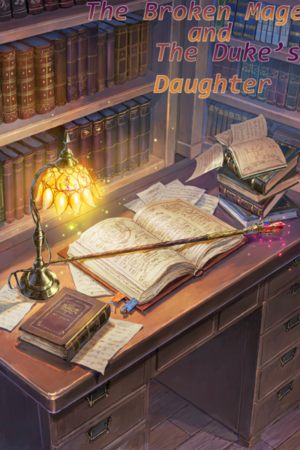
The Broken Mage and The Duke's Daughter
Mia comes for me at twenty past nine, and she’s got ears.
They’re up in her hair, grey-brown and mobile, and one of them turns towards a noise somewhere down the corridor while she’s mid-sentence and she doesn’t appear to notice she’s done it. There’s a tail as well, out through a gap in the back of the dress that’s been finished properly with a hemmed edge, because of course it has. Somebody had that dress made.
“Oh my,” she gasps before I can leave the room. “She’s adorable. And fluffy. Please can we keep her?”
I ignore her as I follow Mia out.
She looks about four inches taller than she did yesterday. I think she’s actually just standing differently.
“That’s twelve,” she says.
“I’m aware.”
“You can look. I’d rather people looked than did the other thing.”
“What’s the other thing?”
“Very carefully not looking,” Mia says, “while thinking about it the entire time.”
We go down the east stairs. Somewhere below, a footman says good morning to her and she says it back, and neither of them does anything at all, and it occurs to me that in this house the extraordinary thing is the concealment, not the ears - and that every single person here has spent four years watching a girl put herself away for two days a month for a man who isn’t even the Duke.
“He got off at eight?”
“Ten past. He was unhappy about the road.” She says it perfectly pleasantly. “Lord Halvard is usually unhappy about the road.”
The lesson room is on the ground floor of the new range and it used to be something else. You can see where they took a partition out. There’s a long table, a slate board on an easel, two windows facing the yard, and a practice circle laid into the floor in brass - proper work, the kind that costs money, laid by someone who knew what they were doing.
The brass is polished to a shine. A year of nothing happening in it, and somebody still polishes it.
And standing behind the table, hands folded, spine like a plumb line, is Lady Verena Ashveil.
“Master Iori,” she says. “Welcome to Ashveil. I’m very grateful you’ve come so far.”
She curtseys. It’s flawless. Everything about her is flawless: Dark green dress, pale silver hair up and pinned, not a thread out of place, fourteen years old and holding herself like a portrait of herself. She’s got her father’s air of nobility and none of his height.
“Just Iori, my lady. Maybe later you can call me teacher.”
“Then you must call me Verena, or we’ll spend the whole year being very silly at each other.” A small, exactly measured smile. “Please sit. Mia, would you - thank you.”
Mia’s already pouring tea.
It’s a performance. That’s obvious within about ten seconds. Not a dishonest one, it’s not hiding anything, it’s armour, and it’s been fitted to her over the course of a year by many specialists in a row, and she’s very good at wearing it now.
And underneath it -
Underneath it, her mana.
I feel it the moment I sit down, and I have to work quite hard not to react.
It’s not weak. That’s the first wrong thing. Every report in that house says her circles are unremarkable, two of them, standard grade, nothing to note. And the circles are unremarkable, they’re sitting exactly where mine pretend to be, But the mana itself is heavy. It’s like putting your hand flat on a wall you expected to be plaster and finding stone behind it. There’s a great deal of it and it’s packed tight and it is going absolutely nowhere.
And I can’t see past it.
That’s the second wrong thing, and it’s worse. Normally, looking at somebody’s mana is like looking into shallow water - there’s a surface, and there’s a bottom, and the bottom is where you find the pathways and the little frayed places and whether somebody’s been overdrawing. With her I get the surface and then nothing. Not darkness. Not damage. Just a flat, mute no, the way a mirror is very informative about the room and tells you nothing at all about the wall behind it.
Something’s in the way.
“Oh, that’s interesting,” she says, leaning right over the table with her face about six inches from Verena’s, entirely uninvited. “That’s genuinely interesting. I take back three things I said about you.”
“Master - Iori?”
“Sorry. Long road.”
“You teleported.”
“Long road before that.”
“Mm,” says Verena, and files it, and I have a very clear sense of something being written down in a place I can’t see.
“So,” she says, once the tea’s poured and Mia has retreated to her three feet of doorway. “I expect you’d like me to try to cast something.”
She says it lightly. Her hands are folded on the table and her thumbs are pressed flat against each other, hard enough that the nail beds have gone white.
“No,” I say.
There’s a pause.
“No?”
“Not today. Probably not tomorrow.”
The pause gets longer.
“Everyone asks in the first ten minutes,” Verena says.
“I know.”
“Doctor Melvane asked before he’d sat down. He asked in the corridor.” She’s still smiling. It’s gone slightly brittle at the edges. “May I ask why not?”
“Because I’ve read nine reports about you and every one of them says the same thing, and every one of them was written by somebody who watched you fail in the first ten minutes.” I pick up my tea. “I don’t need a tenth. I’d rather have something nobody’s got yet.”
“Which is?”
“What you think is wrong with you.”
Verena Ashveil goes very still.
It’s a small stillness. It’s the stillness of somebody who was braced for a particular kind of morning and has just had the floor move under them, and she covers it fast, inside a second, but Mia sees it too, because Mia’s ears have both come round.
“Nobody’s ever asked me that,” she says.
“I guessed as much.”
“No, I mean-” She stops. Starts again, and something’s gone out of the portrait posture, not much, an inch. “They ask me to describe what I feel. That’s not the same. They ask me what happens, and I tell them, and they write it down and then they tell me what it means.” Her chin comes up. “Nobody has ever asked me what I think it means.”
“Then tell me what you think it means.”
“You’ll laugh.”
“I won’t.”
“Everyone laughs. Politely.”
“Verena,” I say. “You reshelved three cases of theory in chronological order so you could watch the field change its mind. You’re not going to say anything I’ll laugh at. I’ve seen stranger.”
Her mouth opens slightly.
“You went in the library,” she says.
“Last night.”
“You saw the sequence-”
“I saw the sequence.”
“Mia, he saw the sequence-”
“I did hear, my lady.”
“Nobody sees the sequence, they all think I’ve muddled them up-” She catches herself, visibly, in the middle of the air. Sits back down. Folds her hands. Reassembles the entire portrait in about a second and a half.
It’s a magnificent piece of work and it doesn’t hold for thirty seconds.
What breaks it is that I ask about the notes.
She’s got them in a drawer of the long table, and there are more than I was expecting, and they’re not a girl’s diary of feelings. They’re a log. Date, hour, conditions, spell attempted, circle count, result, and a column headed “note” that’s where all the actual thinking lives.
A year of them. Six hours a day.
“This is the eighth volume,” she says. “The first two are embarrassing, I didn’t know what to record. May I-” She turns a page for me, leaning across, and there’s no armour left in her at all, it’s simply gone. “Here. This is the one that matters. Look. Eleventh of Ashen, I tried a first-circle light forty times in a row, which is stupid, I know it’s stupid-”
“It’s not stupid.”
“It’s very stupid, Doctor Melvane said it was compulsive-”
“Doctor Melvane sounds like a man who’s never tried anything forty times.”
Somewhere behind me there’s a small noise from Mia that could be a cough.
“-but look at the fourth column.” Verena’s finger comes down on the page. “Four out of forty, there’s a flicker. Not a light. Nothing you could see in daylight. But something happened, four times out of forty, and it’s always the same four conditions, and no one will tell me what that means because they’ve all decided nothing happens, and something happens, it’s just very small and very rare and I can’t make it do it on purpose.”
I look at the four rows.
All four are late at night. All four are after a long day. Two of them have “exhausted” written in the note column, and one says “half asleep, nearly gave up.”
I read them again.
Then I sit back in my chair and look at Lady Verena Ashveil, who has been told for a year by nine expensive men that nothing is wrong with her, and who has independently kept the only useful record anybody has ever made of her condition, and who has been sitting on it in a drawer because nobody thought to ask.
“Can I show you something?” I say.
I put my hand on the table, palm down.
“Mana, gather,” I say, and my circles turn. Two of them, exactly two, quiet and slow and entirely unremarkable.
“Seeping Flood.”
The water comes out through the wood grain. Not much of it. A palm-sized patch, going dark, spreading out from under my hand in a slow ring until there’s a wet circle on the table about the size of a plate.
Verena leans in so fast she nearly puts her chin in it.
“That’s not a water spell,” she says.
“It’s the most basic water spell there is.”
“No, it is, but you did it wrong.” She’s not being rude. She’s delighted, her whole face has changed. “It’s meant to be condensed. Above the surface. It’s in Vellman, it’s - you pushed it through the table, there’s a suppression, you ran a suppression underneath it so it couldn’t rise-”
“Yes.”
“Why?”
“Because I wanted the water in the wood and not on it.”
“But why would you-” She stops. Her eyes go somewhere. “You wanted to know how wet the table gets.”
“I wanted to know how it takes water. Which tells me the grain, and the age, and whether it’s been sealed, and roughly how long.” I lift my hand. “It hasn’t been sealed in about six years, by the way. Somebody should see to it.”
Verena stares at the wet patch on her table.
“That’s not in any book,” she says.
“No.”
“Where’s it from?”
“I made it up,” I say. “When I was about your age.”
There’s a silence of a very specific quality. It goes on for perhaps four seconds.
“Teach me that,” says Lady Verena Ashveil.
“You can’t cast yet.”
“I don’t care. Teach me how you thought of it.” She’s got both hands flat on the table now, mirroring where mine was, the portrait entirely abandoned somewhere in the last ten minutes and nobody is bothering to go and look for it. “Everyone teaches spells. Every single one of them comes in here with a list of spells and a great enormous face on and teaches me spells, and I can already do - I know four hundred spells, I know them cold, I could recite the forms for half the academy syllabus right now, and not one of them has ever once explained to me how a person makes one-”
“Verena.”
“-and you sat down at my table and put water in it-”
“Verena.”
She stops.
“That,” I say, “is the lesson. That’s what I’m here for. The casting is a separate problem and we’ll get to it.”
“A separate problem,” she repeats.
“A separate problem entirely.”
She looks at me for a long moment. And then something happens in her face that I’m not ready for. Something small and young and completely unguarded, gone again in half a second, quickly replaced by a girl sitting up straight and putting her hands in her lap.
“Uncle Winny said,” she begins, and then stops to clear her throat, and starts again more carefully. “Captain Bringer recommended you. To my father.”
“He did.”
“He tells me about mages. He’s done it since I was small.” She’s looking at the table. “There’s one he talks about more than the others. Never a name. Just, a man who did the work nobody was watching, and never took credit for any of it, and cleaned up after everybody else without being asked. I used to make him tell me the same three stories over and over until he got cross with me.”
“Oh, this is delicious,” she says. “This is the best day I’ve had in three years.”
“He’s got a lot of stories,” I manage.
“Is he real?” Verena asks. “The mage? Or did Uncle Winny make him up for a little girl?”
The room is very quiet. Mia’s by the door. The wet ring on the table is already starting to dry at the edges.
“I don’t know,” I say. “I’d imagine he’s a bit of both.”
“Mm,” says Verena, and files that too.
At the end, when Mia’s cleared the tea and I’m standing up to go, I take the parcel out of my coat and put it on the table.
“That’s for you.”
Verena looks at it. The wrapping’s brown paper. It cost less than my dinner.
“You didn’t have to bring anything.”
“I know. Ellery’s gran would have had my ear off.”
“Whose gran?”
“Long story.”
She unties the string carefully, the way people do when the think they might have to re-tie it, and folds the paper back, and looks at a plain brown notebook, a pencil, and a small knife for sharpening it.
She doesn’t say anything.
“It’s not much,” I say, “and you’ll have better ones, but that’s not-”
“How many do you think they brought?” Verena says.
“Sorry?”
“The specialists.” Her voice is very level and she’s not looking up. “Nine of them. Do you know how many books they brought to this house?”
“A lot, I’d imagine.”
“Books, and journals, and case notes, and a man from the academy with a whole case of things.” She opens the cover. A hundred blank pages. “And they all wrote in them, and they all took them away again, and I never saw one single word of what any of them said about me. My father got to read them. I got the summary.”
She turns a page. Then another. All of them empty.
“Nobody’s ever given me one,” she says.
“No.”
“Why this?”
“Because you’ve been keeping the best notes in the building for a year,” I say, “and doing it in a household ledger you stole out of a cupboard.”
Verena Ashveil makes a small noise.
Then she picks up the pencil, opens the notebook to the first page, and writes something at the top of it in small, extremely neat handwriting and turns it round so I can see.
Day 1. Water goes in the table, not on it. Ask why suppression under and not around.
“Tomorrow,” she says. “Half nine. Don’t be late, I’ve got about nine hundred questions and I’ve started writing them down.”
Out in the corridor, Mia walks me as far as the stairs.
“She’s not usually like that,” she says.
“Like what?”
“Like herself,” Mia says. “Not with anyone new. Takes her about a month, normally, and by then they’ve gone.”
She stops at the top of the stairs, and looks at me, ears and all.
“You know she’ll ask you to cast something proper eventually,” she says. “A real one. She’ll want to see it.”
“I know.”
“And you’ll show her.”
I think about a scorpion on a dark road, and my arms up, and nothing coming out.
“Eventually,” I say.
“Liar,” she says, cheerfully, from about two feet behind my left shoulder.




Please sign in to leave a comment.