Chapter 6:
Chapter 6
The Forsaken Legacy: Weight of Every World
A thick, coppery mist clung to the shattered plain, mingling with the sour bite of smoke that curled from smoldering pikes and broken wagons.
Sir Bernard moved through the wreckage with the deliberate, unhurried stride of a man who had learned long ago not to rush toward horror. His armor was dented where a pike had glanced off his breastplate, and a fresh gash above his left brow bled freely, half-blinding him and matting his gray beard. He did not wipe it away. He had stopped feeling such things decades ago.
He had lost sight of Elias in the chaos after the cavalry charged into their lines. One moment the prince had been beside him, shouting orders; the next, the world had become screaming horses and falling men. Bernard had cut his way through twelve Imperial soldiers searching for the boy, his enormous hands steady on his sword hilt, his storm-cloud eyes scanning the dead for that familiar dark hair.
He found him a hundred yards from where the Black Prince stood gloating over his father.
Elias lay on his side in the mud, one arm flung out as if reaching for a sword he no longer held. His face was turned toward the sky, eyes open, fixed on the bruised clouds. Blood pooled beneath him, dark and still, spreading into the hollow where his body had settled. His armor was rent where the blade had entered, the metal edges stained rust-red. A raven stood nearby, head cocked, waiting.
Bernard's breath stopped. Not from shock-he had seen too many young die, but from the precise, surgical nature of the wound. This was not battlefield chaos. This was a duel. Elias had faced someone blade-to-blade and lost.
He knew that face-the earnest set of the jaw, now slack, the dark hair matted with blood and dirt. The boy who had stood in the war tent hours ago, voice steady despite the tremor in his hands, asking for command of the vanguard. The boy who had trusted him.
Bernard did not kneel. He had not knelt for the dead in twenty years, not since the northern campaign where he had buried half his company in frozen ground. Instead he stood over Elias's body, his shadow falling across the boy's face, and he let the weight of it settle in his chest like a stone he would carry until he died.
He had promised the boy victory. He had promised him purpose. He had given him neither.
Behind him, he heard the Black Prince's voice-low, measured, speaking to someone Bernard could not see. He did not turn. Let the prince gloat over his father. Let the kingdom burn. Bernard's kingdom had just become this ten yards of mud and blood, this boy he had loved with the fierce, unspoken devotion of a father who had never had children of his own.
He reached down with one enormous, calloused hand and closed Elias's eyes. The lids resisted, then yielded. The boy looked younger in death, almost peaceful, as if the battle had been a nightmare from which he had finally awakened.
"You were not ready," Bernard said. His voice was low, even, stripped of everything but fact.
"That is my failure. Not yours."
He straightened, his joints protesting, and looked toward where the Black Prince stood over King Varin's kneeling form. Bernard's hand found his sword hilt. Not to strike-the battle was lost, and he was a practical man-but to remind himself that he was still alive, still armed, still dangerous.
He would not die here. Not today. The kingdom needed men who remembered what honor looked like, and Bernard was the last of them.
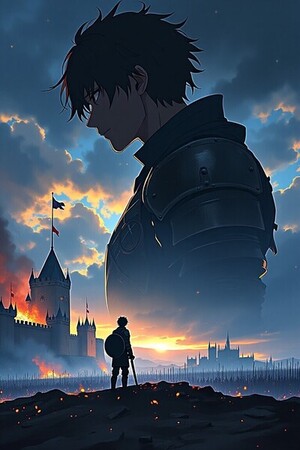
He turned from Elias's body without looking back. The raven scattered with a harsh cry. Bernard walked toward the tree line where survivors were gathering, his stride deliberate, unhurried, the weight of the dead boy pressing down on his shoulders with every step.
He did not weep. That would come later, in the dark hours when memory became cruelty. Now, moving through the wreckage of everything he had built, Sir Bernard felt only the hollowness of a man who had outlived his usefulness, and the cold, familiar resolve of a soldier who had decided to keep living anyway.
***
A hundred yards away, King Varin still knelt in the mud where the battle had left him.
The Black Prince's shadow fell across him.
Varin looked up at his son's face and found no recognition in the eyes behind the visor. Only patience. The patience of a man who has already won.
"Father," the Black Prince said. The word was not a greeting. It was a sentence.
Varin did not reach for his sword. He let his hands fall to his sides, the mud soaking through his robes.
Around them, the battlefield had gone quiet. The Imperial soldiers held their positions, watching. The few Coalition survivors who could still stand did so in stunned silence, their weapons lowered, their eyes fixed on the tableau of father and son. Even the wounded had stopped screaming.
Varin's knees ached from the cold ground. He was sixty-three years old, and he felt every year in his bones. He remembered Kaelen at six, practicing with a wooden sword in the garden, laughing when he knocked Varin's blade aside. He remembered Kaelen at sixteen, sullen and silent after his mother's death, refusing comfort. He remembered Kaelen at thirty, returning from the eastern campaigns with a hardness in his eyes that Varin had chosen not to name.
He had seen this coming. He had simply lacked the courage to stop it.
"Why, my son?" King Varin's voice cracked, hoarse as distant thunder.
"Years of peace. Fifty years of building. And you would trade it all for... what?"
"Fifty years I have waited," the Black Prince answered, each word measured and coldly resonant,
"For what is mine by right."
He leaned low, the blade's tip pressing into the muddied ground.
"After all I've sacrificed for the realm, you refused to relinquish the throne. You refused to die."
A single tear traced a clean line through the grime on Varin's cheek. His shoulders shook-rage or frailty, none could say-but his voice rose in trembling accusation.
"So you betray your kingdom? Your people? And conspire with these foreign vultures?"
"The Empire has promised me the kingdoms of Vaelon and Durrath," the prince replied, tone hollow as an echo.
"Our lands will grow sevenfold."
Varin laughed, a broken sound.
"Sevenfold. You think that's what your mother wanted? Sevenfold graves?"
The Black Prince's jaw tightened, the only crack in his composure.
"My mother died waiting for you to become a king worthy of her."
Behind them, King Boros of Eastmere staggered forward, his crown cracked, crimson seeping between his fingers from a mortal wound.
"You treacherous bastard!" he spat, pressing against the gaping wound in his side.
"I allied with your father. I trusted this coalition. And you repay honor with butchery?"
Without warning, the Black Prince pivoted. His sword whistled like a winter gale before it split Boros from shoulder to hip with ruthless precision. A collective gasp rose among the survivors as the severed crown clattered across the blood-soaked field. Even in war's brutality, to fell a crowned king outside the bounds of honor was sacrilege, and the air trembled with the weight of that ancient taboo.
Boros's body folded like a puppet with cut strings. His eyes, still open, fixed on Varin with an accusation that would outlast them both. The Eastmere king had come in good faith, had brought his armies, had believed in the Coalition's honor. Now he lay in pieces, his kingdom leaderless, his alliance a joke.
Blood still dripping from the blade, the prince turned back to his father.
"All you've ever done is warm that throne and accomplish nothing. History will remember your weakness."
Varin's gaze sharpened at his son, defiance igniting in his fading strength.
"And you will be remembered as the ruler who sold his birthright to foreigners." His voice fell into sudden silence.
There was a flash of steel-sunlight caught the blade as if heaven itself reflected-then the old king's head rolled from his shoulders, coming to rest at the feet of the Black Prince. Even the ravens paused mid-caw, the world hushed in the finality of regicide.
Varin's last thought, as the darkness took him, was not of his lost wife or of Elias or of the throne he had guarded for fifty years. It was of a garden in summer, and a boy with a wooden sword, laughing.




Please sign in to leave a comment.