Chapter 1:
THE BATTLE OF ACHERON
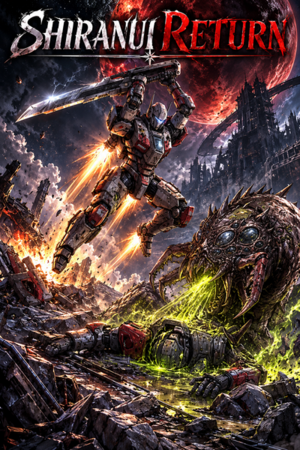
Shiranui Return
The fall of Mars was the event that reshaped humanity's hegemony. Before it, the invasion had seemed distant, concentrated along the orbital routes near Jupiter. Afterward, governments stopped talking about containment and began talking about survival. The Martian colonies had megalopolises, water refineries, greenhouses, space elevators, and a network of tunnels connecting the industrial regions. They were humanity's second home, with nearly 800 million inhabitants when the invasion began.
The insects arrived gradually in swarms, carried by rocky projectiles from the asteroid belt that were, in fact, incubation chambers disguised as meteorites. First came small Chronians, capable of slipping through ducts and contaminating the colonies' cooling systems, spreading biotoxins that killed millions within weeks. Then came the burrowing insects, which attacked the foundations of the protective domes surrounding the colonies' urban centers. By the time Martian Defense sent mechanized reinforcements, the swarms had already learned to evade artillery bombardments. The creatures used silicon carapaces to reflect some of the kinetic energy and secreted fluids that corroded even the heaviest tanks' armor.
The Battle of Valles Marineris lasted eleven days. Humanity defeated the swarm in three offensives, but lost during the fourth incursion because a Leviathan emerged beneath the power station and destroyed the planetary defense system at the main defense base, allowing the swarm to use the connecting tunnels to invade the other facilities. The Leviathans were colossal creatures measuring dozens of meters, some with structures exceeding two hundred meters in length. They had no uniform shape. The first resembled armored worms; others had spear-like appendages, retractable dorsal plates, and incubation cavities. Their bodies functioned as production platforms, capable of releasing smaller units and reorganizing biomass harvested from human bodies.
High Command ordered an evacuation. The withdrawal was chaotic. Transport ships gave priority to technicians, officers, and the families of key personnel. Millions were trapped in underground cities. Subsequent reports called the episode the “operational loss of Mars.” Renji remembered seeing the phrase repeated for years, as if an entire civilization could be reduced to a line on a balance sheet.
Humanity learned two lessons on Mars. The first was technological: weapons had to strike the nervous cores, not merely pierce the carapaces. The second was political: governments were willing to abandon entire regions when they believed the cost of defending them was too high.
From then on, mechs were equipped with seismic sensors, variable-frequency blades, and particle cannons with short-burst discharge modes. Pilots were trained to recognize attack patterns and avoid concentrating their units. The Kaze-Guruma Doctrine emerged in this context, but the hierarchy continued to reward officers who achieved visible results, even when the costs were concealed.
◆
The night before the Acheron operation was marked by a meeting Renji would remember for years. Captain Masaru Takeda gathered the pilots in the briefing module and presented the route as a cleanup operation. The maps showed the crater, the mining tunnels, and the withdrawal corridor. There were three objectives: check the sensors, locate abandoned equipment, and eliminate any isolated Chronian presence. The document classified the risk as moderate.
Hana Sato asked to speak and pointed out that the network of fissures did not match a natural collapse. Masaru replied that the data was outdated and that the team should not confuse caution with hesitation. Morita suggested positioning the medical vehicle behind the ridge. The captain refused, arguing that the transport needed to remain nearby to speed up the evacuation of any recovered equipment.
Renji studied the faces around the table. Naoki looked uneasy; Takeru tried to hide his nervousness; Sato kept her arms crossed. Everyone sensed that something was wrong, but no one wanted to be the first to challenge the commander. Renji could have pressed the point, but he knew Masaru would turn the objection into a test of loyalty.
After the meeting, he found Sato in the corridor.
“Do you think we should go?” she asked.
“I think we should change our formation.”
“That's not what I asked.”
Renji glanced at the evacuation panel.
“If we don't go, another team will be sent with the same data and the same orders.”
Sato rested her head against the wall.
“I wish that were a better answer.”
“So do I.”
In the mess hall, Morita split a protein bar with the Akiyama brothers, Takeru and Naoki. They talked about the families they had left behind on Earth. Naoki wanted to request a transfer to an orbital unit; Takeru said he would rather stay on the Moon, where the creatures were less numerous. Morita offered no advice. He simply reminded them that no one should enter a crater without knowing where the withdrawal route was.
Renji sat with them. He said little, but listened. At the end of the meal, Naoki asked whether the Shiranui was as bad as it looked.
“It's worse,” Renji replied.
The three of them laughed.
“Then why do you still pilot it?” Takeru asked.
“Because I know where it fails.”
That night, Renji reviewed the map and marked three possible emergency points. He had no idea the ambush would be so precise or that the team would be nearly wiped out in four minutes. But he recognized the signs of an operation in which command confused obedience with safety. When he reached the hangar, he found the Shiranui covered in lunar dust. He ran a hand over its side plate and wished the machine could go on one more mission.
◆
Before the radar identified the three amber blips, the patrol had already crossed two hours of dead terrain. The mission had been presented as a simple sweep: confirm the absence of Chronian activity in a decommissioned mining corridor and retrieve any human equipment that could still be salvaged. On the tactical map, Acheron Crater appeared as an unremarkable depression, an impact scar surrounded by low ridges. The intelligence report, however, contained a note in smaller print: “recurring vibration anomalies, origin undetermined.” Renji had read that line three times before boarding. Captain Masaru Takeda had dismissed it as irrelevant.
The patrol consisted of six combat units, two support units, and a medical evacuation vehicle. Along with Renji, there was Lieutenant Hana Sato, a reconnaissance pilot who spoke little and calculated everything; Sergeant Itsuki Morita, who operated the support mech; and the Akiyama brothers, Takeru and Naoki, who piloted light Warden-class units. The team was far from homogeneous. Some had come from the ground forces; others from orbital garrisons. They shared only the same uniform and the certainty that the next call-up might be their last.
Sato piloted a heavily modified Kestrel reconnaissance mech. The machine had external sensors shaped like folding antennae, thinner armor plates, and a set of micro-thrusters that allowed it to make long jumps in low gravity. It did not have the strength to face an Ouroboros head-on, but it could observe the terrain without making the noise of a heavy mech. Morita, on the other hand, operated a Warden support unit equipped with two ammunition modules and a tool arm. It was a slow platform, but indispensable when a teammate lost a joint or a hydraulic line.
“Are you still reading the report?” Sato asked over the private channel.
“I'm looking for the part where they say the mission is simple,” Renji replied.
“It's right after the part where they promise our pay will arrive before the end of the month.”
Morita let out a deep laugh over the general channel.
“If we find an intact mining station, I'm demanding to be paid in real food.”
“There's no such thing as real food on the Moon,” Naoki commented.
“There is. I saw a photograph.”
“It was a potato.”
“A potato is food.”
The joke lasted only a few seconds. The soldiers' humor was a small act of resistance against their environment, a way of remembering that they were still people when the command systems treated them as interchangeable parts. Renji listened to the others talk and checked the sensor readings again. The underground vibration did not follow the pattern of a regolith slide. It was rhythmic, almost regular, as if something enormous were shifting its weight from one body segment to another.
He enlarged the geological map. The crater's northern wall was marked by a chain of recent fissures. The sequence formed an arc around the projected positions of Alpha and Beta. The pattern looked familiar. In earlier reports, the Chronians had used underground structures to drive prey toward areas where the surface would give way easily. It was not a burrow; it was a trap built into the terrain.
“Sato, can you observe the northern flank without crossing the line?” he asked.
“I can, but I'll need to climb another forty meters.”
“Do it. Keep the Kestrel away from the edge.”
The pilot hesitated.
“Did the captain authorize it?”
Renji glanced at Masaru's identifier on the tactical channel. The Atlas-IX icon was advancing at the head of the formation.
“Not yet.”
“So you're asking me to disobey.”
“I'm asking you to take a look.”
Sato remained silent for a few seconds. Then the Kestrel veered a few meters off the main route and began a controlled climb. Renji tracked the change on the map, careful not to turn a precaution into yet another disciplinary problem.
◆
The Moon's silence was not true piece.
Inside the cockpit of the Mk-IV Shiranui, the world reached Renji in fragments: the high-pitched hum of the neural implants behind his ears, the reactor vibrating beneath the floor, the occasional click of relays, and his own breathing, amplified by the helmet. Outside, however, stretched a desert without wind, birds, or a blue horizon. The gray regolith absorbed Earth's slanting light. Earth hung in the black sky like a distant eye that no longer knew how to protect its children.
It was September 17, 2191. Humanity still had flags, governments, and maps, but no longer controlled the planet it lived on. They called that war the Titanomachy—a name drawn from an ancient myth about gods overthrowing other gods. The name sounded far too grand for what was actually happening: cities turned into nests, oceans contaminated by corrosive secretions, and patriotic soldiers sent to die before creatures that could not tell one nation from another.
Renji was twenty-five and held no rank worth remembering. He was a private in the mechanized infantry, assigned to the Kaze-Guruma Doctrine Battalion, and piloted a Shiranui that should have been retired at least two generations earlier. The Mk-IV had been designed for shock operations in low-gravity environments. It stood nearly fourteen meters tall, weighed forty-two tons, and had a humanoid silhouette with broad shoulders, reinforced legs, and a narrow head protected by an angular carapace. In the machine's youth, its titanium-ceramic armor had been considered revolutionary. Now, patched with plates from different sources, it bore weld scars, scraped-off serial numbers, and impact marks that no maintenance report had ever managed to explain.
The diesel-plasma reactor occupied the center of the torso. It powered the hydraulic actuators, dorsal thrusters, and heavy particle cannon mounted on the right forearm. In its left hand, the Shiranui carried a vibration blade: a short sword with a thick spine whose edge oscillated at ultrasonic frequencies. It did more than cut through sharpness; it disrupted the cohesion of materials and tissue along the point of contact. Two vector nozzles on its back allowed for short jumps, course corrections, and movement across uneven terrain. The neural interface system translated muscular impulses into commands, making the pilot feel the machine's weight as an imperfect extension of his own body.
Imperfect was the right word. The Shiranui took a fraction of a second to respond to hip movements and sent a harsh vibration back to the pilot whenever the reactor exceeded seventy percent load. Renji knew every flaw. He knew the right knee locked after three consecutive bursts and that the cannon's thermal sensor lagged by two seconds. He also knew that if the cooling system failed, the metal around the cockpit would become hot enough to cook a man inside his own armor.
Even so, he trusted that piece of scrap more than he trusted many of the officers who commanded it.
The patrol advanced across the Acheron plain in an open formation. Ahead, the craters cast black shadows over the terrain. On Renji's display, the Alpha and Beta units appeared as small blue icons; behind him, two support transports kept their distance, carrying ammunition, repair parts, and a medical team that was already overworked before the operation had even begun.
The first warning appeared as three amber blips on the long-range radar.
Renji slowed down. The Shiranui sank its metal boots into the regolith, kicking up a slow cloud of dust that remained suspended for a few seconds before falling.
“Vanguard, this is Captain Masaru Takeda. Contact confirmed at Acheron Crater,” the commander announced over the tactical channel. His voice had the arrogant clarity of a man who believed the sound of his own authority could take the place of experience. “Three biological signatures in the lower sector. Alpha and Beta, take the northern rim and seal the escape route. Renji's unit will make the initial descent.”
Renji magnified the radar reading. The signatures did not move like isolated animals. They vanished for a few seconds, reappeared somewhere else, and seemed to shift the ground around them.
“Captain, I recommend we halt the approach,” he said. “The mass reading is wrong. The radar shows three targets, but there's underground movement all along the eastern wall. They're Ouroboros.”
There was a brief pause on the channel. Then one of the officers gave a dry laugh.
“You're not in a position to classify targets, soldier,” Masaru replied.
“The thermal signature matches Class V. So does the excavation pattern. If we descend without air cover, they could break through the slope from below and split our units apart.”
“Did you hear an order to analyze the terrain, Renji?” the captain asked. “Your job is to pilot when you're told to pilot.”
“My job as a veteran is to bring the recruits back alive.”
The words escaped before Renji could weigh the consequences. On the general channel, the silence became heavier than the lunar dust.
Masaru was stationed in an Atlas-IX mech, a fifty-eight-ton command platform equipped with reinforced frontal armor and a long-range electromagnetic cannon. It was superior to the Shiranui in almost every respect, but the captain treated the machine as though the chassis's superiority had somehow been transferred to his own judgment. He was in his early forties, with a square face, close-cropped gray hair, and a narrow scar on his chin, earned during an operation he often recounted as if he had won it single-handedly.
“You're confusing courage with competence, soldier,” Masaru said. “The Vanguard does not retreat from alien scum. Frontal encirclement. Now.”
Renji looked at the crater's dark outline. The Shiranui's artificial intelligence suggested an alternate route, marked in red. The risk calculation exceeded the limit permitted by any combat manual. Even so, the captain's order took priority over the machine's warnings.
“Understood,” Renji replied, without conviction.
The mechs descended.
The slope was steep and uneven. The Shiranui braced its weight on magnetic heels and fingertips, using short bursts from its dorsal thrusters to maintain balance. With every step, rocks broke loose and rolled downhill. Renji watched the telemetry of the units following him. The two transports had lost visual contact with the rim. Alpha was too close to the western wall; Beta, acting on Masaru's order, was moving to seal the passage.
It was exactly the position the Ouroboros needed.
The first sign was not a sound but a change in local gravity. The regolith trembled. A line of rocks jumped off the ground. Then the slope split open.
The Ouroboros emerged like an armored tank hurled out of the Moon's entrails. It was more than forty meters long, with a segmented body made up of dark chitin rings reinforced by metallic silicon plates. Each segment joined the next through thick muscular membranes, and lateral spines served as anchors when the creature burrowed. Its head was flattened, with no eyes recognizable at a distance, but three sets of light-sensitive sensors glowed beneath a translucent carapace. Its circular mouth opened in concentric layers of jaws, each lined with teeth that looked like tiny drill bits.
Its tail ended in a curved blade covered by a glassy film. According to the reports, that structure could pierce titanium alloys when the monster built up energy in the muscles of its final segment.
The first Ouroboros was not fleeing. It was waiting.
“Contact! Underground contact!” someone shouted over the channel.
The creature struck the ground with its tail. The seismic wave tore through the crater and hurled two of Alpha's mechs against the rock wall. One broke in half at the waist; the other vanished beneath an avalanche of regolith. Armor fragments, power cables, and jets of frozen hydraulic fluid scattered across the terrain.
Renji shoved the controls to the left. The Shiranui leaped over the wreckage of a unit and fired its particle cannon at the monster's head. The weapon charged with a deep hiss; for an instant, the inside of the cockpit was bathed in blue light. The shot struck the central sensory cavity and blasted a plasma crater into the carapace.
The Ouroboros recoiled. Dark green blood gushed from the wound, evaporating into corrosive bubbles that left whitish marks on the regolith.
“One down!” Renji announced.
“Hold your position!” Masaru ordered. “The others are exposed!”
The response came from beneath the Shiranui itself.
The second Ouroboros burst through the ground beneath its left leg. A scythe-shaped claw seized the machine by the hip and tore away two armor plates. The cockpit lurched. Renji felt the impact in his teeth despite the neural dampers.
“Structural integrity at sixty-three percent,” the synthetic voice reported.
The creature raised its head, opening its jaws. Renji activated the right dorsal thruster, twisted the torso, and drove the vibration blade into the monster's mouth. The oscillating edge cut through the inner plates and severed the muscle bundles that supported the jaws. The Ouroboros thrashed, wrapping its body around the mech's arm.
Renji kept striking. Once. Twice. On the third blow, the blade found the neural control cavity. The monster let out a shriek that cut through the external microphones like a metallic whistle, then collapsed onto its side.
The Shiranui's reactor began flashing red warnings. Its left leg lost power. The weapon arm remained functional, but the side armor had been reduced to a frame of twisted metal.
Only the third remained.
It was the largest of the three, about forty-five meters long, and it advanced without haste. Its dorsal segments were wider, covered in overlapping plates that formed a kind of shell. The creature raised the front half of its body, bracing itself on its lower spines, exposing a throat filled with vibrating membranes. It did not seem to see the battlefield; it seemed to sense it through the vibrations transmitted by the ground.
Masaru's Atlas-IX fired twice. The electromagnetic projectiles struck the shell and ricocheted, carving bright grooves without penetrating the tissue.
“Fall back!” a pilot shouted.
Masaru did not answer. He advanced with the Atlas-IX, determined to prove that brute force could correct the tactical mistake he himself had made.
The Ouroboros lashed its tail. The blow struck the Atlas-IX cockpit head-on and caved in the armor around it. The mech was hurled against the rock, its cannon trapped beneath its own torso. Masaru's transmission dissolved into static and ragged breathing.
Renji watched the commander try to open the emergency hatch. The cockpit was warped, and the pilot could barely move his arms.
For a second, Renji considered leaving him there. The captain had sent him into a suicidal position, ignored every warning, and condemned men who trusted him. Anger surged through him, hot and fierce, but it never became a decision. A soldier could hate his commander; he could not abandon someone who was still alive when he still had the means to reach him.
The Shiranui could barely stand. Renji transferred all remaining power to the thrusters, ignoring the overload warnings. The machine lurched across the crater. The cannon no longer had enough charge to pierce the third Ouroboros's carapace. The blade was all he had left.
“Renji, fall back!” the support operator shouted. “Your reactor is going into thermal runaway!”
He did not answer.
The Shiranui leaped. For an instant, low gravity suspended the machine above the monster. Renji twisted its torso and drove the vibration blade into the thoracic region where two dorsal plates met. The sword shuddered against brutal resistance. The neural system registered the force as though Renji's own arm were being crushed.
He pushed.
The blade pierced the shell and struck a bundle of luminous organs. The Ouroboros convulsed. Its tail lashed in every direction, destroying what remained of two already-damaged mechs. The Shiranui was thrown to the ground, but the blade remained lodged in the creature's body.
Renji triggered the cannon's discharge mechanism. The shot, weak and unstable, traveled along the sword and exploded inside the monster's chest. The Ouroboros's body folded in on itself. A dark, smoking mass seeped from the joints in its carapace, and the colossus toppled with a tremor that shook the entire crater.
The battle ended in less than four minutes.
The silence afterward was worse than the fighting. The radio channels were filled with unanswered calls. The radar showed only four functioning human units, including the Shiranui. Renji tried to locate the Atlas-IX. The system detected Masaru's signal beneath a pile of debris.
“Captain, respond. I'm opening the cockpit.”
The Atlas-IX's hatch was partly open. Masaru was trying to get out when the body of the last Ouroboros underwent a reflexive contraction. Its tail, still taut with residual muscular impulses, rose and swept downward in an arc.
Renji saw the movement before the sensors did. He shoved the Shiranui forward, trying to put its own torso between the blade and the captain.
“Watch out!”
The blow struck the Atlas-IX.
The tail pierced the warped cockpit. The impact pulverized the structure and hurled fragments against the Shiranui's display. Renji saw Masaru's body disappear amid metal and red dust. A shard of armor pierced the front shielding of his own cockpit; its incandescent edge struck his left eye and blacked out the world on that side. The next shock wave tore the pilot's left arm off at the shoulder, along with part of the neural support system.
The pain did not arrive as an isolated sensation. It came as a white blackout, an invasion of noise and heat. The alarms overlapped. Internal pressure plummeted. Blood escaped from the wound and crystallized into tiny scarlet flakes in the cockpit's thin air before the emergency systems sealed the breach.
The last thing Renji heard was his own failing breath.
◆
Acheron was more than just a crater. Geological maps showed layers of compacted regolith, basalt, and old mining galleries. The galleries had been abandoned after the first underground vibrations were recorded. The engineering team had installed sensors along the northern wall, but several had stopped transmitting. The report classified the failure as a loss of power. Renji knew the Chronians could produce structures that interfered with human equipment signals.
When the creatures emerged, he realized the terrain had been altered. The first breach occurred near an old extraction platform; the second, at a point where the rock appeared intact. The ground had not given way by chance. The Ouroboros had dug tunnels that converged on the area where the patrol was supposed to descend. Each creature occupied a position that restricted the mechs' escape routes.
The Shiranui reacted with a delay to the first impact. Renji felt the difference between the movement he had imagined and the one the machine had actually executed. Its right knee locked for a fraction of a second, and the reactor fluctuated. In combat, small delays were not minor defects; they were the distance between life and death. He redistributed the load, reduced power to the right arm, and used the dorsal thruster to compensate for the leg.
The heavy particle cannon needed three cycles to reach maximum power. The weapon gathered charged particles in a magnetic field and released them in a concentrated beam. The shot was effective against sensory cavities but lost energy when passing through thick organic plates. The vibration blade, in turn, required contact and could become trapped in tissue that closed around its edge. Renji knew both limitations. Victory depended on alternating between the weapons, not insisting on using just one.
When the third Ouroboros fell, its tail remained tense from residual impulses. The phenomenon was not uncommon. The Chronians had distributed neural networks; parts of their bodies could continue reacting even after the main core had been destroyed. The medical team had protocols requiring them to keep their distance from carcasses until all movement ceased. Renji knew this and still advanced to save Masaru. The decision was not tactical. It was human.
The subsequent report described the strike as an “unpredictable postmortem movement.” Renji would always remember that the manuals had already anticipated the supposedly unpredictable behavior, and the command team had ignored them. The system had not failed because of a lack of knowledge. It had failed because those in authority had chosen not to listen.
◆
The recovery operation at Acheron began with a headcount no one wanted to make. Medical teams advanced in armored vehicles, accompanied by drones that analyzed the atmosphere and the risk of contamination. The mechs' wreckage was marked with blue beacons. Each cockpit was checked before anyone attempted to open it, because the Chronians could leave active biological filaments in the joints. Protocol required the invaders' bodies to be isolated and incinerated, but the teams did not have enough equipment to collect them all.
Renji never saw the operation. His Shiranui had lost power, and the cockpit had been sealed by the automatic system. When the rescuers found him, he was unconscious, his left arm destroyed and his display fractured. The field doctor reported that the pilot was in shock and had lost a severe amount of blood. He was evacuated in a pressurized capsule connected to the medical vehicle by a safety cable.
Sato remained missing. A team found drag marks near the northern fissure, but there was no blood and no cockpit debris. The case was classified as “missing in action.” Morita insisted that the search continue, but he was ordered to return to base. The crater remained sealed off for weeks.
The casualty review board recorded the operation as a tactical victory because all three Ouroboros had been destroyed. The number of units lost was included in an appendix, and Sato's disappearance appeared in a footnote. Renji did not know this when he woke up. He would discover it later, when he read the report used to justify his transfer.
◆
The mission report did not explain why Masaru had insisted on the descent. Renji remembered the Acheron briefing, but certain details became clear only after the captain's death. The operation had been included in a series of inspections recommended by lunar command. Sensors had recorded similar vibrations in three craters, and the intelligence team had suggested that the Ouroboros might be migrating through an underground network. The patrol was supposed to confirm that theory, not destroy a nest.
Masaru's order had changed the mission. He had chosen to advance directly to the bottom of the crater to ensure that the targets would be seen and destroyed in front of an observer team. A tactical camera had been installed in a support module, and the captain wanted footage demonstrating the Atlas-IX's effectiveness. Renji had not known this during the battle. He would find the reference only in the command evaluation report, attached to a recommendation for a posthumous promotion.
The discovery stayed with him throughout his recovery. The dead pilots had not merely fallen victim to an unknown creature; they had been placed in a vulnerable position to bolster an officer's reputation. High Command turned Masaru's death into an example of bravery and used the recording to justify the frontal-assault doctrine.
Renji kept the information without knowing what to do with it. There was no way to bring the dead back, and an accusation against the captain would not change the outcome. But the memory taught him that war was not made up of monsters alone. It was also made up of men who needed to appear invincible.







Please sign in to leave a comment.