Chapter 2:
WEIGHT OF VICTORY
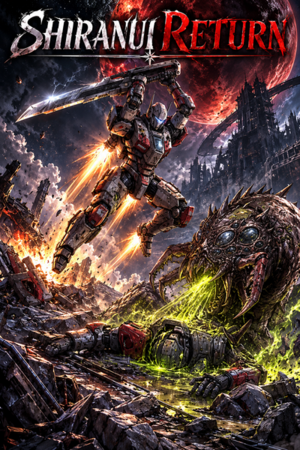
Shiranui Return
He woke up in a military hospital on Selene-Alpha three days later. The white ceiling light seemed to pierce his skull. The left side of his face was covered in bandages, and the space where his arm should have been felt like an absence heavier than any limb.
A doctor informed him that the sight in his left eye could not be restored. His arm had been lost above the elbow, and his neural interface had sustained permanent damage. He also had an injury to the temporal lobe, which caused tremors, memory lapses, and episodes of phantom pain. The prognosis for returning to piloting was, in the doctor's words, “statistically insignificant.”
Renji did not ask how many men had survived. He already knew the answer from the way the doctor avoided looking at him.
The official report called the Acheron operation a “tactical victory with acceptable losses.” Masaru's name was added to the list of officers killed in the line of duty. The decision to attack, the lack of cover, and the ignored warnings disappeared in an administrative review. The Shiranui was classified as a total loss. Renji received a campaign medal, a disability form, and a compulsory transfer.
High Command did not want veterans who remembered the generals' mistakes. It wanted clean numbers.
Without his left arm, partially blind, and suffering neurological aftereffects, Renji was removed from the mechanized infantry. Instead of receiving combat rehabilitation, he was assigned to equipment maintenance at the Selene-Alpha lunar base. His new duties consisted of checking supply reports, cleaning actuators, cataloging parts, and replacing couplings that other soldiers broke more often than they cared to admit.
The base was an underground city embedded in the Moon's near side. Its corridors had curved walls of pale alloy, exposed pipes, and artificial lighting that imitated a day that never truly began. The air smelled of damp filters, industrial oil, and disinfectant. Command, strategy rooms, and officers' quarters occupied the upper sectors. Mechanics, cargo operators, and discharged soldiers lived on the lower levels, where the pressure fluctuated and the elevators broke down.
It was in the lower sector that Renji met Aoi Tachibana.
She was twenty-three, with red hair tied in a practical bun, alert brown eyes, and the hands of someone who could take apart an engine in the dark. She wore the dark blue uniform of lunar engineering, with chief engineer insignia on her collar. Her bearing was firm, almost military, but the grease beneath her fingernails made it clear that she did not delegate the difficult work simply because she could.
Aoi was not tall, but she took up space like someone accustomed to being heard. A small scar near her right eyebrow had been left by a valve explosion in a reactor prototype. Her voice was clear and direct, and her most irritating habit—according to her colleagues—was asking questions whose answers she already knew, just to find out whether someone would lie.
On the first day, she found Renji trying to adjust an actuator fitting with the wrong tool. The temporary prosthesis on his left arm trembled whenever he applied force.
“So you're the soldier from Acheron,” she said without introducing herself. “The man who took down three Ouroboros and came back to base as if he'd broken a teacup.”
Renji did not look up.
“The teacup belonged to the government. Maybe that's why they were concerned.”
Aoi studied the scar running across his cheek and the old bandage over his left eye.
“Do you always answer like that?”
“Only when the question deserves it.”
“Good. Then let's understand each other. I'm Aoi Tachibana, and I'm in charge of this sector. I don't care what High Command wrote in your file. Here, a poorly calibrated part can kill someone. If you intend to work in my shop, you'll learn to tell the difference between a worn-out actuator and one that's about to explode.”
“And what if I don't want to?”
“You'll learn anyway. I'd rather have an irritated employee than a corpse caused by negligence.”
She picked up a pneumatic wrench, dismantled the assembly in a few quick movements, and pointed out the warped component. Renji realized she was not trying to humiliate him. She was assessing whether he could still learn.
That difference was enough to make him step closer to the workbench.
Over the following weeks, Aoi discovered that the disabled soldier had an extraordinary memory for combat systems. Renji could recognize the sound of a faulty valve, calculate piston tolerances without consulting the manual, and identify the source of a vibration by the way it traveled through the chassis. He, in turn, discovered that Aoi was more than a brilliant engineer: she was a professional who knew every employee, hid spare parts for the night shifts, and altered inventory records when the quartermaster cut essential supplies.
Their partnership grew out of small gestures. Aoi left a mug of synthetic coffee beside his terminal. Renji checked the shift logs before she arrived so she would find the faults already marked. When the temporary prosthesis jammed, she pretended she needed to test a calibrator and discreetly adjusted the neural fitting.
Their relationship never became comfortable enough to be given a name. Aoi had a habit of disguising concern as sharp orders; Renji responded with dry humor whenever he realized she was trying to help him. At night, they shared rations in the technicians' mess hall, where the menu changed only when the protein printer managed to produce something that did not taste like rubber.
“You need to eat more,” Aoi said one night, pushing a packet of algae protein toward him. “Tomorrow we're lifting the cooling module in Hangar Four. I'm not carrying that block by myself just because you've decided to live on coffee.”
“I can handle it.”
“This isn't a competition.”
“You turn everything into a competition.”
“Only when the other person insists on losing.”
Renji opened the packet and tasted the mixture. It tasted like wet paper and salt.
“If this is food, humanity has already lost the war.”
Aoi laughed. It was a brief, rare sound that quickly vanished beneath the noise of the fans. Renji realized he had never heard her laugh like that before.
The workshop became the only place on the base where he did not feel disabled. He still had nightmares about Acheron Crater. Sometimes he woke in his quarters with his right hand clenched around a nonexistent control, feeling the vibration blade cut through flesh and metal. Other times, phantom pain in his left arm struck so fiercely that he had to sit on the floor until the tremors passed. Aoi never asked what had happened. She simply left a light on in the corridor and a bottle of water within reach.
Outside that routine, the war continued to spread.
◆
Dr. Ibarra would not let Renji spend the night alone after his first phantom-pain episode. The procedure to adapt him to the temporary prosthesis had triggered a neural discharge that activated damaged fibers. The nonexistent arm seemed to fold against his chest, and the sensation persisted even after the medication took effect. Ibarra adjusted the blocker's settings and explained that the brain needed to relearn how to map the body.
“The prosthesis doesn't just replace the limb,” the doctor said. “It changes the way the nervous system organizes movement.”
“Then teach the system to accept it.”
“It doesn't work that way. The brain isn't a machine you can reboot.”
“And what if I don't accept it?”
Ibarra remained silent for a few seconds.
“You're still you. You just need to learn to live with a change you never chose.”
Renji looked away. The doctor was not trying to comfort him with empty words. Perhaps that was why his answer was harder to hear.
In the following days, Renji began helping other wounded soldiers. A young pilot named Emre had lost part of his leg and was afraid to climb into a cockpit again. A support mechanic had suffered burns on her hands and could no longer hold tools. Renji had no experience guiding rehabilitation, but he knew how a sense of uselessness could destroy someone before the wound had even healed. He sat beside the patients and talked about machines, command's mistakes, and what could still be salvaged.
By the time the officers arrived with the transfer order, he already understood that he was not being removed solely because of his physical limitations. High Command did not want the survivors of Acheron discussing the operation. Each of them would be reassigned to a position where the memory of the battle could be diluted by routine.
Renji kept the Shiranui's nameplate in his inner pocket. The medal remained on the table in his room. He did not take it to the workshop.
◆
The Acheron report was completed before Renji was discharged. The document was forty-two pages long, but only three described the battle. The rest dealt with ammunition consumption, lost units, and component replacement. Captain Masaru Takeda's decision was described as an “aggressive containment maneuver.” Renji's warning appeared in a partial transcript, without the sentence in which he had recommended a retreat.
Morita tried to challenge the minutes. The commission replied that the sergeant had no authority to review the tactical decisions of a dead captain. Sato was still missing. The status of the Akiyama brothers, Takeru and Naoki, had been updated, but none of the survivors' testimonies was attached to the main report.
Renji received a copy only after his transfer. He read the document in the workshop and realized that the official story did not need to lie in every line. It only had to choose what would be recorded. The numbers were correct, but the sequence of events had been arranged to absolve the command.
He kept the copy with the Shiranui's nameplate. He did not plan to use it right away. He knew that one day he would need to prove that the institution had learned to conceal its mistakes even before facing the invasion on a full scale.
◆
The Selene-Alpha hospital smelled of antiseptic, heated plastic, and clean metal. For combat casualties, the corridors were a sequence of doors that opened without a sound, suspended stretchers, and screens that recorded everything: oxygen saturation, neural impulses, temperature, blood pressure, and involuntary responses. The amputee ward occupied a wing apart from the main infirmary. Its windows were fake—light panels simulating an Earth sunrise. Renji discovered that the medical staff kept them at the same brightness throughout the night so patients would not confuse the absence of gravity with the absence of time.
The first month was a succession of procedures: cleaning damaged tissue, rebuilding nerves, adjusting pain medication, and balance tests. Losing an arm was more than losing a hand. The neural connectors had been torn away along with the muscle support, leaving a broken network of impulses. The brain kept sending commands to fingers that no longer existed. Sometimes Renji woke convinced that his left hand was clenched around the Shiranui's control lever. He tried to open his fingers, felt an electric pain shoot through his shoulder, and found only the wrinkled bedsheet.
His monocular vision altered his sense of depth. Screens looked flat, corridors seemed narrower, and nearby objects appeared too late when he turned his head. A therapist taught him exercises to compensate for the loss of his eye: shift his chin, judge distances using lateral reference points, and walk without looking directly at his feet. Renji completed the tasks without complaint, but he hated the way the professionals praised every simple movement.
“Excellent progress,” the physical therapist would say after watching him pick up a glass.
Renji watched the water tremble inside the glass.
“I used to pilot forty tons.”
“And now you're relearning how to coordinate your own body.”
“Feels like a demotion in reverse.”
The man did not smile. He had no obligation to understand.
The first official visit came on the twelfth day. A colonel from the personnel department entered with two aides, all in uniforms without a speck of dust. The colonel sat beside the bed and read the medical file as if the patient were a spreadsheet.
“Private Renji Kurogane. Your conduct at Acheron has been recorded as individual initiative beyond the scope of your orders.”
“The orders led the patrol into an ambush.”
“The report does not support that interpretation.”
“The report wasn't in the crater.”
The younger aide looked up, surprised. The colonel's expression remained unchanged.
“Captain Masaru Takeda died in the line of duty. There is no reason to tarnish his memory.”
“I'm not talking about his memory. I'm talking about the pilots who died.”
“The operation was deemed a partial success. The threat was neutralized.”
“And the survivors?”
“They will be reassigned according to operational needs.”
The colonel handed him a tablet. The document stated that Renji would be removed from the mechanized infantry. His pilot's license was suspended, and a medical review would be conducted in ninety days. There was no provision for combat rehabilitation.
“Is this a discharge?” Renji asked.
“It's a reclassification.”
“Call it something else and it's still a discharge.”
“High Command needs people who can operate without compromising unit safety.”
Renji looked at his shoulder. His skin was still marked by bandages and monitoring wires.
“I protected the captain.”
“And you were recognized for it.”
“He was wrong.”
The colonel closed the tablet.
“Soldier, there are things we don't discuss in an infirmary.”
“That's why the reports come out clean.”
The officer stood. One of the aides left the campaign medal on the table. It was small, round, and polished, with the emblem of the Terran Union engraved in the center. Renji did not touch it.
When the officers left, the room seemed even smaller. The heart monitor maintained a steady rhythm, indifferent to what had been decided. Renji heard two patients talking in the corridor. One had lost his legs in a collision; the other had burns on his face. Both were discussing the possibility of returning to the front lines. He did not have the heart to tell them that command had already answered on their behalf.
The following week, Morita came to visit. The sergeant entered wearing a knee brace and carrying a small box of parts. He had survived the crater, but his Warden had been destroyed and his right arm was temporarily paralyzed. He sat in a chair beside the bed and placed the box on the table.
“I brought you something.”
Renji opened the lid. Inside was a dented nameplate covered in heat marks.
“It belonged to the Shiranui,” Morita said. “It fell off when they pulled the cockpit out. I thought you'd want to keep it.”
Renji ran a finger over the engraving. The serial number was almost illegible.
“Sato?”
Morita took a moment to answer.
“They found her Kestrel near the northern wall. The cockpit was empty. We don't know whether she was dragged underground or managed to eject.”
“And the brothers?”
“Naoki is dead. Takeru is in rehabilitation. He doesn't talk much.”
Renji closed the box.
“Does the report say how many survived?”
“It says four. But it doesn't count the ones they never found.”
Morita remained silent for a while. Then he mentioned that the support unit had been dismantled before it even reached the workshop. The maintenance corporation had salvaged the useful parts and discarded the rest. That was how the system treated a damaged machine, and the men who piloted them ended up receiving the same treatment.
“Do you think you'll be able to pilot again?” the sergeant asked.
“I don't know.”
“If you can, let me know. Someone's going to need a mechanic who doesn't lie about the condition of the machines.”
Renji almost laughed. It was a small promise, but for the first time since Acheron, someone had spoken to him as if a future still existed.
Rehabilitation became routine. He learned to use a temporary prosthesis powered by residual muscle signals. The device was heavy, had only three basic movements, and made a gear-grinding noise whenever his shoulder contracted. It was not suitable for piloting. Even so, Renji trained with it for hours, trying to teach his body to accept an artificial extension. The technician in charge, Dr. Ibarra, explained that a permanent neural interface would require a stable connection to the peripheral nerves.
“Your system was damaged unevenly,” Ibarra said. “We can recover some channels, but the process will be slow.”
“How long?”
“Months. Maybe years.”
“And returning to combat?”
Ibarra took off his reading glasses.
“That's not a medical decision.”
Renji understood the answer. The decision had already been made in another room.
On the night before the transfer, he received a message from the engineering department. The address pointed to the lower block of Selene-Alpha. The notice included a reporting order: “report to the actuator maintenance section at 0700.” The position was temporary, offered no private quarters, and came with no prospect of promotion. The text did not use the word punishment, but Renji recognized the gesture.
He put on the gray coveralls the next morning. The temporary prosthesis was covered by a technical-fabric sleeve, and the Shiranui's nameplate remained tucked into his inner pocket. The elevator descended through several levels, taking him away from the administration's clean corridors. The farther down it went, the hotter and heavier the air became. On the lowest floor, the walls were dark steel, the floor was marked by wheel tracks, and the fans produced a constant rumble.
The sign on the door read: “MAINTENANCE ENGINEERING — SECTION C.” Renji stepped inside, unaware that this corridor would change the course of his life.
◆
The medical board kept Renji under observation for another two weeks before approving his permanent transfer. During that time, he began visiting the workshop during his free hours, first as a visitor and then as an assistant. The place was less quiet than the hospital and, for that reason, easier to bear. Someone was always arguing over a measurement, asking for a tool, or complaining about a part that had arrived out of specification. The noise of the machines gave the day a sense of purpose again.
Aoi set up a workspace near the diagnostic bench. She put an adapted support there for his temporary prosthesis and a box of short-handled tools. Renji noticed that the instruments were organized by size and torque, exactly as she organized her own. He said nothing. If he thanked her out loud, Aoi would pretend the setup had not been made for him.
One afternoon, a mechanic named Jovan arrived with his hand bandaged. A lifting actuator had slipped from its mount and crushed two of his fingers. Aoi examined the injury and ordered him to go to the infirmary. The man tried to argue that the shift was already behind schedule.
“The shift doesn't have fingers,” she replied. “You do. Go.”
After he left, Renji checked the mount. The retaining pin was worn, but the defect had been recorded as operator error. Aoi opened the report and found the signature of a supervisor who had authorized the part's reuse.
“If I challenge this, they'll say I'm making trouble,” she said.
“If you don't, someone else will lose a hand.”
She looked at the form.
“Do you always choose the harder answer?”
“Only when the easy one gets someone hurt.”
Aoi documented the failure, attached the measurements, and suspended the entire batch. The decision delayed maintenance on four mechs but prevented further accidents. That night, she received an administrative reprimand. Renji offered to write the technical assessment. Aoi refused.
“I don't want you carrying all my fights.”
“I'm not carrying them. I'm offering data.”
“That's worse. You make it sound as if there's a difference.”
The argument ended when the ventilation system entered its cleaning cycle. The lights dimmed, the filters began to vibrate, and the workshop filled with the smell of ozone. Aoi stared at the ducts while Renji organized the tools.
“Have you ever thought about what you'd do if you couldn't work with machines anymore?” she asked.
Renji remembered the workshop in Tokyo, the shelter, and the last time he had heard her voice.
“No.”
“Never?”
“I don't have a Plan B.”
Aoi nodded, as if she understood. She did not know that he had already lost Plan A once.
◆
Renji's recovery began to improve when Ibarra replaced the temporary prosthesis with a rehabilitation model that provided limited tactile feedback. The device consisted of a carbon socket, low-power actuators, and three pressure sensors. It could not support a heavy load, but it allowed fine movements. The first exercise was to pick up a small polymer sphere and place it in a holder without dropping it.
Renji failed eleven times. On the twelfth, he crushed the sphere. On the thirteenth, he managed to hold it, but the object trembled between his fingers. The physical therapist recorded the muscular response and asked him to repeat the exercise.
“One more time,” he said.
“I understand the movement already.”
“Understanding it isn't the same as performing it.”
Renji took a deep breath. The artificial arm responded with a delay that seemed to mock him. He tried again. The sphere dropped into the holder without breaking.
The next exercise was to walk along a line marked on the floor, using his monocular vision to adjust his sense of depth. The medical team installed small obstacles and asked him to move around them without touching the handrails. Renji hated every step, but he kept going. He did not want to return to combat out of pride alone. He wanted to prove that he could still decide what to do with his own life.
Ibarra noticed the difference.
“You don't have to beat rehabilitation as if it were a battle.”
“And what if I stop?”
“Then we'll find out what is possible without turning every limitation into a defeat.”
Renji did not answer. He saved the words for later that night, when phantom pain woke him again.
◆
The casualty review board summoned Renji for an interview before closing the Acheron report. The officer in charge asked why he had abandoned his position and advanced against the third Ouroboros. Renji explained that Masaru was trapped in the cockpit and the creature was still active. The officer asked whether he had received orders to rescue the captain.
“No,” Renji replied.
“Then you acted on your own initiative.”
“I acted because he was still alive.”
“That does not answer the operational question.”
Renji looked at the form.
“If the operational question is why I didn't leave a man to die, that's the answer.”
The officer ended the interview without recording the sentence. He asked about the sensor failure, the vehicles' positions, and ammunition consumption. Renji answered everything, but realized the board had already reached its conclusion. The operation would be classified as a success, and the command failures would be presented as unavoidable circumstances.
When he left, he found Morita in the corridor. The sergeant said he had also been interviewed, and that his answers had been summarized differently. They both understood that the report would not reconstruct the battle. It would be a justification for keeping authority untarnished.
◆
The first rehabilitation session took place before dawn, in a narrow hospital room whose windows simulated the light of an Earth morning. Dr. Ibarra disliked beginning treatment with promises. He preferred to show patients what they could still do and measure what they would need to relearn.
Renji sat in a support chair, his left shoulder secured to a stabilizing frame. The temporary prosthesis ended in a set of articulated fingers, but their response was slow and irregular. Each command passed through the neural interface, through a translation module, and into the arm's motors with a delay that varied according to fatigue.
“Close your hand,” Ibarra said.
Renji obeyed. The mechanical index finger moved first, followed by the middle and ring fingers. The thumb remained still.
“Again.”
“I understand already.”
“No. You understand the movement. You still don't understand the difference between commanding the prosthesis and fighting against it.”
Renji exhaled through his nose. He tried again. His fingers closed, but the palm struck his exercise glove with excessive force.
“Too much force,” the doctor observed.
“The machine isn't responding.”
“It is responding. You're sending impulses as if you still had your whole arm. The interface has to learn to recognize what remains of your signals, and you have to learn not to turn every failure into an order to push harder.”
Ibarra placed a small polymer sphere on the table. It was just over an inch across, with a smooth surface and almost no weight.
“Pick it up without crushing it.”
Renji tried. The first time, his fingers did not close enough, and the sphere slipped away. The second time, his thumb squeezed too hard and launched the object against the padded wall. On the third attempt, the mechanical hand managed to hold it, but the arm trembled so much that the sphere fell before he could lift it.
“This is ridiculous,” Renji said.
“It's difficult. Don't confuse the two.”
The doctor picked up the sphere and returned it to the table. Then he opened a file containing the combat data from Acheron. The external camera showed the Shiranui staggering across the crater, its frontal armor torn open and its left arm reduced to twisted cables.
“You kept piloting after the first loss of pressure,” Ibarra said. “Your nervous system was exposed to a sequence of shocks. The report mentions overload, but it doesn't describe what happened to your motor perception. I need to know whether you can still feel the commands to the arm you lost.”
Renji looked at the image. In the recording, the mech moved like a wounded animal.
“Sometimes I feel my fingers closing. Other times, it feels as if someone is pulling my elbow. There's nothing there, but the pain is real.”
“Phantom pain. The brain retains old maps of the body. The prosthesis may help reorganize those maps, but it won't erase the memory of the accident.”
“So I'll keep missing something that doesn't exist.”
“Maybe. But that doesn't mean you have to obey the pain.”
The comment irritated Renji more than it should have. He turned his eyes to the terminal, where the list of rescued pilots was open. Several names appeared in gray, accompanied by times and identification codes. Morita's name remained beside a note: “transferred for stabilization surgery.”
“Did he survive?” he asked.
Ibarra did not answer immediately.
“The sergeant lost part of his right leg. He's conscious. I don't know when he'll be able to walk without support.”
Renji nodded. The news was not a victory, but it was better than total absence. He remembered Morita's radio failing during the descent, the sergeant's insistence on keeping the channels open, and the way he had tried to organize the pilots after the first attack.
“Can I see him?”
“After the session.”
The second part of the treatment involved walking down a corridor with illuminated markers on the floor. His monocular vision altered his sense of distance; the balance system corrected each sudden movement too late. Renji moved slowly, keeping his right hand on the railing. Halfway down the corridor, he lost his alignment and touched the wall with his shoulder.
“Stop,” Ibarra ordered.
“I can finish.”
“I'm not asking whether you can. I'm telling you the exercise is over.”
Renji turned, furious. The doctor did not back away. He had seen soldiers far stronger than Renji destroy their own bodies trying to prove they were still invulnerable.
“You won't be returning to the infantry in this condition,” Ibarra said. “We still don't know whether you'll recover enough to pilot. You need to accept that possibility.”
“High Command has already accepted it for me.”
“High Command isn't in this room.”
Renji fell silent. For the first time, he realized that the doctor was not trying to convince him to give up. He was trying to stop him from turning rehabilitation into another battle against an imaginary authority.
When the session ended, Ibarra handed him the polymer sphere. Not as a reward, but as an exercise for the rest of the day.
“Five minutes at a time. Don't force the joint.”
Renji slipped the object into his shirt pocket.
“And if I succeed?”
“Tomorrow I'll make it harder.”
“That's all?”
“That's how you rebuild something. One movement at a time.”
That night, Renji repeated the exercise in his quarters. The sphere fell several times, but he did not throw it against the wall. When he managed to keep it between his fingers for ten seconds, he felt no pride. He simply felt that there was a task in front of him and that, for the first time since Acheron, the task did not involve killing anything.



Please sign in to leave a comment.