Chapter 4:
RUIN
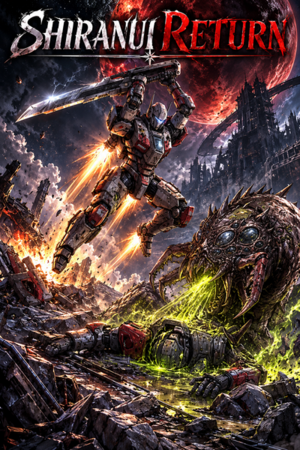
Shiranui Return
The transport that carried them to Earth had no windows for passengers. It was a pressurized cargo ship, adapted with rows of seats and restraint nets. The hull vibrated during descent, and the recycled air left a dry taste in their throats. The discharged employees traveled with a small suitcase and whatever work files the administration considered useful. Some brought photographs, clothes, and family keepsakes. Others carried only tools.
Aoi sat near the emergency hatch, her tablet on her lap. Renji sat beside her, watching the status lights change from green to amber. Neither spoke during the first hour. Earth appeared on the central monitor as a stained sphere covered by ash clouds and chemical storms. The blue of the oceans had almost vanished. The polar regions gleamed with reflections from contaminated ice, and large dark patches marked the old industrial centers.
“It's strange,” Aoi said. “I spent my childhood seeing photographs of this planet as if it were a perfect place.”
“It was never perfect.”
“No. But it seemed possible to fix it.”
Renji looked at the map of Tokyo, their transfer destination. The city was one of the last centers of engineering on Earth. Its outer walls protected underground workshops, civilian shelters, and anti-aircraft platforms. The metropolis housed thousands of refugees from other islands in the archipelago and the coastal regions of continental Asia, but evacuation transports to the Moon were reserved for essential personnel and the families of command officers.
From above, Tokyo could still be recognized by the shape of the bay, although its waters had darkened under Chronian contamination. The towers of Shinjuku rose like broken pillars behind anti-aircraft barriers; the old Shuto Expressway had been converted into an elevated military corridor, while sections of the Yamanote Line and subway tunnels served as evacuation routes and shelters. In Odaiba, makeshift seawalls struggled to hold back the acidic tides. The partially damaged Tokyo Skytree remained visible between clouds of ash, used by defenders as a point of reference when navigation systems failed.
Their arrival was marked by a series of instructions. Passengers had to wear filter masks until they entered the pressurized sector. The spaceport was crowded with lines of military personnel, civilians, and displaced workers. On a distant platform, an evacuation ship waited for clearance to take off. The gate was guarded by armed soldiers, and dozens of people held documents against the glass.
A girl of about eight was crying near a column. Her father was trying to explain that their family was not on the list. Aoi approached, crouched down, and asked whether she wanted some water. The child accepted the canteen with both hands.
“Are they going to let them board?” Renji asked when Aoi returned.
“I don't know.”
“The transport is almost full.”
“I know.”
Her answer came out quietly. Aoi did not look at him.
The Earthside workshop was located beneath an old Yamanote Line station, on the edge of the Shinjuku sector. The complex had been reinforced with airtight doors, independent generators, and a ventilation network capable of isolating contaminated air. The walls showed signs of seepage, and cooling pipes crisscrossed the ceiling. There were rescue mechs, patrol drones, and combat platforms from different generations. Some machines had been built for military operations; others had been converted from industrial vehicles. The rescue units used telescoping arms, winches, and heat sensors to find people beneath the rubble.
Aoi took over technical supervision. Renji was assigned to maintenance and diagnostics. The workshop had fewer resources than Selene-Alpha, but it offered an unexpected freedom: mechanics could modify equipment without waiting weeks for central authorization, as long as they recorded every change. The work was difficult, but tangible. A repaired actuator could lift a shelter door. A calibrated sensor could find a child beneath a wall.
It was in this environment that Aoi began rebuilding the Shiranui. The project required patience and parts that should not have been available. She recovered a frame from the old fleet, replaced the hip joints, reinforced the torso with titanium-ceramic plates, and adapted the cooling system to handle the particle cannon. The dorsal thrusters received new vector nozzles taken from two transport drones. The left arm was designed from scratch to connect to Renji's neural interface.
The prosthesis was not a simple replacement. The socket had to distribute force without transmitting the full impact to the damaged nerves. Aoi created a support ring that attached to the clavicle and upper chest, with six neural connectors and a limited tactile feedback system. The outer shell was matte dark gray, with compact joints. The fingers had three segments and micro-actuators capable of controlling pressure precisely enough to hold a delicate tool or close into a fist around a mech's control lever.
Work continued at night, after the shift. Aoi said she was only using discarded materials, but the consumption records showed that she was diverting components from newer projects. Renji did not confront her. He knew that if he asked, she would invent a technical justification.
On the night before the test, a pressure alarm interrupted the workshop. One of the eastern sector's bulkheads had lost synchronization. Renji followed Aoi to the control room and watched the engineer take over the operation manually. The problem was resolved in four minutes, but the report stated that the failure could have caused an entire corridor to decompress.
“You should sleep,” Renji said when they returned to the hangar.
“So should you.”
“I'm not rebuilding a mech.”
“No. You're just trying to convince your own mind that the arm you lost isn't going to come back.”
Renji froze.
Aoi set the tool down on the workbench.
“I'm not saying that to hurt you.”
“I know.”
“Sometimes you look at the empty sleeve as if you're waiting for it to move.”
He lowered his eyes. The temporary prosthesis lay on the table. It seemed too small for what it was supposed to do.
“I don't miss the metal,” he said. “I miss not having to think about every movement.”
Aoi stepped closer to the neural assembly.
“That's why I made the system respond to residual muscle signals instead of relying only on direct commands. The arm has to learn from you, not the other way around.”
She showed him the three-dimensional model of the connectors on the monitor. The response curve was smoother than that of the military prototypes. There were small compensations for tremors, signal delay, and loss of sensitivity.
“It won't be perfect,” she continued. “But you'll be able to hold a tool without crushing it. You'll be able to pilot if the synchronization works.”
“And you?”
“I'll be in the control room.”
“That's not what I asked.”
Aoi looked away.
“I'll be wherever I'm needed.”
Renji did not press her. The next day, the prosthesis was installed. The first contact produced a sequence of pulses that traveled through his shoulder and down to his fingers. The sensation was strange, a mixture of pressure, heat, and vibration. He slowly closed his hand. The index finger lagged. The thumb responded too early.
“Don't force it,” Aoi ordered.
“I'm trying to feel it.”
“You don't have to feel everything right now. You need to learn to trust the feedback.”
Renji opened his hand again. The system adjusted its position. A small green bar appeared on the display.
“Primary calibration complete.”
He touched the workbench with his fingertips. He felt a faint touch, almost symbolic.
“It works.”
Aoi folded her arms.
“I told you it would.”
“You also said you hadn't spent nights here.”
“That has nothing to do with engineering.”
Renji smiled. She turned her face away to hide her own smile.
◆
Tokyo had ceased to be a city of neighborhoods and had become a sequence of defense zones. Each sector had an officer in charge, a main shelter, and an evacuation route. The old street names remained on the maps, but residents used codes: North-3, East-2, Central Ring, and so on. Buildings near the walls were reinforced with metal structures, while those farther away housed hospitals, workshops, and water depots. The city survived through redundancy. If one generator failed, another took over. If a bulkhead jammed, a manual team tried to close it. If communications went down, messengers traveled through the tunnels.
The problem was that the Chronians attacked those very redundancies. The drones cut external cables; the rams breached doors; the Ouroboros burrowed beneath foundations. Human defenders built one line only to discover that the enemy was already behind it. Civil defense tried to protect the people, while the military command prioritized communications centers and artillery platforms.
Aoi knew the city through its maintenance maps. She knew which shelters had old filters, which elevators needed repairs, and which bulkheads could be closed manually. The eastern shelter was considered safe, but its automatic lock had been failing since the last ash storm. She had requested repairs twice. Both requests had been postponed because of a shortage of parts.
When the alarms sounded, the engineer did not think about heroism. She thought about the closing cycle, the pressure in the corridor, and the time needed to get the children to the inner chamber. Only afterward did she realize that the technical decision would place her directly in the enemy path.
◆
Before the eastern shelter opened, Tokyo's civil defense had organized evacuation corridors by sector. People received wristbands with identification codes, and medical teams distributed respiratory filters with limited service lives. The shelter had three levels: an armored entrance, a decontamination corridor, and a main occupancy chamber. The main bulkhead was too heavy for one person to move, but it had an emergency manual lever.
Aoi had been assigned to supervise the lock because she knew the hydraulic system. She knew the mechanism had been unstable since a pressure failure the previous week. A repair request had been submitted, but the defense platforms had been given priority. When the first civilians arrived, Aoi decided to stay at the site to make sure the entrance could be sealed.
The technicians working with her were young and had no combat training. One of them, Keisuke, tried to reassure the children while checking the oxygen level. Another, Rina, organized the elderly into groups to keep them from blocking the passage. Aoi gave clear instructions: no one was to remain near the track once the bulkhead began to descend.
When the invasion alert came in, the shelter received hundreds of people within minutes. The pressure rose, the corridor became crowded, and the automatic system stopped responding. Aoi opened the manual panel and found the main cable severed. She could have abandoned the lock and tried to escape, but she knew the children would not have enough time to reach the second chamber if the entrance remained open.
Renji heard her voice over the radio and ran toward the shelter. The distance between the hangar and the plaza seemed greater than it had on the map. The streets were blocked by vehicles, drones were falling out of the sky, and anti-aircraft guns fired without coordination. The Shiranui moved through the wreckage, using its shoulder to push aside an overturned ambulance. The combat clock showed only a few minutes, but every second seemed long enough to hold an entire lifetime.
When the Juggernaut struck the structure, the bulkhead was not fully closed. Aoi held the lever down until the very last moment. The shelter withstood the impact, but the corridor ceiling collapsed. Her choice saved the people behind the door, though it cost her own life.
◆
The workshop's routine became more intense after the technicians received an order to prepare the civilian evacuation equipment. The rescue mechs needed winches, heat sensors, and telescoping arms capable of supporting unstable structures. Aoi assigned tasks but continued working at the main bench. Renji took charge of the pressure valves and the actuators' feedback modules.
The first prototype failed during a load test. The telescoping arm lifted a concrete slab, but the elbow joint lost pressure and let the structure fall. Aoi stopped the test before the arm could hit a technician. Renji found a microscopic crack in the valve body, probably caused by a low-quality alloy.
“The supplier guaranteed that the part could handle twice the load,” Aoi said.
“The part didn't read the contract.”
She shot him an irritated look but ended up smiling.
The two of them dismantled the assembly and fabricated a temporary seal. It was not an elegant solution, but it allowed them to complete the tests. Aoi recorded the modification and asked the team to manufacture a new part before putting the unit into service.
That afternoon, a child arrived at the workshop accompanied by a shelter worker. He had found a small maintenance drone in the rubble and wanted to know whether it could be repaired. Aoi examined the device, found that its motor still worked, and handed the boy a tool so he could remove the casing. Renji watched the scene. It was the first time he had seen Aoi teach someone without expecting any professional result.
“Don't tighten it too much,” she said. “The part may be small, but it has a job to do.”
Renji recognized the sentence she would later use when talking about the prosthesis.
◆
The first invasion alarm began less than ten minutes later. The entire city shook. The northern sector's sensor network lost contact with the outer bulkheads. The defense system detected flying organisms, rams, and a large mass advancing down the avenue. The alert confirmed the worst: the containment line had been breached.
Aoi received the first emergency message from the eastern shelter. The automatic lock had lost power, and the bulkhead had to be closed manually. Children, elderly people, and entire families were in the lower corridor. The local security team was trying to keep the entrance clear, but the drones were already crossing the streets.
Renji ran to the Shiranui. Aoi followed him.
“You just tested the arm.”
“And the machine is ready.”
“It's not ready to face a horde.”
“No machine is.”
She took hold of the mechanical arm. The neural connection transmitted a small pressure pulse, as if the system recognized her touch.
“Promise me you won't try to win this entire battle by yourself.”
“I'll clear the way.”
“That's not a promise.”
“It's what I can promise.”
Aoi released his hand. Renji climbed into the cockpit, connected the interface cables, and waited for synchronization. The Shiranui identified the prosthesis, adjusted the controls, and began ignition. The diesel-plasma reactor awakened with a deep growl. The display opened a layer of data over the city, showing targets, evacuation routes, and areas at risk of collapse.
“Neural synchronization unstable,” the machine warned.
“Compensate through the auxiliary channel.”
“Compensation may cause neuromuscular fatigue.”
“Do it.”
The engine spooled up. The hangar doors opened. The ash-covered Tokyo sky appeared before the display. Sirens mingled with the distant thunder of cannons. Renji moved out, knowing the war had finally reached the city that was still trying to pretend it was normal.
◆
The central plaza was a corridor of smoke between destroyed buildings. The outer walls had been breached, and the drones were pouring through the gap in swarms. They were flying insectoids with a wingspan of about one meter, membranous wings reinforced by silicon filaments, and a segmented abdomen pulsing with bluish light. Their triangular heads had thin mandibles designed to pierce pressure suits and harvest living tissue. Small lateral sensors tracked heat sources, while their distributed nervous systems allowed them to change direction in midair without losing stability.
When they dove, they released retractable stingers loaded with corrosive enzymes. A single drone could pierce the visor of an unprotected soldier. In groups, they could blind sensors, sever cables, and guide larger creatures toward breaches in the walls.
The Shiranui left the hangar and fired at the first formation. The particle cannon cut a blue swath through the smoke, striking three drones in succession. Their bodies burst in midair and fell like incandescent fragments. Renji advanced, feeling the gyroscopes correct the machine's weight with every step.
“Renji, can you hear me?” Aoi's voice came through the portable radio. In the background, children were crying and a door was being pounded. “The eastern access point is two blocks away. The manual mechanism is jammed.”
“I'm on my way.”
“There's movement on the northern avenue. It's not just drones.”
“How many?”
“My sensor has lost the reading. Renji...”
The transmission broke off for a moment.
He saw the first ram emerge between the overturned buses. It was a low, broad creature with four forelimbs transformed into muscular columns and a wedge-shaped frontal carapace. It was just over eight meters long. Its skull was protected by a silicon plate that heated with every impact; the organism used its own mass as a projectile, charging into doors and barriers until they broke.
Renji fired at its left knee. The ram lost its balance but did not stop. The Shiranui veered to the side and drove the vibration blade into the joint between the carapace and the neck. The edge cut through the tissue, and the creature fell onto its side, dragging a line of cars with it.
Two more drones dove at the cockpit. Renji sealed the display armor and crushed them against the mech's shoulder guard.
“The entrance is in sight,” Aoi said. “But we have a problem.”
The sound that followed did not seem to belong to the city. It was a deep, heavy roar, too powerful to have come from a throat. The remaining windows vibrated. The smoke parted, as though something enormous were pushing the air ahead of it.
The creature emerged from the flames of a ruined boulevard, charging furiously at anything it considered valuable to the enemy.
In Tokyo's central plaza, the defenders realized that the outer wall had not been breached at a single point. The Chronians had attacked three sectors at once, forcing the guns to divide their ammunition. The drones used the ash clouds as cover, while the rams advanced against the service bulkheads. The civil defense team tried to keep the evacuation corridors open, but every explosion changed the pressure in the tunnels.
The local command transmitted a retreat order to the light mechs. The rescue unit protecting a civilian bus received authorization to abandon the vehicle, but its pilot refused because people were still trapped inside. Renji saw the signal on his radar and changed course. The Shiranui moved between two buildings, using the side of its torso to push aside a block of concrete blocking the street. The mech did not have enough power to support the structure, but it managed to open enough space for the rescue vehicle's winch.
One of the civilians, an elderly man, emerged carrying a child in his arms. The medical vehicle's pilot tried to take them to the nearest shelter. Renji continued forward, not knowing whether he would have time to return. Aoi's channel indicated that the eastern entrance was still open and that the manual lock had to be closed.
The city was not merely under attack. It was being dismantled: power, ventilation, communications, and transportation. The Juggernaut would not need to destroy every building. It only had to strike the structure that kept the defense system running.
It had four legs, stood forty-two meters tall, and possessed a biomechanical structure resembling a living fortress. Its back was protected by overlapping plates of organic titanium, so thick they looked like blocks of armor welded together. Between the plates, copper-colored muscle fibers pulsed like power cables. Its head hung low, protected by a crown of spines; six red eyes were arranged in two levels, each with chitin lenses that contracted independently. Its jaws were broad enough to crush concrete, and viscous acid dripped from them, steaming when it touched the asphalt.
It was an Omega-class Juggernaut.
The combat records of the Stellar Vanguard listed only two encounters with that class, both of which had occurred during the fall of the Martian colonies. Both ended with the complete loss of the defense units before the civilian population was massacred. The organism was not simply an armored animal. Its thorax contained pressure chambers that accumulated chemical energy, and its forelimbs had joints capable of channeling the impact of its entire body into a single point. Its dorsal plates deflected conventional ammunition; its distributed sensory network identified sources of heat, vibration, and electromagnetic emissions.
The Juggernaut looked toward the eastern shelter.
Not at the mechs firing at it. Not at the soldiers shouting in the avenue. At the underground entrance where Aoi was trying to lower the bulkhead manually.
“It's following the heat from the shelter,” Renji said.
“The children are inside,” Aoi replied. Her voice grew quieter. “The lock hasn't completed its cycle.”
The Juggernaut advanced.
Renji activated the dorsal thruster and ran. The Shiranui fired its cannon at the creature's chest. The first discharge opened a smoking mark; the second struck the same area, but the organic armor contracted and closed part of the wound.
The monster turned its head. One eye tracked Renji; the others remained fixed on the shelter.
“Turn around and face me!” the pilot shouted.
The Juggernaut answered with a charge.
The collision hurled the Shiranui against the facade of a building. The cockpit shook. The mech's right arm was caught between the creature's jaws and torn away along with the cannon. The structural integrity alarm began flashing. Renji felt the impact through the prosthesis and nearly lost the neural connection.
He released the controls of the destroyed arm, transferred power to the legs, and rolled the torso to evade the second blow. The Juggernaut's claw tore through the sidewalk where the cockpit had been a moment earlier. Renji fired the thrusters at close range, reached the monster's side, and buried the vibration blade in a rear joint.
The cut opened a gap between the plates. The Juggernaut roared and staggered. Renji seized the opportunity to fire the cannon's emergency mechanism, which still held a residual charge. The system released plasma directly into the wound. The heat burned through the internal tissues and lit the creature from within.
The colossus dropped to its knees. The impact cracked the asphalt. It still tried to raise its head, but its hind legs gave way. A final convulsion ran along its back, and the body collapsed beside the plaza, crushing the remains of an armored vehicle.
Renji opened the hatch manually and fell into the street. The air was thick with smoke, concrete dust, and the smell of ozone. His left prosthesis was trembling; his right shoulder ached beneath the pressure of the connectors. He ran toward the shelter.
The steel door was twisted out of shape. The upper section had been crushed by the Juggernaut's claw; the frame leaned inward, blocking half the entrance. Renji braced his mechanical hand against the metal and tried to lift it.
“Aoi!”
There was no answer.
He forced the door. The metal groaned but did not give. Through a narrow opening, he could see the children gathered in the inner corridor, protected by two technicians. A little girl held a cloth toy against her chest. Her eyes were wide, but she was no longer crying.
Then Renji saw Aoi.
She lay beside the threshold, between the entrance and the children. The bulkhead had collapsed on top of her when the Juggernaut struck the structure. Her lower body remained trapped beneath the twisted plate. Her blue uniform was torn and covered in dust; one hand still gripped the lock's mechanical lever. The other reached toward the corridor, as if she had tried to keep the children behind her until the very last moment.
Aoi's expression was strangely peaceful. There was blood at the corner of her mouth and a dark stain on her collar, but her half-closed eyes seemed to follow the children as they made their way out. She had died protecting the door.
Renji stopped breathing.
The world did not go dark all at once. First, the sound disappeared. Then distance vanished. The alarms, gunfire, and screams grew so distant that they seemed to belong to another city. He fell to his knees and shoved his hands beneath the plate, trying to lift the metal.
“Aoi. Aoi, look at me.”
Her body did not move.
He tried again, using the mechanical arm and his intact shoulder. The metal would not budge. The prosthesis snapped; one of its fingers broke. Renji did not even notice.
“You said you'd charge me for the maintenance,” he murmured. “I haven't even tested the cannon properly yet. You have to get up.”
The children began crying again. One of the technicians tried to approach, but Renji raised his head with a look that made him stop.
“She saved you,” the man said, his voice breaking.
Renji looked at Aoi. The lever was still caught in her hand. Even after being wounded, she had completed the bulkhead's manual closing cycle and kept the passage blocked long enough to prevent the Juggernaut from reaching the corridor.
She had done it.
And she would never know.
Renji pulled her body close, unable to gauge how tightly he was holding her. Her uniform became stained with blood. He tried to warm her fingers between his hands, as if the contact could undo the cold that was spreading through them.
“The children are alive,” he whispered. “You did it, Aoi. Do you hear me? You did it.”
There was no answer.
A light cut through the black clouds.
Renji lifted his face. Above the atmosphere, a Terran fleet cruiser was losing altitude, its hull torn open and its engines burning. The ship was large enough to cover the sky above the city; sections of its structure broke away in incandescent chunks, leaving plasma trails that illuminated the clouds. The orbital defense system tried to divert it, but its trajectory was already pointed at the center of Tokyo.
Over the radio, a voice repeated the impact warning. Someone mentioned a loss of propulsion control. Another transmission called for an immediate evacuation. There was nowhere to go.
Renji looked back at Aoi. The anger he had felt toward High Command, the Chronians, and himself dissolved into a sadness so deep it barely seemed like a human emotion.
The ship fell.
The flash covered the plaza, swallowed the ruins, and pierced the Shiranui's armor. Renji held Aoi with what little strength he had left and, in the final instant, thought that perhaps death was simply the cruelest way to go home.


Please sign in to leave a comment.