Chapter 3:
THE ENGINEER OF SELENE
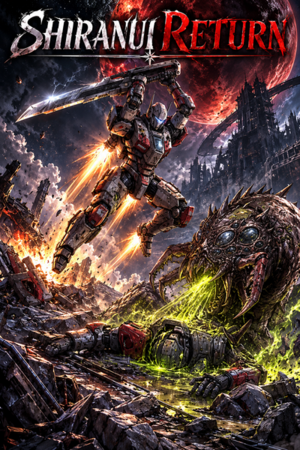
Shiranui Return
The first official records that would later be associated with the invasion dated back to March 2184, when automated probes sent to study gravitational anomalies near Jupiter detected a region of space where light seemed to bend inward. Scientists gave the structure the codename Abyss. At the time, however, there was no proof of a passage, extraterrestrial life, or any intelligent intent. The probes recorded only contradictory gravitational readings and instrument failures that could not be reproduced in a laboratory.
For five years, governments debated whether the phenomenon was a threat, a scientific opportunity, or a measurement error. No communication was established, and no sample of biological origin was recovered. In 2189, the Abyss opened.
First contact did not come in the form of a fleet of ships, but as a rain of organisms. Creatures the size of fighter craft crossed space like seeds carried by an invisible current. Then came the Titans of Titanium and Silicon, colossi that seemed to combine deep-sea animals with war machines. Mars was the first world lost. The colony's underground cities held out for nineteen days; after that, the tunnels became incubation corridors.
Humanity called the invaders insects because it needed a simple word for the horror. Researchers later adopted the term “Chronians” for the organisms that emerged from the anomaly after 2189. The military classification was more practical: drones for the aerial units, burrowers for the underground organisms, rams for wall-breaking units, Ouroboros for the armored worms, and Juggernauts for the quadrupedal siege platforms. Above them all were the Leviathans, gigantic organisms capable of altering the environment around their own bodies.
They were not insects in the biological sense used on Earth. The resemblance came from their segmented exoskeletons, functional specialization, and collective organization. Their bodies combined living tissue, conductive fibers, and mineral silicon plates. Their blood carried acidic compounds and metallic particles. Instead of a central brain, many species had distributed ganglion networks linked by bioelectric pulses. Killing an organism's head did not guarantee its death: certain segments continued attacking reflexively for minutes.
After the invasion, scholars began to suspect that the Abyss was not merely a passage, but a transit region between realities. That hypothesis emerged only after the first organisms crossed the anomaly; in 2184, there was not enough evidence to formulate it. The Chronians did not seem like ordinary colonizers. They adapted to their environment, reorganized their own matter, and turned everything they touched into a resource for their ecology.
In 2191, the Moon was still considered a defensible position. Its underground complexes housed helium-3 factories, arsenals, and orbital shipyards. Earth, meanwhile, was losing territory every month. The oceans were accumulating alien compounds, the forests were being covered by parasitic alien flora, and cities survived behind walls and energy containment barriers. To High Command, holding the Moon meant preserving humanity's last vital line.
But building a massive lunar base consumed too many resources.
◆
The Selene-Alpha workshop operated in three shifts and had more damaged machines than available technicians. The benches were organized by equipment type: hip actuators, plasma valves, hydraulic pumps, neural cables, cooling modules, and propulsion assemblies. Each section had a wall displaying a list of recurring failures. The manufacturers' names had been covered with labels because the parts came from different batches and were rarely compatible with one another.
Aoi Tachibana managed that chaos with a discipline that seemed impossible. She was twenty-three, of average height, with red hair tied in a high bun and brown eyes that examined every detail of a machine before accepting any diagnosis. The scar near her right eyebrow was thin and pale, but it made her furrow her brow in a way many people mistook for irritation. She wore safety boots, pants with wide pockets, and the dark blue engineering jacket, almost always unzipped because the heat in the sector was unbearable.
Her authority came from more than her title. Aoi knew how every production line worked, which technicians had steady hands and which ones cut corners to finish their shifts, and could calculate an actuator's limits without consulting the manual. When a piece of equipment failed, she did not ask who was responsible before finding out why the machine had failed. That attitude had earned her both respect and enemies.
Renji's first job was to sort valves that could be salvaged. He performed the task in silence, comparing codes and checking internal wear. Aoi walked past his bench, studied the pile he had set aside, and picked up a component marked for disposal.
“Why did you put this one here?”
“The rated pressure is within limits, but the return is irregular.”
“The manual says it can be refurbished.”
“The manual doesn't record the vibration after the third cycle.”
She fitted the valve into a test rig. The equipment shook and made a metallic noise on the third activation.
Aoi shut the system down.
“How did you notice?”
“The sound changes before the pressure drops.”
“Do you have perfect pitch?”
“No. I've just spent too much time inside faulty machines.”
She examined the part again and made a note.
“Then you'll work with me.”
The partnership did not begin with affection. Aoi disliked having to depend on someone she had not chosen, and Renji had no interest in being treated as a rehabilitation project. During the first few days, they spoke only about tools, tolerances, and reports. She corrected the movements of his temporary prosthesis; he pointed out problems with equipment that others failed to notice. Gradually, they discovered that they thought in similar ways: they distrusted solutions that were too elegant and preferred a simple machine that worked to a brilliant prototype that failed under pressure.
Section C received a batch of actuators imported from a factory on Earth. The parts had been designed for the Atlas-IX model but were to be adapted for maintenance mechs. Aoi noticed that the supplier had changed the composition of an alloy without updating the technical sheet. Renji found the flaw in the thermal response. Together, they prevented twenty-six actuators from being installed in machines that would operate near overloaded reactors.
“Are you sure the alloy is different?” Aoi asked, looking through the industrial microscope.
“I'm sure the coefficient of thermal expansion doesn't match the report.”
“That could be a measurement error.”
“It could. So let's measure it again.”
They spent four hours repeating the test. In the end, the discrepancy appeared. Aoi called the supplier, filed a complaint, and received an automated response denying any change. She ended the call and stared at the terminal.
“The supplier says our equipment is at fault.”
“Is our equipment broken?”
“No.”
“Then write that in the report.”
She stared at him and, for the first time, laughed for real.
Their routine brought them closer in small ways. Renji learned that Aoi did not like overly sweet drinks and kept defective parts in a box of her own because she believed every mistake could teach them something. She discovered that he remembered the smallest details of combat but could not talk about the dead without clenching his jaw. At mealtimes, they sat at the same table because it was the only one near the ventilation outlet that did not make the air vibrate.
One night, Aoi found Renji trying to adapt a work glove to his temporary prosthesis. The device jammed whenever he closed his fingers, causing him to drop the tool.
“You're overloading the torque motor.”
“It can take it.”
“That's exactly what people say right before they break a gear.”
“The gear can be replaced.”
“Your shoulder can't.”
She took the glove, dismantled the fitting, and replaced the inner lining with a layer of flexible polymer. She adjusted the pressure sensors and handed the device back.
“Try it now.”
Renji closed his fingers. The tool stayed firmly in place.
“Better.”
“Don't thank me. I want you to stop destroying my parts.”
“Your parts?”
“Everything that works in this workshop becomes my problem.”
He put the glove away.
“Then I'll try not to be a problem.”
Aoi looked at him for a moment, as if the remark had touched a place she had not intended to reveal.
“I can't promise that'll be possible.”
Their bond grew as the pressure on the base increased. Supply reports shrank with every passing week. The lunar fleet needed helium-3, durable alloys, and components that were no longer being manufactured. Earth's defense forces demanded parts, but the lunar administration prioritized its own facilities. In closed meetings, administrators spoke of “consumption optimization.” In the workshop, the phrase meant cut shifts, reused filters, and machines kept running with improvised welds.
Renji began to realize that High Command was not merely losing the war. It was choosing which parts of humanity deserved to be preserved. The lunar colonies had recycled water, food grown in greenhouses, and their own defense systems. On Earth, billions of people lived under Chronian contamination, protected by walls and filters that needed constant repair. The distance between the two worlds was not merely physical; it was a political decision.
Aoi had a clear opinion about that.
“They call it strategic calculation because they don't want to call it abandonment,” she said one night while reviewing an inventory.
“If the Moon falls, Earth loses its last industrial reserve.”
“And if Earth disappears, the Moon loses its reason to exist.”
Renji studied the supply figures.
“The generals don't think about reasons. They think about deadlines.”
“Deadlines are how bureaucrats hide people inside numbers.”
She closed the file and fell silent. Renji realized he had said more than he usually did. The subject of Earth was sensitive for Aoi. Her family had lived in Novgorod before the evacuation, and contact with her relatives had been cut off after the transport routes were lost. The engineering sector received delayed messages, when it received any at all. She rarely talked about it.
“Do you intend to go back?” Renji asked.
“To Earth? Yes. Someone has to fix whatever can still be fixed.”
“The surface isn't safe.”
“The Moon isn't home either when the people you know are down there.”
The words hung between them. Renji had no answer.
◆
One of the few nights when Aoi and Renji stopped talking about work came when the workshop lost power for almost an hour. The backup generators took over the load, but the ventilation system shifted into reduced mode. The technicians were dismissed until the pressure returned to normal. Aoi and Renji stayed in the section to monitor the equipment that could not be shut down.
They sat on the floor near a workbench, with two rations heated by a small portable unit. The food tasted like plant protein and salt. Aoi opened the packet, examined the texture, and grimaced.
“If anyone asks, I'll say this is an insulation compound.”
“Would it be easier to swallow?”
“No, but at least it wouldn't come with expectations.”
Renji laughed. The sound surprised them both. He had gone weeks without a genuine laugh.
Aoi said that when she was a child, she had taken apart the fan in her house to find out why it made noise. Her mother had found the pieces scattered across the floor and made her put everything back together before bedtime. The fan worked again, but it spun more slowly. She said it had been the first engineering project she was proud of.
Renji told her about the radios he used to take apart with Masaru at the orphanage. He did not describe his entire childhood, but he talked about the smell of dust in the cupboards and the way the boys kept components in a cookie tin. Aoi listened without interrupting.
“Do you still talk to him?” she asked.
“Sometimes.”
“He's important to you.”
“He was.”
Aoi noticed the change in tense but did not ask. Instead, she offered him half her ration.
“I don't want you passing out at the workbench tomorrow.”
“Is that concern or a productivity calculation?”
“Both.”
The power came back. The lights turned on, the fans resumed their normal speed, and the workshop became a workplace again. But Renji kept the memory of that hour as one of the few that had nothing to do with the war. In the other time, he would remember that night after losing the battle. Now, he could only live in the moment.
◆
The order to dismantle part of Selene-Alpha's engineering division arrived in a three-page memorandum. The document spoke of “personnel rationalization,” “consumption optimization,” and “human asset redeployment.” In practice, the technicians would be sent back to Earth, while senior officers remained in the Moon's pressurized quarters.
Aoi read the memorandum twice. Then she placed it on the workbench as if it were a contaminated object.
“They're going to dismantle the entire section,” she said.
Renji examined the transfer list.
“There isn't enough room on the cargo ships for all the equipment.”
“They're not taking the equipment. They just want to get rid of the people who keep it running.”
“There are still workshops on Earth.”
“There are ruins. Besieged cities. An atmosphere full of ash and colonies of Chronian fungi. That's not a workshop.”
Renji looked at her. Aoi's eyes were fixed on the terminal, but her fingers were trembling on the table.
“We can request a review.”
“I already did. It was denied in eleven seconds.”
◆
On the last night before the transport to Earth, Renji found Aoi asleep at the workbench. The engineer had one arm resting on the prosthesis schematics and the other hand closed around a pen. Her red hair had escaped its bun, and a smear of grease crossed the sleeve of her jacket. The emergency lighting made her face look paler than usual.
Renji slid the tablet out from under her arm and draped his jacket over her shoulders. Aoi woke almost immediately.
“I wasn't sleeping.”
“Of course not.”
“I was checking the fitting tolerances.”
“With your eyes closed?”
She sat up, irritated with herself.
“You should be resting.”
“I was looking for you.”
The words hung in the air. Aoi turned her gaze toward the Shiranui.
“Tomorrow everything goes onto the cargo ship. I don't know whether we'll have another hangar to work in.”
“We'll find one.”
“You say that as if there's always a workshop waiting for us.”
“No. I say it as someone who learned that when there isn't one, you build it.”
Aoi looked at him. For a moment, she seemed about to say something, but in the end she gathered up the schematics.
“Then don't lose the prosthesis during transport. I'm not rebuilding all of it again.”
“You just said you don't know where we'll be working.”
“Don't confuse uncertainty with a lack of planning.”
Renji smiled. Their farewell did not include an embrace or a promise. It consisted of a parts list, two toolboxes, and the certainty that they were taking something greater than equipment with them to Earth.
◆
The final shift at the Selene-Alpha workshop was a farewell without ceremony. The employees labeled the machines, filled out forms, and turned in their locker keys. Morita showed up with a walking cane and helped carry two toolboxes. The sergeant had been transferred to Earth, where he would be responsible for training civilian maintenance crews. Renji was glad to see him alive, but did not ask whether his knee still hurt.
Aoi spent part of the night checking the Shiranui's inventory. Its frame had been restored, but load tests were still missing. She adjusted the cooling system, checked the dorsal nozzles, and resealed the cockpit. Renji's prosthesis was ready, although the neural system still needed calibration in a real-world environment.
“If you pilot it, don't exceed sixty percent load during the first five minutes,” she said.
“And if there's an enemy?”
“Then try not to get hit.”
Renji let out a short laugh.
“That's the best technical advice I've ever received.”
Aoi put the tool away.
“I don't like advice that depends on luck.”
They stood together in the empty hangar. The Shiranui looked larger beneath the maintenance lights. Its armor bore weld marks, but the frame was solid. The original nameplate had been reattached to the side of the torso. Renji recognized the number and felt a mixture of pride and fear.
“Why did you want to rebuild it?” he asked.
Aoi took a while to answer.
“Because it was the only machine designed to keep working after taking damage that should have destroyed it. And because you never treated people as disposable parts.”
He looked at her.
“Do you think that's enough to go back to war?”
“No. But maybe it's enough to choose who is worth fighting for.”
Aoi looked away as soon as she spoke, as though she had revealed more than she intended. Renji did not try to turn the moment into a promise. He simply thanked her and helped close the cockpit cover.
The next morning, the employees boarded the cargo ship. The Moon receded on the monitor until it became a pale disk. Renji watched Selene-Alpha disappear behind the satellite's curve. The engineering section that had welcomed him as disabled would be decommissioned, but what they had built there would continue on to Earth: parts, designs, tools, and the memory of a workshop where two survivors had learned to work together.




Please sign in to leave a comment.