Chapter 8:
FORTY-TWO SECONDS
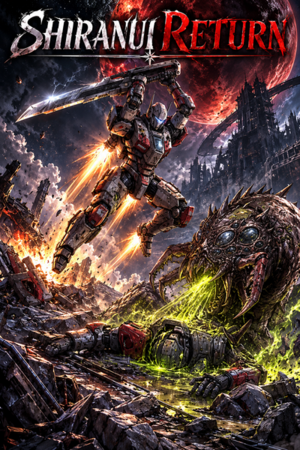
Shiranui Return
The tactical laboratory occupied the heart of the academy. Its simulation chambers were cylindrical pods surrounded by holographic emitters and neural processors. Each one recreated combat environments with varying gravity, temperature, electronic interference, and atmospheric density. The training was not just about learning to pilot. Cadets had to learn to process information while their bodies received artificial stimuli simulating acceleration, impact, and disorientation.
Renji chose chamber seventeen. The terminal recognized his profile and displayed his previous evaluations: good performance, above-average reflexes, inconsistent emotional control. No record indicated that he knew the future.
He connected the interface leads at the base of his skull and put on the helmet. The inner surface adjusted to his head; small sensors touched the skin behind his ears. The virtual environment appeared around him: an orbital platform, Jupiter shining in the distance, and ten hostile fighters in attack formation.
The simulator offered graduated difficulty levels. Renji selected the maximum setting but reduced the physical feedback so he would not raise suspicions by displaying a neural response incompatible with his age.
The system announced:
“Multiple-target combat exercise. Ten hostile targets. Victory condition: total neutralization. Failure condition: loss of more than fifty percent integrity.”
The fighters advanced.
The first formation launched training missiles. Renji did not try to outrun them. He knew the algorithm’s logic: the targets reacted to the pilot’s trajectory, not to his intentions. Instead of fleeing, he changed his acceleration vector at the last instant and let two missiles cross paths in front of the third fighter.
The first target exploded in a flash of white light.
Renji rolled the virtual craft, fired the dorsal thrusters, and used its own plasma trail as a screen to disappear from the enemy radar. The second fighter tried to lock on. Renji reversed his rotation, came in from below, and fired the Rheinmetall-GX9 heavy particle cannon.
The GX9 was a concentrated-energy weapon that used a set of magnetic chambers to compress charged particles. In the field, its power requirements called for a stable reactor and a bulky cooling system. In the simulator, the model reproduced recoil, charge delay, and thermal dispersion. The fifty-megawatt beam passed through the fighter and disintegrated it into a cloud of glowing particles.
Three targets tried to flank him. Renji pulled in the thrusters, spun around one fighter, and struck it with the energy blade. The virtual unit split in half. He used the wreckage as a shield against missiles from the fourth and fifth opponents. The chain reaction covered half the holographic battlefield.
The system increased the aggression of the remaining targets. Two fighters came from above, two more climbed in from the side, and the last stayed back, charging a heavy shot. Renji identified the attack pattern before the algorithm had finished executing it.
The last fighter was the real threat. If it remained active, the program would classify the evasive maneuver as a failure of prioritization.
Renji charged straight at it.
The simulator registered a maneuver overload and issued a warning. The cadet ignored it. He sent the craft into a dive, shut down the thrusters for half a second, and used the drop to escape the firing cone. The acceleration flung him beneath the target. The cannon fired at point-blank range.
The tenth fighter vanished.
The simulation ended in forty-two seconds.
For a few moments, Renji remained seated, listening to his own breathing. The helmet opened. The central display showed the result: a new all-time record, veteran-level performance, and a sequence of maneuvers not included in the cadet repertoire.
The chamber door opened.
Outside, the students were silent. The instructor in charge, Major Hiroshi Hasegawa, approached the terminal with a furrowed brow. He was fifty years old, with narrow shoulders and a face marked by old burns. He had lost two fingers on his right hand during a containment operation on Mars and had distrusted any cadet who seemed too talented ever since.
“Who authorized the maximum setting?” he asked.
“I selected it.”
“You completed the exercise in forty-two seconds.”
“The record is right there on the screen.”
Hasegawa examined the command sequence.
“These maneuvers aren’t part of basic training.”
“The simulation didn’t prohibit them.”
“That’s not what I asked.”
Renji held his gaze.
“I used the algorithm’s responses against it. The fighters repeat pursuit patterns when the pilot maintains the same acceleration. I changed my trajectory and made the missiles cross paths.”
“Have you ever piloted a combat mech?”
“Only the academy simulators.”
The answer was true, though incomplete. Renji had piloted real machines for years, but not in this life.
Hasegawa closed the report.
“I want an in-person evaluation. Tomorrow, six hundred hours. And don’t try to repeat this just to impress the others.”
“That wasn’t my intention.”
“Then what was?”
Renji watched his reflection in the terminal’s dark glass.
“To find out how much time we have left.”
Hasegawa did not like the answer. He put away his tablet and ordered the other cadets to return to their exercises.
Renji left the chamber certain he had drawn attention too soon.
In the hallway, Reika Kisaragi was waiting by the wall. She had moved to another workstation and was now holding a tablet with the propulsion prototype report.
“Major Hiroshi Hasegawa wants to speak with you,” she said.
“He already spoke to me.”
“No. He asked me to give you this.” She held out the tablet. “Your result has been forwarded to the aptitude board.”
Renji did not take the device.
“Why?”
“Because the system recorded commands that aren’t in the manuals. The major wants to know whether you found a flaw or are using an external program.”
“And which explanation do you believe?”
“I haven’t decided yet.”
“Then don’t decide before checking the data.”
Reika raised her chin.
“You talk as though you already have authority over me.”
“I don’t. And I don’t want it.”
She seemed surprised by the answer. For a moment, her cold expression gave way to something more human.
“Why did you help me today?” she asked. “You don’t know me.”
Renji considered telling her that he knew her better than she would like. He thought of the promotion she had denied him, the altered reports, and the lives lost because of decisions made in air-conditioned rooms. But this Reika had not done any of that yet.
“Because Daichi was abusing his position.”
“You could have ignored it.”
“I could have.”
“And yet you went into the lab.”
“Don’t confuse doing the right thing with trust.”
Reika took back the tablet.
“You’re strange, Renji.”
“I’ve been told.”
“And you don’t seem to care.”
“I’ve learned to choose what deserves my attention.”
She remained where she was as he walked down the hallway. She did not know whether she felt gratitude or suspicion. Maybe both.
◆
That night, Renji visited the historical archives wing, where cadets had access only to public planetary defense reports. He checked the preliminary March 2184 record on gravitational measurements near Jupiter. The document was brief and inconclusive: it described reading deviations, occasional losses of atomic-clock synchronization, and a recommendation to repeat the observation using independent probes. There was no mention of organisms, recovered materials, or any form of communication. Renji closed the file. He knew the phenomenon would matter in the future, but treating it as a threat at that point would be mere speculation. For now, his work was at the academy.
◆
Renji’s combat training was not a sequence of perfect movements. What set him apart was his memory of consequences. He knew that an overloaded thruster could respond explosively, that an overheated cannon would lose accuracy, and that a vibration blade needed time to reach the proper frequency. The Synaptic Piloting Program had taught him not to confuse response speed with control. A pilot had to recognize when the machine began responding faster than the body itself could withstand.
At the academy, the simulators still reproduced conventional enemies. The virtual fighters used attack patterns from human forces, and the training mechs had no underground vibration sensors. Renji asked the simulation lab to include scenarios with interrupted communications, unstable terrain, and targets that changed their behavior after taking damage.
The request was rejected for lack of funding.
He submitted an alternative proposal: use the existing scenarios, modify the terrain parameters, and limit automated assistance. Hasegawa supported the experiment, provided the data was shared with the instructor team. The first test used three Kestrels and a support vehicle. Renji took command, Reika was responsible for reading the terrain, and Masato operated the communications platform.
The exercise began with an evacuation route. The first failure occurred when the medical vehicle’s signal was interrupted. Daichi’s group, participating as the opposing force, attacked the communications point. Renji ordered Reika to check the alternate route and asked Masato to use a low-frequency channel.
The simulation introduced an underground anomaly. The virtual ground split open, separating the units. A Kestrel lost a leg and began to topple. Renji had to decide whether to send a unit to rescue it or keep the evacuation route open.
“We can recover the pilot in forty seconds,” Masato said.
“And lose the extraction window,” Reika replied.
Renji studied the map. In his first life, he would have ordered a withdrawal and left the Kestrel behind. This time, he told the medical vehicle to use its winch while the support unit diverted the enemy with a pulse emitter. The operation took longer, but no one was abandoned.
Hasegawa watched the simulation from an upper room. When it ended, he did not comment on the score. He only asked whether the team had managed to maintain communications.
“Partially,” Masato replied.
“What would you do differently?”
“I would have brought a backup transmitter.”
Reika pointed out that the alternate route was too narrow for the medical vehicle. Renji suggested changing the evacuation model so the vehicle could split into two modules. The idea was not in the manuals, but it could be tested.
The instructor board approved a second round. Renji realized that, without revealing the future, he could introduce small changes to the doctrine. He might not be able to stop the fall of Mars on his own, but he could prepare people to make decisions under conditions the manuals did not yet describe.
◆
Earth’s defense inventory looked like a list of stopgap solutions. There were electromagnetic cannons mounted on civilian platforms, armored vehicles with biological filters, interceptor drones, and mechs from several generations. The newest models, such as the Atlas-IX, prioritized armor and firepower. The older Shiranui combined mobility with short- and medium-range weapons. The Kestrel was a training platform. Between them were machines specialized in reconnaissance, repairs, and evacuation.
Engineers were already trying to adapt the equipment to a threat that did not follow the rules of conventional warfare. The problem was that the Chronians evolved. A downed drone could be analyzed, but the next swarm did not have to repeat the same configuration. A Ram whose carapace had been pierced by a particular type of ammunition could reappear in a later generation with denser plates. Ouroboros learned to identify the vibrations of heavy mechs and used the ground to set ambushes. Juggernauts could identify areas with the greatest concentration of humans.
Military classification divided the creatures into five main groups. Drones were airborne units used for reconnaissance and quick strikes. Rams broke through barriers and disrupted defenses. Ouroboros tunneled through the ground and attacked from below. Juggernauts served as heavy breakthrough units, protected by thick organic plates and equipped with multiple neural centers. Leviathans were large organisms capable of altering their environment and producing smaller units.
The latest reports suggested that the Chronians did not have a centralized chain of command. Instead, they transmitted vibration patterns and chemical signals that coordinated different groups. Their behavior could appear instinctive, but the combination of attacks indicated strategy. One unit would sacrifice itself to expose a weakness; another would wait for the right moment to strike. Humans called this collective intelligence.
Renji knew the difference between understanding a creature and understanding the enemy. Scientists studied anatomy, pilots studied armor, and strategists calculated routes. Few considered that the Chronians might be observing humanity with the same attention. The war was not merely an invasion; it was a process of mutual learning, and humans were losing because they insisted on believing the creatures were animals with no memory.
He began recording behavior patterns during exercises. He did not present his conclusions as knowledge from the future. He used field reports, sensor comparisons, and plausible hypotheses. One suggested that underground organisms reacted to specific frequencies transmitted by mech actuators. Another proposed that the light from particle cannons attracted certain airborne units. The instructors found the ideas interesting, although there was not yet enough data to confirm them.
Hasegawa kept a copy of the reports.
“You’re trying to turn the academy into a war laboratory,” he said.
“The war is already in our system.”
“It hasn’t reached Earth yet.”
Renji looked at the map of Jupiter.
“It’s only a matter of time.”
◆
The simulator’s logic was based on human decision-making patterns. The virtual fighters did not think; they executed behavior trees that responded to the target’s position, distance, and number of allied units. For most cadets, it was enough to memorize the rules and react to the signals on the screen. Renji knew that a truly adaptive intelligence would not repeat the same pattern after being observed.
He suggested that the academy create scenarios in which enemies changed their behavior after taking damage. The lab replied that the simulation processor lacked the capacity for complex models. Renji proposed an alternative: use random variations in frequency, distance, and response time to keep pilots from memorizing the routes.
Hasegawa supported the test. The result was unsettling. Cadets with high scores struggled because they depended on predictable scripts. Others, with less experience, managed to survive the scenario by observing the environment and communicating changes.
The experiment reinforced one of Renji’s convictions: the war against the Chronians could not be won by pilots who merely followed instructions. Soldiers would have to recognize patterns, share information, and accept that the enemy would learn from every attack.
During the discussion, Daichi said the idea would weaken discipline. Renji replied that discipline without adaptation was just repetition. Shun observed that the academy could not replace doctrine with improvisation. Reika suggested that doctrine should include protocols for situations that had not yet been classified.
Hasegawa ended the discussion with an assignment: each group would have to write a response procedure for an unknown threat. For the first time, the cadets were forced to admit that the manuals did not contain every answer.
◆
The first team exercise after the scenario revisions put four Kestrels against a simulated force that changed formation each time it took damage. Renji did not take command immediately. He asked Reika to identify the choke points, Masato to handle communications, and another cadet to check the units’ integrity.
The simulation began with a clear route. When the first opposing unit was hit, the others changed altitude and attacked the medical vehicle. Masato lost the signal for three seconds. Reika spotted a route along the flank but needed cover. Renji used a pulse emitter to draw the enemies’ attention away and ordered the support Kestrel to fall back without shutting down its transmitter.
The group completed the mission with one damaged unit but without losing the medical vehicle. The result was not perfect. Masato’s communications failed again near the end, and Reika’s route was exposed for a few seconds. Instead of hiding the mistakes, Renji asked each of them to explain what they would do differently.
The discussion lasted longer than the exercise. By the time it ended, the cadets had a new protocol for communications failures and one simple rule: no unit would be considered lost until the team had confirmed the absence of a signal through two independent channels.
Hasegawa approved the procedure for a second round. Renji’s idea was beginning to spread through the academy without him having to claim credit for it.
◆
The second training cycle in the simulator included an opposing team controlled by adaptive parameters. The enemies did not repeat the same route after taking damage; they changed altitude, varied their distance, and tried to attack the most vulnerable unit. Renji asked the cadets not to treat the exercise as an individual competition. The objective was to maintain formation and protect the medical vehicle.
Reika coordinated the terrain assessment. Masato managed communications. A cadet named Soren took the support unit. Renji stayed in the rear, ready to correct the formation. When the first attack began, the enemies diverted toward the medical vehicle. Masato lost the main signal but activated the backup channel. Reika found a route behind a concrete structure. Soren used the support arm to remove an obstacle.
The exercise ended with one virtual unit destroyed, but the team completed the evacuation. Hasegawa asked each pilot to explain what decision they had made and why. The discussion revealed that some cadets had followed the automated map without noticing the change in enemy behavior.
“The system showed us the safest route,” one of them said.
“It showed you the safest route for the pattern it knew,” Renji replied. “When the pattern changed, the map fell behind.”
The lesson was incorporated into training. From that day on, cadets were also evaluated on their ability to recognize when the data no longer represented the environment.
◆
The record review took place in a small analysis room beside the simulation chambers. Hasegawa had asked Renji to explain every move he had made during those forty-two seconds. He did not want a display of talent, but an explanation that could be turned into training doctrine.
The panel replayed the sequence in slow motion. The ten virtual fighters appeared in space, split into three groups, and opened fire. The system recorded speed, energy consumption, trajectory, firing angle, and neural response time.
“Here,” Hasegawa said, freezing the image. “You cut acceleration before receiving the first impact warning. Why?”
“The targeting algorithm was calculating the trajectory based on relative velocity. If I had kept accelerating at a constant rate, the missiles would have corrected their course early enough to catch me.”
“And you knew that?”
“I recognized the pattern in the first shot.”
Hasegawa advanced the recording.
“You used the second fighter’s wreckage to block the third fighter’s missile.”
“The simulation system calculates collision and mass. The destroyed unit still had enough volume to alter the projectile’s trajectory.”
“That’s not in the manual.”
“It’s in the environment’s physics.”
The major leaned back. He disliked it when cadets turned an exercise into a record-breaking contest. The simulation had been built to teach decision-making under pressure, not to reward whoever found loopholes in the algorithm.
“A real pilot can’t depend on an enemy exploding in just the right place,” he said.
“I don’t. I used the wreckage because it was there. If it hadn’t been, I would have used the hangar structure or changed my escape vector.”
“And if there had been no structure?”
“Then I would have had to choose which damage to accept.”
Hasegawa fell silent. That was the answer he had been looking for. Renji was not talking about invulnerability. He was talking about cost.
The major opened a second simulation. This time, four Kestrels had to defend a mining platform against a drone force. The targets changed formation after taking damage. The team had to keep two evacuation corridors clear while preventing the drones from reaching the reactor.
“You’ll participate as an observer,” Hasegawa said. “Don’t take command. I want to know whether you can assess a team’s behavior without trying to control every move.”
Renji agreed. Reika was given responsibility for coordinating the defense, Masato took charge of communications, and Daichi was assigned to the support unit. Shun watched from a station to the side, with no operational role.
When the simulation began, Reika deployed the Kestrels in two pairs. The first wave of drones attacked the platform through the northern corridor. Daichi answered with concentrated fire but left the southern flank open. Masato warned that the backup channel was experiencing interference.
Renji did not intervene.
Reika spotted the failure and ordered one unit to fall back and protect the corridor. The decision seemed to sacrifice the platform, but it kept the evacuation route clear. When the second wave appeared, the drones attacked the point where the system expected to find the human defenses. They found nothing there.
“They’ve changed vectors,” Masato warned.
Reika repositioned the second pair and ordered Daichi to stop pursuing the isolated target. The cadet hesitated, irritated at giving up a chance to score points.
“Kurosawa, fall back!” she ordered.
He obeyed too late. The support unit was hit, but the corridor remained open. The Kestrels completed the virtual evacuation and shut down the reactor before the enemy reached its core.
The simulation ended in a partial victory.
“Insufficient result,” Daichi said.
“A complete evacuation,” Reika replied. “The mission was to protect the personnel, not preserve the score.”
Hasegawa closed the log.
“That’s exactly the difference I wanted to observe. Cadet Kurogane, what would you have done?”
Renji studied the data before speaking.
“Reika made the right call. The mistake was allowing Daichi to leave the flank open after the first warning. The group needs a protocol for transferring command when communications are lost.”
Reika looked at him.
“You could have warned us during the simulation.”
“The major asked me to observe.”
“You could have asked permission.”
“You needed to make the decision with the information you had.”
Hasegawa approved the observation. He added that the exercise would be repeated under one rule: no cadet could receive individual points for eliminating targets if the team failed to meet the evacuation objective.
Renji left the room with one certainty: the academy was beginning to teach, albeit slowly, that winning a battle did not mean completing a mission. In the first timeline, that distinction had cost entire cities.
◆
The academy laboratory received a shipment of neural interface components for evaluation. Aoi participated on the Novgorod team by videoconference, and Renji was assigned to compare the prototype’s behavior with the Kestrel actuators. The session seemed routine, but he knew that research into prosthetics and neural response systems would be crucial when the war arrived.
The prototype used a mesh of flexible sensors embedded in a support that fitted around the operator’s neck and shoulders. Instead of translating each muscular impulse directly into a motor command, the system recognized patterns of intent and calculated the most stable response. The method reduced tremors but could introduce variable latency when the pilot performed unexpected movements.
Aoi presented the results.
“The mesh recognizes repeated movements with good accuracy. The problem is the transition between commands. When the operator changes direction abruptly, the system tries to smooth out the movement and may delay the response.”
Renji examined the graph.
“The smoothing response is slower on the left side.”
“Because the reference sensor is misaligned,” she replied. “We still can’t calibrate the mesh for every profile.”
“And what if the system receives an incomplete command?”
“It chooses the lowest-risk response.”
“Lowest risk for the system or for the pilot?”
Aoi paused for a moment.
“For both. At least, that’s what the model is designed to do.”
“It can’t assume that the best trajectory for the machine is also the best one for the person inside it.”
The engineer studied the design. Then she opened a second version of the algorithm.
“You’re suggesting that the operator should take priority over automatic correction.”
“The correction should keep the machine from destroying itself, not prevent the pilot from making a difficult decision.”
“That could increase the failure rate.”
“And it could reduce the number of movements the system interprets as errors.”
Aoi asked them to repeat the test using a less aggressive command profile. Renji simulated a change of direction followed by an abrupt stop. The mesh corrected the first movement but ignored the stop. The Kestrel’s arm continued forward for several more inches.
“See?” he asked.
“I see.”
“The system tries to finish the previous movement even after the operator has changed intent.”
Aoi changed the priority protocol. The new version interrupted the correction whenever it detected a consistent change in the command. The movement was less smooth but more predictable.
“It’s still not ready for combat use,” she said.
“It doesn’t have to be. It has to be honest about what it can do.”
Aoi smiled faintly.
“You have very specific opinions about machines.”
“I’ve had to trust my life to a few of them.”
“And did you?”
Renji looked at the Kestrel’s frame, the data cables, and the empty cockpit.
“Not always.”
The engineer did not press him. She asked the team to record the change as a design hypothesis, not a definitive solution. Then she shut down the prototype and removed the sensors. Renji realized she did not need praise to do her job. She needed someone who would identify the problem without trying to control the outcome.
At the end of the session, Aoi sent a copy of the revised algorithm. Renji saved the file in the group’s technical repository. It was not a weapon or a defense against the Chronians. It was a small adjustment that could let a pilot survive when a machine tried to make decisions for him.
◆
The analysis group received authorization to test the relay network Masato had created. The system used three mobile units, each equipped with a low-power antenna and a storage module. Instead of depending on a central station, the transmitters shared data packets and maintained alternate routes when a node was lost.
The test took place in the outdoor training sector. The first transmitter remained in the hangar; the second was installed on a Warden; the third was carried by a Kestrel to a concrete structure simulating a mining station. Masato supervised the sequence while Reika coordinated the movement. Renji monitored the system’s behavior, and Hasegawa observed the operation.
“Main channel active,” Masato reported. “Node two received. Node three hasn’t confirmed yet.”
The Kestrel advanced to the designated position. The signal appeared for a moment, then vanished.
“Contact lost,” Masato said.
Reika did not order the unit to return. She asked the Warden to change position and establish a relay line. The signal came back, but with a long delay.
“Latency is above the limit,” Masato warned.
Renji studied the map. The Warden’s antenna was partially blocked by a concrete wall. The system was trying to relay every packet, including old ones, creating a data queue that delayed recent commands.
“Prioritize control signals,” he instructed. “Historical data can be sent later.”
Masato adjusted the protocol. The delay was cut in half. Reika ordered the Kestrel to complete its route to the simulated platform while the Warden backed up a few yards to improve line of sight.
The network kept the channel active even after the hangar transmitter was shut down. The second and third nodes took over the route. Hasegawa asked them to repeat the interruption twice; both times, the network restored communications without losing the control packet.
“This could be useful on an orbital station,” Masato said excitedly.
“It could be useful anywhere the main antenna might be destroyed,” Renji replied.
Reika checked the telemetry.
“The system needs a silent mode. If a unit is under interference, it can’t relay everything it receives.”
Masato agreed. He created a function to suspend automatic transmission and preserve the data locally. The network would continue receiving without replying until the operator authorized transmission.
Hasegawa watched the change.
“This is more than a backup system. It’s a way to control what leaves the team.”
Renji looked at the map. The idea mattered for a reason not covered by the test: in a war, a communications network could fail because of damage, electromagnetic interference, or simple saturation. A backup channel that prioritized short commands would allow units to maintain basic coordination without relying on continuous video. The proposal required no new technology, only a rule for using it and repeated drills.
“Let’s make that rule mandatory for the next communications exercises,” he said.
Masato smiled.
“So my old radio has become a military system.”
“Not yet. But it might be the beginning.”
The test ended with provisional approval. Reika sent the results to Hasegawa, and Masato saved the data on two independent drives. Renji watched the group dismantle the antennas. For the first time, everyone was working without waiting for him to tell them what to do.




Please sign in to leave a comment.