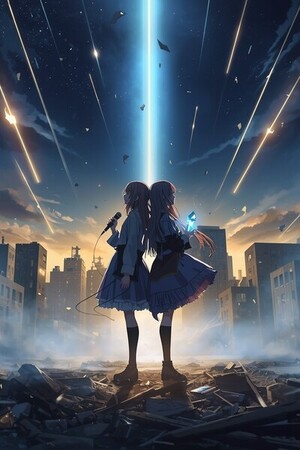


The Blessing of Diva: Resonance Zero is a story about sound as responsibility - about what it means to sing when silence might be safer, and to stand on a stage while the world quietly falls apart. At first glance, the premise feels familiar: idols, supernatural threats, an organization tasked with defending humanity.
But the story quickly sets itself apart by refusing to treat music as mere spectacle. Song here is work. Resonance is tension. Every transformation and performance costs something - physically, emotionally, and psychologically. This grounding gives the story its weight.
Tachibana Reina is an effective protagonist. Because she is burdened, and her identity as an idol clashes constantly with her role as a Diva. Someone whose voice can harm as easily as it can heal. The story does not rush her confidence or shield her from doubt. Instead, it allows uncertainty to linger, making her growth feel earned rather than inevitable.
Structurally, the story excels in escalating tension. Early chapters establish tone and rules patiently, blending training, investigations, and character bonding. As the story shifts into arcs like Cantus Null and Dies Irae, it becomes darker and more abstract, exploring what happens when resonance fails, fractures, or disappears altogether. Silence becomes as frightening as noise. These parts are emotionally intense, but intentionally so - they compel the reader or us to confront loss, aftermath, and the limits of heroism.
One of the story's strongest and my favorite elements is its use of contrast. Moments of large-scale destruction are often followed by small, intimate scenes: shared warmth, quiet conversations, exhausted kindness. These pauses keep the story from becoming relentless and emphasize that the characters aren’t fighting for victory but for continuity - tomorrow, normalcy, each other.
The writing favors atmosphere over flashiness. Descriptions of fog, light, sound, and aftermath recur throughout, creating a cohesive sensory experience that is both vivid and immersive. Some exposition-heavy sections slow the pacing, but also reinforce the methodical, almost procedural tone of the world. This is a duty-bound story.
When the story reaches its final chapters, it feels less like an ending and more like a sustained note held just long enough to ache. Resonance Zero does not promise easy resolutions. Instead, it leaves us with the sense that survival is an act of defiance, and that singing, in such a world, is a choice made again and again, regardless of the cost.
And Last nitpicking is that the author didn't kill enough.