Chapter 2:
Chapter 2 orientation I
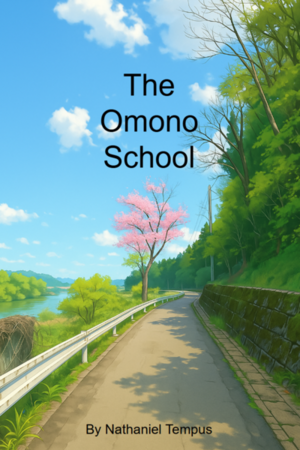
The Omono School
Next Morning
I got up at around 7:40. The town outside was stirring, birds chirping echoing in the crisp spring air. I put on a charcoal grey suit, slipped on the translation device, and stepped out into the streets of Shimoyashiki. The school I will be attending is called “the Omono School”. I had woken up in that school's infirmary yesterday. However, besides that, and the principal’s office, I haven't really seen much of the school. While the other students and I were walking to school we noticed the elderly residents of Shimoyashiki. Smiling and waving at us as if we were in a parade.
Upon entering the school, we were instructed to go into the Assembly Hall. And once I got there, I noticed an empty seat in the front. And next to that seat, there seemed to be a female student. About my age, however, unlike the others, her uniform seemed particularly worn out, with oil stains on it. So I decided to sit next to her, sensing an interesting story behind that uniform. Before I even sat down, the girl glanced at me before saying: “Please forgive me. I stayed up all night trying to get these stains out. However, I feared my identification patch might fall off.”
Only then did I notice her uniform. It didn't just have oil stains. It wasn’t like any school outfit I’d seen before. Loose trousers hung all the way to her ankles, and she carried two bags. The shirt she wore was vaguely military in style, written on a patch was her name, her address and even her blood type stitched haphazardly on her right arm.
I asked cautiously, “So where are you from?”
The girl looked at me before responding, her glare as sharp as a knife “Nagasaki.”
“Oh, I've been there before, my mother's family is from Fukuoka."
Her shoulders softened slightly, as if that detail offered some small reassurance. “Well… ever since I arrived here yesterday, I haven’t really met any locals. besides the elderly residents”
I shifted in my seat, still unsettled by her outfit. “You know, your uniform looks kind of odd. I’ve never seen one with a patch for name, blood type, and address. And the bags, you’re carrying two. I can guess one is for school supplies, but what’s the other one for?”
“Well, the other one mainly contains medical supplies. In the event of an incident, I could treat my fellow classmates.”
Her tone was matter-of-fact, almost clinical. I wasn’t sure whether to be impressed or disturbed. “That is… certainly interesting. And useful, I suppose. But may I ask you one more question?”
She tilted her head slightly. “Go on.”
“What year are you from?”
There was no hesitation in her reply. “I was born in the year 2587, and I came here from the year 2603.”
I blinked at her, certain I had misheard. “Wait… what calendar are you using? The Kōki calendar largely fell out of use in 1945.”
Her expression rapidly changed to one of confusion and disdain. “Well, that’s the calendar I grew up with. And anyway, why wouldn’t a miko use the calendar of Emperor Jimmu?”
By this point I knew that only a Japanese person could answer that question. So I turned to the person sitting next to me who explained everything to her. And let's just say the expression on her face upon learning of events that transpired after she left was a combination of deep shock, astonishment and disbelief.
“Attention everyone I am headmaster Ichirō Takeda. I am pleased to announce the start of a new beginning. Because this is the first year that the Institute for the training and education of time travelers will be operating out of the former Nakajimai High. This Institute was initially closed in the year 2020 due to the coronavirus pandemic. However, a combination of factors including the declining population and the fact that the government prioritized schools in central Daisen. Led to the decision to keep Nakajima closed, and the school would still be closed were it not for the Institute purchasing the school in spring 2021. The school has in the intervening year undergone a multitude of small but impactful renovations that would make it suitable as a school for the education of time travelers.”
Once the Headmaster finished his speech, the deputy head teacher rose and began his speech.
“All right, before we get ahead of ourselves, I first need to make this clear. This is not your average school. In this school you are being educated to fulfill a mission. And that mission is being an effective time traveler. This is an education that will open up a career that 99% of people think is impossible. If you were to walk up to one of these 99% of people and tell them you partake in this career they would laugh you off and call you insane.
So here is how the school operates. Classes start at 9:00. You may arrive anytime between 8:00 to 9:00 anything past 9:00 will be considered late. When you arrive at school you're expected to first make your way to the home room. Your homeroom is where you will be taught your main specialty. This is because when time travelers go on a mission they are expected to carry a specialty that they excel at. These specialties are: Leadership/Pilot, Time engineer, Communications officer, Medic and Security.
Your homeroom class will last for 2 hours from 9:00 to 11:00. Then you will be given education in a secondary role that you are proficient at. This class lasts 1 hour between the times of 11:00 to 12:00. During the 12th hour, you are on a break; you are free to do as you please. Then, at 13:00, you will begin the free minor classes, which last ½ hour each, or 1 ½ hours in total.
These are regarding the other 3 Subjects that are neither your primary nor secondary roles in a time traveling mission. Once you've completed these three minor classes there is a 1 hour period at the end of the day where you will either be taught history, technical skills, survival techniques and resourcefulness.
The school day ends at 15:30.”
The Headmaster then got up and asked “Does anyone have any more questions?”
After a brief moment of silence, a student of about fourteen rose from the back and asked, “When will we be receiving our school uniforms?”
The Headmaster responded “We were supposed to receive them today but there's been a delay in shipping expect to have them in by Friday this week. Any more questions?”
Once again a silence filled the room before that same person asked: “I have trouble remembering stuff; can I get a written-down version of the schedule?”
The Headmaster responded. “If you look underneath your seats you will find the schedule of the school written down. We hope you appreciate it. Because it costs a fortune to print 500 copies of something. And it costs an even greater strain on our sanity! BECAUSE THE PRINTER REFUSES TO PRINT THIS BECAUSE IT DOESN'T HAVE BLUE INK!”
At that moment everyone scrambled to get the schedule from under their seats. Once just about everyone had it in their hands the Headmaster asked. “Does anyone have any more questions?” The assembly hall remained silent this time. And then the Headmaster said, “All right then, let's get started by sorting you into your respective classes. Let's begin with Dr Takahashi’s class.”
At that moment Dr Takahashi stood up and began calling out the names of his students. “All right, class 2-A: Ayami Aoi, Haruka Aoi, Miai Amano, Daniel Bay, Rimi Chikara, Akiji Fujiwara, Kioto Ibuki, Maho Itsuki, Miyu Hayashi, Aya Kobayashi, Saki Makoto, Frederica Müller, Hiroshi Nakagawa, Ibrahim Al Saud, Kenta Sato, Noriko Shiomi, Emiko Tanaka, Rieko Tachibana, Alice Taylor and Mailing Yuan. You're with me.
And so I got up from my seat and followed my teacher. On my way to my class, I passed through the school. I caught glimpses of the school’s first and second floors, the quiet library, and a cafeteria that doubled as a bakery.
Introductions
When we entered the classroom, a cool spring breeze drifted through the windows, washing over me and my fellow students like the waters of a lake.
I slid into a desk next to the window. Sunlight spilled across the floorboards, and for a fleeting moment, this class looked like any other school in Japan. However, the people around me, the mix of accents from Kanto, Kansai and abroad, you quickly remember where you are.
“Good morning, I’ll be your homeroom teacher during your time here. Today, we’ll begin simply: introductions. Would anyone like to go first?”
Seeing as I’d have to do this eventually, I volunteered first.
“I’m Daniel Bay. I am sixteen years old, 188 centimetres tall. My mother is Japanese, from Fukuoka, and my father’s a mix of Turkish, Syrian, and Lebanese. So, basically, I’m a blend of Anatolian, North Levantine, and Japanese heritage. My date of birth is the twelfth of March, 2007, and I specialise in history, biology, science, and technology.
“Very good, Daniel. Who would like to go next?”
Just then, a familiar face stood up. “I’ll go next.”
It was the same girl who’d helped me up after I stumbled on the cinder block yesterday. Her posture was straight, her voice calm yet firm, the kind of composure that came from experience rather than age.
“I’m Saki Makoto, I was in nursing school in Tokyo. I grew up in the countryside, so the city was… a bit of a shock. Everything was fast, loud, and expensive. The financial strain was too much, and honestly, I realised city life just wasn’t for me. I suppose this is my chance to start over somewhere quieter…. somewhere that makes more sense.”
“Excellent, Would you like to tell us about your personality, your likes and dislikes, that sort of thing.”
“Alright then my favourite food is strawberry shortcake. I could eat it every day. My least favourite is marmalade; I can’t stand the bitterness. I’m 168 centimetres tall, my blood type is O-negative, and I was born on the third of May, 2009, which makes me twenty-one years old.”
She hesitated a moment, then added, “I’m the eldest in my family, so I guess I’ve always been the one people look to when things go wrong. Maybe that’s why I like things done properly.”
For a moment her eyes flicked in my direction before she looked back to the teacher, her expression polite but unreadable.
“That’s very good. Who'd like to go next?”
At the very instant the teacher finished his sentence, a student at the back of the class launched her arm into the air like a rocket. Her uniform was clearly altered, with a longer skirt and kanji written on nearly every available surface. She complemented her outfit with dyed-brown hair.
“Alright, you seem very enthusiastic. Come up to the front of the class.”
Once she reached the teacher’s desk, she surveyed the class for a brief moment before speaking.
“I am Rimi Chikara. I come from Osaka, and I was born in the year 1968. I was fifteen years old when I left the streets of that city for this place, and I hope to finally get away from the life I had grown tired of. I came here so I could formalise my studies in biology and history.”
“That is very interesting. So you’re a Sukeban?”
“Well, I still go with that aesthetic, but I’m done with the less savoury parts of that culture i.e., stealing lunch money and extinguishing a cigarette on the arm of a girl for stealing one’s boyfriend. Anyway, time travel is way cooler than getting arrested.”
“Well, that is amazing news to hear, and I wish you the best. Would anyone else like to go next?”
Just then, in a similarly enthusiastic fashion, the girl sitting next to Rimi raised her arm. The teacher gladly invited her to the front.
“I am Rieko Tachibana, Rimi’s childhood friend and the number two in her gang. For the most part, it’s the same story as Rimi’s, except that I like tinkering with machines. I would say engineering is my specialty.
“Once again, I wish you the best and hope to see you succeed. Who’s next?”
In response to the teacher's question a young man raised his hand before standing up. “I am Akiji Fujiwara, but you can call me Tadano Fujiwara. I was born and grew up in Tokyo. From a young age, I took a strong and passionate interest in physics and the study of the human body. My parents had high expectations for me; however, real life is often disappointing, and this was no exception. While I scored well in school, usually above the class average, I was never the top student. Because of this, my parents wrote me off as a failure and told me I had no future. So, what does a person with no future do? He looks to the past.
As I studied the history of physics and biology, I discovered I had a talent for memorizing history — and for the first time, I studied without my parents’ explicit orders. Then, in the winter of 2028–2029, as my high school career was coming to an end, an exchange student from American Samoa arrived at my school. At first, he seemed to be just like any other ordinary American exchange student. However, as time went on, he began to display some kind of supernatural ability: whenever a major event occurred anywhere on Earth, he would tell us two days before it happened.
I eventually decided to confront him about his ability, and his response was simple and direct: ‘I am a time traveler.’ When I asked him to explain, he told me everything. And so, that’s how I ended up here today.”
Dr Takahashi seemed to be very pleased with Tadano's introduction. “That was an amazing introduction, it's very detailed and interesting to know about your history.”
The next student introduced themselves was none other than the Saudi prince Ibrahim.
“Good morning, everyone. My name is Ibrahim. And I am from the Saudi royal family and I would first like to put up some disclaimers. 1. I don't have a mountain of cash at my disposal at every moment of my life. 2. I am not here because I'm in the royal family. 3. I am here because I want to become a time traveler, and I specifically chose Shimoyashik because it is a calm laid back area where I wouldn't have to put up with the expectation and pressure of being a member of the royal family. So now that we have that out of the way, my interests are practically the same as everyone else here. I was born in Jeddah on the red sea coast and I lived there for the majority of my life. I hope to make many good connections and learn many valuable lessons during my time here.”
“All right, that is very important to know, and I hope your time here will be pleasant, with many good memories. So, who would like to go next?”
“Can I go now? And can my younger sister go next?”
“Of course.”
“My name is Ayami Aoi. My sister and I are from the small town of Takahagi, Ibaraki. For higher education, I had to move to Tokyo. But as time went on, life in Tokyo grew tiring, and I longed to return to the way I lived when I was younger.”
“Alright, Haruka, your turn.”
“My name is Haruka Aoi. Like my sister, I grew up in Takahagi, Ibaraki. I had wanted to live in the big city of Tokyo, but when I heard from my sister that life was not all it was cracked up to be, I began to look for an alternative. It just so happened that my sister and I were scouted by the time travel recruiters around the same time, so we both decided to become time travelers and students at Omono.”
The rest of the first period continued much the same, and the remaining student introductions were largely what you would expect. Still, a few stood out.
Emiko Tanaka (the student who had sat beside me during the assembly) introduced herself as someone who once lived and worked in Nagasaki during the Second World War, assisting in the production of the Type 93 Long Lance torpedo while serving as a shrine maiden on the side.
Noriko Shiomi admitted, with visible embarrassment, that she was a terrible swimmer despite having grown up on a beachfront property in Chibuya.
Maho Itsuki maintained a perfectly blank expression when asked to name something, anything about her hometown of Sapporo that an outsider would instantly recognise, besides snow.
Alice Taylor’s dumbfounded expression, when asked to name something she genuinely liked about her hometown of Birmingham (other than the many options for leaving). It was impressive just how many options she knew.
Mii Amano and Miyu Hayashi, both from Kyoto, arrived wearing kimono for the entire day because “first impressions matter” and “North Japan is too cold to wear the less formal yukata.”
And finally, for the last introduction of my homeroom class, Frederica Müller stared in disbelief upon learning that she, at age nineteen, could not legally drink in Japan.
11:00–12:00 | Security & DefenseAfter getting out of homeroom, I went on to my next class, Security and Defense. When I got there my professor got up and shook my hand.
“Good morning. I am Colonel Masaru Shimazu. I’ll be your professor of Defence and Security.”
The Colonel stood with a posture so rigid it could have been carved from stone. He was tall, broad-shouldered, with a weathered face and a neatly trimmed beard streaked with gray. His uniform was pressed to perfection, his boots polished to a dull shine.
The class (1-C) was quite long, about twice the span of a normal classroom. And unlike in the rest of the school, which had a classic wooden floor. This classroom’s floor was a more modern vinyl tile. Weapon Racks lined the walls. Behind the glass cases gleamed polished swords, halberds, shields and a great variety of bows and arrows. In the left corner stood a suit of European plate armor. Likewise in the right corner stood a suit of samurai armour. Both of them standing like sentinels.
In the Racks at the back of the class there were weapons which vaguely looked like firearms except different. All looked to be extremely modern, bearing a distinct white finish instead of the usual royal blue or black. All of it locked behind bulletproof glass.
As the classroom filled with students, a few familiar faces streamed in. Rimi Chikara and Rieko Tachibana looked perfectly at home, slipping into their seats with easy laughter. Their grins were wide and unguarded, like children set loose in a candy store, and for a moment their energy cut through the quiet tension that hung in the room.
Ibrahim Al Saud sat with quiet dignity, his posture straight and deliberate. In his homeland, it was almost unthinkable for the head male of a household to go unarmed. He carried himself with that same unspoken authority, as though the weight of tradition rested on his shoulders. Hunting trips with his extended family had given him years of experience handling rifles, learning patience in the desert heat. And beyond the hunts, his schooling had introduced him to weapons of every kind, theory and practice woven into his education.
Across the room, Emiko Tanaka carried herself differently. Her gaze lingered on the weapons displayed along the walls with a kind of somber familiarity. Where others might have looked on with curiosity, she studied them like old acquaintances. For her, weapons were not just instruments of violence, but chapters of history she had lived through and studied. She had once competed in archery tournaments, firing arrows with precision and grace. To Emiko, a bow was more than wood and string, it was memory, heritage, and resilience.
Sitting in the back was a familiar face. Yesterday I had met him searching for his friend. The Banchō from Tokyo, and it appears that he found his friend. And he even made a new friend, a delinquent girl from Yokohama.
When Rimi noticed them, she smirked. In response, the Kanto delinquents smirked back. For a moment, the air between them crackled with something unspoken, a challenge waiting to be issued.
However, there were also new faces among us. A studious boy sat hunched over his desk, already scribbling furiously in a notebook as though the lesson had begun. Toward the back, an older student with a soldier’s bearing studied the display of white colored rifles mounted on the wall. His expression was caught somewhere between suspicion and nostalgia, as though he couldn’t decide if they were toys, ghosts or a different version of something he once carried. And then there were the others, a scatter of ordinary faces, polite but unremarkable, the kind that blurred together in memory and would vanish from your mind a week later.
Just then the colonel clapped his hands.
He began, “You have been gathered here today to learn not only the history of weapons, but the way they shaped the societies that wielded them. You will learn how to use them, how to defend against them, and most importantly, how not to die when facing off against them.”
Just then he reached for the wall and pulled a longsword free from its rack. The blade gleamed under the fluorescent lights.
“This was the pinnacle of European melee combat in the fifteenth century. But do not think it unbeatable. Armor evolved to counter it. Spears outranged it. Guns rendered it obsolete. Every weapon meets its counter.”
Just then he raised his sword before striking it against the suit of armour standing in the left corner. At that moment, it felt like the world fell into a deep and cold silence. Then he rapped the flat of the blade against a breastplate on display, the sound ringing sharp and hollow.
Once the room fell silent, he turned towards the class and said: “Remember this, if you fumble in the past, you will not be graded. At best you will be severely injured. And at worst you will be dead.”
The colonel went on to describe his service history. He had apparently been a samurai who served in the Boshin war. After that war ended, and the samurai were abolished, he left Japan.
“When the war was lost, and the samurai class abolished, I found myself obsolete. So I decided that if Japan didn't want me maybe some other country would.”
After a long journey he eventually made it to Europe, where he joined the French Foreign Legion in 1878. During his time in the Legion, he was deployed to Indochina. To fight in the Sino-French war. Shortly after the war ended in 1885. He tried to get a job; however, his skill set was not really needed in this civilian market. He was only about three days away from being evicted when a time traveller happened to run into him.
“I accepted the offer. I graduated from an institution much like the one you’re attending now, and then I began to travel. I walked through the manicured lawns of 1950s American suburbs. To the bombed-out streets of Europe and the Middle East in the twentieth and twenty-first centuries. But again and again, I found myself drawn back to the mid-nineteenth century. The time when I grew up and spent my youth. Back then I thought that I would be set for life. There had not been a Japan without samurai in over 800 years… Oh, what I would say to my younger self if only I had the opportunity.”




Please sign in to leave a comment.