Chapter 7:
The Hopeless Task
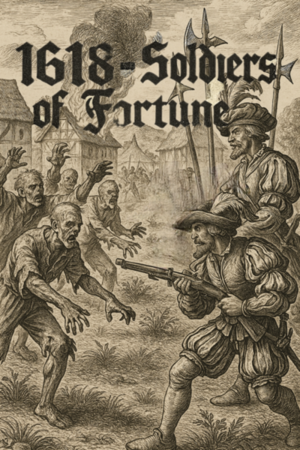
1618 - Soldiers of Fortune
The other officers were now all belowstairs.
Near the kitchen, in a shadowed corner, one of them sat upon a wooden stool, scraping dirt from beneath his fingernails.
He had long, thinning hair and a wild, bushy beard which, unlike the carefully clipped whiskers of the other officers, was left rough and unshapen.
In all, he cut a figure anything but polished.
He was plainly one of the few who had risen from the ranks.
Accordingly he enjoyed little favour among the men around him, their pointed neglect of him made that clear enough.
Such men, I had learned, were often the least guarded in their speech.
Thus I resolved to speak with him, if only to learn somewhat more of the Obrist.
“Good day, sir. Might I beg a moment of your time?”
I halted before him.
He ceased scraping and looked up, surprised.
“Sir?” he said. “No offence, but I am seldom called that. Knave, whoreson, and cur are the names I hear most commonly these days.”
“I am sorry to hear it,” I replied.
He blinked, plainly not accustomed to friendly address.
Then he folded his hands and straightened upon the stool.
“You know,” he said, “when I campaigned in Lombardy, a wise fellow told me: 'An insult is never free. A man pays it out for profit, for sport, or for pride'. As for me, I have no need of such follies, and so I give little heed what others think of me.”
He regarded me as though he had waited long for someone willing to listen, and I did not hurry him.
“Is that so? Then you must have travelled far,” I said.
“Indeed I have!” he replied. “Liguria, Burgundy, even Sicily. And I hail from Regensburg, of all places.”
He spat upon the floor, drawing a few annoyed glances.
“That godforsaken pit. Glad I was to quit it. Damned Evangelical rabble,” he added, spitting again.
“But enough of that. What is it you want of me?”
“I wondered, what manner of man is the Obrist?” I asked in a low voice, so the others might not overhear.
The officer narrowed his eyes and studied me more closely.
“And who are you, to ask me such a question?”
“I am...”
He cut me short.
“If Lothar thinks he may test my loyalty by sending some lackey to sniff about, he is sorely mistaken. Does he take me for a simpleton? Is this about that business with Tilly? If he wishes to test a man’s loyalty, he should begin with those strutting peacocks of officers buzzing about like flies.”
The other officers showed no sign of hearing us, mercifully.
“Me,” he continued, “me of all men, to be subject to such a shabby trick! You may tell him he would do well to remember what befell in Genoa; then he would know where my loyalty lies!”
He paused for breath and I seized the moment.
“You mistake me,” I said. “The Obrist did not send me. I am new here and wished only to know the measure of the man.”
He raised an eyebrow and scrutinised me again.
“Is that so? And how am I to know you speak the truth?”
“You cannot,” I said simply.
He sighed.
“Very well. Spy or not, Lothar is welcome to hear what I think of him.”
He shrugged and lowered his voice.
“The Obrist is, without doubt, dutiful and honourable, at first sight. But be not deceived by that. He is also cold-blooded and calculating. He would sacrifice you, and any other man in this room, without the bat of an eye, if it served the greater purpose. I do not believe he would take pleasure in it; indeed, I am certain he would not. But he would do it regardless, because he deems it needful. I have seen such things often enough.”
For a moment his gaze slid past me, unfocused, as though some memory rose before him.
Clearly he and the Obrist had a long shared past.
Yet now I felt my doubts concerning the mission grow heavier.
“Have you heard of his... plan?” I asked warily.
“The suicide mission?” he snorted. “Hauptmann van Arens just told us.”
He spat again.
“Poor devils who sign themselves up for that.”
I must have looked uneasy, for he laughed.
“You’re one of them, aren’t you? My condolences. You seem a decent sort.”
I kept my misgivings to myself.
“That is how much the Obrist values his men,” the mercenary added, shaking his head.
“I am not so easily broken,“ I said, striving to sound steadier than I felt.
I had heard enough for the moment and resolved to see to my task.
“Would you tell me where Hauptmann van Arens is gone?”
“As far as I know, to the armory. He is tallying what gear he needs for this madness, ere he recruits more gullible souls.”
I had heard enough.
“I thank you for your candour,” I said and inclined my head.
“Good luck,” he called after me as I went to leave. “You shall need it.”
***
Outside, the wind had risen and the tents upon the square flapped violently.
Yet I scarce noticed, my thoughts being elsewhere.
I caught myself seriously contemplating flight, quitting Stratweiler altogether and running.
What use was gaining any favour, if it led only to being devoured by the dead, as all said it would?
If I had managed to reach the city alone, might I not slip out again?
But to what purpose would that serve?
Once more that day, I saw how little choice I truly had.
The mission held much peril, yet also some small hope of advantage.
Thus I made my way to the armory.
It stood near the boundary of the western quarter, where the makeshift barricades alone kept the dead at bay.
Doors, wardrobes, roof-beams, whatever could be spared, had been piled into walls, blocking every narrow alley and passage.
When one of the creatures managed to scramble over, a Landsknecht was ready with a crossbow bolt to its skull.
At one breach where the fortification wasn’t finished, a pair of Landsknechts stood in old plate and mail, their armour dented and mismatched.
They held their pikes low, thrusting at the heads of those that came too near, as men brought more timber to shore up the gaps.
A few yards before it, culverins stood upon raised platforms, a last answer should the barricades give way.
The armory itself stood a good distance behind them, a large building with ornate stucco and a gilded cannon mounted above the entrance.
Within, the armory seemed greater still.
A high vaulted ceiling, borne up by a dozen columns, sheltered the weapons and armour yet remaining.
Old suits of plate stood upon wooden frames, flanked by halberds, longswords, and antiquated cannon.
Men sorted and counted supplies, filled crates with powder and shot, or bent over lists to compare them with the stock.
At the far end I recognized Hauptmann van Arens.
As I approached, his voice rose sharply, not at me, but at the man before him.
“…I have no need of damned longbows!” he thundered. “None of my men can wield them, let alone strike a head at distance!”
“Then you ought to have come earlier,” came a dry, elder voice. “The remaining crossbows are our last reserve for the barricades, and you shall not rob me of those as well.”
“And how in God’s name am I to complete my task?” van Arens snapped. “Two-thirds of my men have but muskets, which are worthless against these beasts! Without proper ranged weapons our pikes shall avail us little!”
“Then try your luck at the east gate,” the older man replied, unmoved. “The last shipment of crossbows and bolts was sent hither.”
“The Obrist did not leave you master here so you might hinder his other men,” van Arens growled. “If my mission fails for want of...”
“Spare me,” the old man said curtly. “The Obrist himself charged me to hold these back unless he gives his writ in person, and I will not risk the barricades for the sake of any single venture, however urgent.”
Van Arens seemed bereft of words.
The quartermaster had already turned back to his desk.
His long, shaggy hair fell over the extravagant millstone ruff about his neck as he bent over a parchment roll.
The Hauptmann, his face dark with frustration, shook his head and turned away.
He strode past me so quickly he nearly missed me altogether.
“Hauptmann!” I called.
He turned, eyeing me in silence.
“The Obrist sent me,” I said.
His eyes narrowed. “I remember you from the briefing. The stray messenger.”
I nodded.
“And what do you want?” he asked. “Are you His Excellency’s new errand-boy?”
“No,” I replied. “Your new errand-boy.”
“Well,” he muttered, “that was swift.”
“Sir?”
“My last factotum died this morning,” he said matter-of-factly.
“I cannot tell whether that bodes well or ill for me,” I said.
He shrugged.
“That depends on whether you enjoy hopeless ventures.”
I had heard enough of such talk for one day.
“To speak plainly,” he went on, “I have little use for someone trailing at my heels.”
“It seemed to me you might yet have use of another pair of hands”, I answered.
He could hardly dispute it.
“Very well,” he said at last. “If you insist on proving your worth, then begin by finding us crossbows. Without them, we shall not last long.”
“But the quartermaster already refused you,” I objected.
“I know that, curse you. You shall not get them from him. Search the city. Fashion them yourself. Steal them from the watch, for aught I care. The manner matters not, only the result. Is that understood?”
I nodded.
“Good. Then excuse me; I must still see what may be done for this folly.”
And with that he strode away, leaving me alone with my task.
Sighing, I wondered, not for the first time that day, what venture I had been swept into.









Please sign in to leave a comment.