Chapter 1:
The Tea Princess of Pinglin
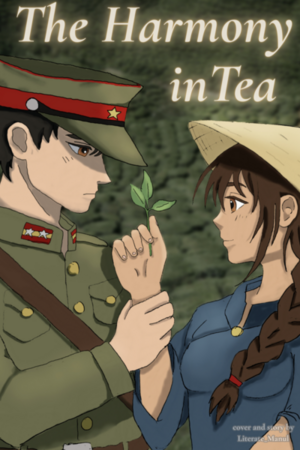
The Harmony in Tea
When they entered the kitchen, Yi-yun stopped in the doorway and looked around.
The room was large, with a high ceiling and dark walls whose shine was long since gone.
Mei-Ling took her bag up from the floor.
“All right. I’ll call as soon as I arrive,” she said, bending down to Yi-yun’s level. “And you’ll behave, okay?”
Yi-yun crossed her arms.
“You say that like I always mess around…”
Mei-Ling sighed.
“Exactly.”
At the stove, her grandmother stood with her back turned, heating water in a kettle as though none of this concerned her.
“Four weeks will pass quickly,” Mei-Ling finally said, a little too loudly.
She smoothed Yi-yun’s hair one last time, hesitated, then let her hand fall.
“Bài-bài,” she said at least, already on her way out.
A moment later, the engine started outside, and the car rolled over the gravel until the sound disappeared behind the house.
“Why don’t you sit down?” came the voice from the stove, without turning around.
Yi-yun dragged herself over to one of the chairs and climbed up.
Two cups and a teapot were placed on the table.
“Would you like some tea?”
Yi-yun shrugged.
“I guess.”
With calm, practiced movements, hot water was poured into the pot, swirled briefly, then poured out again.
A pinch of tea leaves fell softly inside.
The water was poured once more, a single breath passed, and the cups were filled.
Her grandma’s hands were slow and steady, as if they had done this countless times before.
One cup slid toward Yi-yun, warm steam rising gently from it.
She blew on the surface carefully before taking a small sip, then another, her expression slowly brightening.
When she looked up again, a faint smile had appeared on her grandma’s face.
For a moment, neither of them spoke as they drank their tea.
“You asked about your grandfather.”
Yi-yun hesitated, then produced the jade pendant from her pocket, as if she had almost forgotten about it.
She studied it for a moment before sliding it across the table.
“Mom never told me anything about him…” She glanced up uncertainly, then quickly back down at her cup. “Is he… dead?”
Her grandma looked aside, a strange smile on her lips.
“No,” she said after a moment. “He’s just… late.”
Yi-yun pressed her lips together.
“Late?” She tilted her head. “So where is he now?”
“Somewhere else.”
Yi-yun frowned.
“Will you tell me about him?” she asked more quietly.
The old woman studied her for a long moment, then walked to the window, and looked out toward the hills.
Her gaze unfocused, as if the years quietly fell away.
“Are you sure?” she asked. “This isn’t a bedtime story.”
Yi-yun shifted on her chair.
“I’m not a baby!”
“All right,” came the reply. “But I warned you.”
For a moment, silence settled between them.
“I was seventeen back then,” she said at last, her voice lower. “And many things were different here in Taiwan.”
᯽᯽᯽
It was the year 1940, and the tea harvest was in full swing.
Our feet left dark prints in the damp earth as we moved through the rows, checking the leaves, cutting and gathering.
I worked alongside the other women who had been out since sunrise, our hands moving quickly, without exchanging many words.
I always liked that silence.
They treated me no differently, even though everyone knew who I was.
The Tea Princess of Pinglin, people used to call me back then.
Not because of who I was as a person, but because of an image that had travelled far beyond these fields.
When I was younger, my stylized face had been printed on tea packages, a small girl with careful eyes, sold in markets and stores, known by people who had never met me.
Everyone recognized it, and so they recognized me.
After all, I was the only child and heir to one of the largest tea manufacturers in the region, and with that came expectations long before I understood what they meant.
The leaves we harvested this season were soft, deep green and full of sap.
As we gathered them, I knew my father would be pleased.
Some time later, one of the workers came looking for me, having just returned from the main house.
“Lin Shu-fen (林淑芬). Your father is looking for you!” she called, wiping sweat from her brow.
I sighed.
“Well, time for another lecture…” I muttered, and started up the narrow path.
By the time I reached the top, my shoes were splattered with mud, my face damp with sweat, my hands smelling of earth and leaves.
My father stood on the veranda, speaking with a man from the storehouse, but when he saw me, he stopped talking at once.
His gaze travelled from my hands to my knees, where my skirt was stained with dirt.
“Shu-fen! You’ve been out in the fields again?!” he demanded, though he already knew the answer.
“The harvest won’t wait,” I replied simply.
His mouth tightened.
“You are my daughter,” he said sharply. “You shouldn’t be out there with the workers. Look at you. You’ll ruin your hands!”
In Pinglin, my hands were not just mine, they belonged to my family’s name.
He caught my wrist and turned it slightly.
My skin was rough, my nails dark with the juice of the leaves.
“They’ll become ugly like that,” he went on. “And if they do, it will be hard to marry you well.”
I pulled my hand back.
“How am I supposed to be heir to our family business without knowing how tea is harvested?” I asked. “Besides, the workers need every helping hand.”
He snorted.
“You talk like a boy.”
“Then listen to me like I was one,” I said calmly.
He sighed and shook his head, then looked at me, brooding.
Whether it was disappointment or regret, I still don’t know.
“Enough of that,” he said at last. “Go inside and make yourself presentable. You have to accompany me to Taihoku.”
“To Taihoku?” I asked cautiously.
“I need you because you speak Japanese better than any of us,” he said matter-of-factly. “It’s about the contract with the Imperial Army, the prices, and new regulations.”
I looked at him.
“You’re talking about that new official… that war hero?”
My father nodded.
“His name is Onodera Shuichi (小野寺修),” he said. “He has been placed in charge of supply management for the Army.”
I did not respond at once.
Of course, I already knew the name.
Everyone did.
It had appeared in reports, in conversations, in the words of those who spoke of his victories far away.
“The Devil of Xiaofeng,” I said quietly.
My father’s expression darkened.
“Yes,” he replied. “That is what they call him.” He hesitated, then added more softly, “Which is precisely why his presence here is… unusual.”
I frowned.
“A man like that is not sent to manage tea and transport. Why did they transfer him here?”
My father let out a short breath.
“I don’t know. But they say it might only be temporary.”
He paused.
“That’s why we would do well to be very careful,” he continued. “Which means you will only translate,” my father added sharply. “You will add nothing, leave nothing out. You will not argue. You will not improvise.”
“I know,” I said.
“No,” he replied. “You don’t. That’s why I’m telling you.”
There was nothing more to be said, and so we set out that afternoon.
The journey to Taihoku took longer than usual, as the roads grew crowded with people, carts and soldiers.
Uniforms blurred past us, voices overlapped, and everywhere the war made itself felt.
Not in gunfire, but in the way the world seemed tighter, louder, more hurried than before.
Taihoku was especially loud in a way I had never quite grown used to.
Footsteps on stone, the hiss of steam, the sounds of cars.
Tall buildings of stone and concrete rose between older houses, Japanese characters on entrances, banners and signs.
I had seen the city before and yet it felt foreign every time.
You might know it as Taipei.
Shaped by the Japanese from an insignificant port town into the metropolis it has become.
We eventually reached the administrative building near the center of the city, large and severe, built of red stone with broad steps and heavy doors.
Soldiers stood guard outside, motionless, rifles at their shoulders.
Without realizing it, I straightened my back as we stepped inside, the noise of the city fading behind thick walls.
An official led us through the long corridors.
I walked a step behind my father, my hands steady even as my heart beat faster than usual.
“He doesn’t know much about Taiwan,” he whispered as we waited outside the office. “Transferred only a week ago. Straight from the front in China.”
“The front?”
“For propaganda broadcasts,” he continued, without looking at me, “but why he is here now, all of a sudden…”
Finally, the door opened.
Behind a desk stood a man in a Japanese officer’s uniform.
He was younger than I had expected, but even the official who had led us there straightened at the sight of him.
Upright and immaculately dressed, every line of his posture controlled.
His gaze moved first to my father, cool and assessing, before settling on me.
When our eyes met, he opened his mouth as if to speak.
Then, for a brief moment, something flickered in his eyes, softening the severity of his expression.
It lasted no longer than a heartbeat.
His face hardened again, smooth and unreadable.
“Sit,” he said coolly.
We did as he said, and in that moment I knew something had shifted, even if I couldn’t name it yet.
Later, people would whisper that the Tea Princess of Pinglin had been summoned that day in person by the Devil of Xiaofeng.
In time, we both learned how little either name captured the truth.








Please sign in to leave a comment.