Chapter 2:
The Devil of Xiaofeng
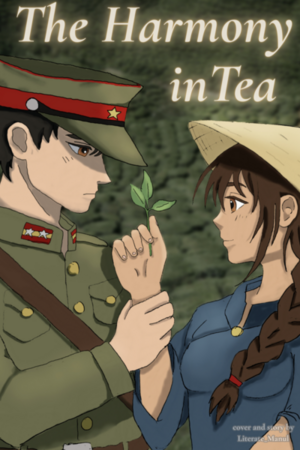
The Harmony in Tea
Your grandfather was taller than I had expected, upright, with a bearing that left no doubt he was accustomed to giving orders.
Immaculate, precise, unmistakable.
I recognized him at once.
Not only because I had seen his face before, but because I had heard his name spoken often enough.
The Devil of Xiaofeng.
Sharply defined features, devoid of softness.
Dark eyes, alert and cool, yet holding something watchful within them, almost calm.
It was a face one did not easily forget.
My father began to speak in Chinese, his voice composed, nearly deferential.
He thanked Onodera for his time and for granting us the opportunity to present ourselves.
I translated every word, clearly and without hesitation.
But Onodera paid my father no heed.
His attention rested entirely on me and I felt the space between us narrow.
It felt like he was measuring me up.
Before my father had even finished, Onodera raised his hand slightly.
“One moment,” he said and his gaze fell on my father, cool and appraising.
“Taiwan has been part of the Empire for more than forty years now,” he said calmly. “And yet you do not address me in Japanese.”
My father did not answer immediately.
His lips pressed together, then he glanced at me.
I lowered my eyes briefly, drew a breath, and spoke before he could.
“My father speaks some Japanese and understands most of it,” I said. “But he believes one should only speak a language if one can do so without error. He does not wish to offend you.”
For a moment, the room was utterly still.
Then the corner of Onodera’s mouth twitched downward, barely perceptible.
“The other tea producers,” he said coolly, “were at least capable of presenting themselves without an interpreter.”
“We are not the other tea producers,” I replied calmly.
Beside me, my father flinched in alarm.
He began to speak himself, in hesitant, halting Japanese, attempting to smooth things over, to apologize.
But Onodera did not allow him to finish.
A single glance sufficed and my father fell silent at once.
He turned back to me more slowly now.
“So you are his interpreter?,” he asked.
“Yes,” I answered. “And his heir.”
Something shifted then.
It was subtle.
Recognition, perhaps.
Or interest.
“Then let us proceed,” he said.
He drew a file toward him and opened it.
His movements were precise, almost mechanical.
“It came to my attention, that my predecessor regularly ordered large quantities of tea from your production,” he said at last. “At considerable expense to the government.”
His finger tapped a number.
My father cleared his throat softly and began to explain with care.
He spoke of soil and elevation, of rising processing costs, of experience and patience.
I conveyed his words faithfully, neither softening nor embellishing them, and Onodera listened now without interrupting him once.
When my father finished, he closed the file.
“All of that may be true,” he said coolly. “But it does not justify a price exceeding that of comparable producers. I see no reason to spend more on tea than necessary.”
I felt my father beside me hold his breath.
For a single heartbeat, I hesitated.
Then I spoke.
“Because it is the finest tea,” I said.
My father turned sharply toward me.
He murmured hastily in Japanese, trying to intervene.
But Onodera raised his hand again.
This time, he looked directly at me.
“The finest?” he repeated. “I know your tea is renown. Famous, even. But that is a bold claim.”
“But it is simply the truth,” I said.
“The truth?“ he repeated, now with a faint hint of a smile.
My heart pounded, yet my voice remained steady.
“I think a country should not be careless with what sustains its soldiers,” I continued. “Good tea is not a luxury. It is part of daily life. Of morale. Of health.”
For a moment, Onodera said nothing.
Then he stood.
His chair slid softly across the floor as he stepped around the desk.
I did not move as he stopped directly in front of me.
“So you claim,” he said quietly, “that you know what soldiers need?”
I lifted my gaze to him.
I was keenly aware of how little distance lay between us.
“I think,” I replied calmly, “that soldiers who fight for Japan deserve the very best tea one can offer them.”
A sharp sound escaped him.
He looked down at me as though I had said something naive.
“Have you ever been to the front?” he asked.
I shook my head.
“Have you ever seen a battlefield?”
I shook my head again.
“Then do not speak as though you know what soldiers need,” he snapped.
The words were sharp, yet controlled.
He turned away and returned to his seat.
His severity should have made me recoil.
Instead, I saw something else.
Just for an instant.
A darkness in his eyes that did not belong there.
Weary.
Out of place.
Like pain.
Like remorse.
And to my own surprise, I wanted to know where it came from.
He leaned back slowly and studied me again, not hostile now, but with a cool, alert curiosity.
“And,” he said at last, “are you still of the opinion that your tea is the finest?”
I nodded.
He sighed, as if my persistence annoyed him.
“If you're not convinced, why not see for yourself?” I asked. “Visit our plantation and taste the tea. I would gladly pour it for you myself.”
Beside me, my father went pale.
Onodera, however, seemed surprised.
Then that fleeting smile appeared again.
“Very well,” he said. “Then I shall do so.”
He rose.
“I will inform you.”
And with a brief motion of his hand, he made it clear the conversation was over.
But after we bowed and were already turning to leave, he spoke once more.
“And if your tea fails to convince me, princess” he added calmly, “your family will never supply the army again.”
“Then,” I said, “we will convince you.”
We bowed one last time and stepped outside
᯽᯽᯽
Shu-fen fell silent for a moment, as though she herself had forgotten where she was.
Outside, dusk had begun to settle, and the last light fell softly through the window onto the table.
Yi-yun stood on a stool, the tip of her tongue caught between her lips in concentration, chopping vegetables under her grandmother’s watchful eye.
The knife was heavy, and she moved it carefully, almost reverently.
“You’re doing very well, Yi-yun,” Shu-fen said.
Her granddaughter beamed.
“You really think so?”
Shu-fen nodded.
“Indeed. You must have inherited that from your grandfather. He was an excellent cook as well.”
Yi-yun glanced up.
“But from what you told me, Grandpa didn’t sound like a very nice man,” she said thoughtfully.
Her grandmother chuckled and rested her hand gently on Yi-yun’s arm.
“That was how he seemed at first glance, yes,” she said. “But first glances rarely tell the whole story.”
Yi-yun thought for a moment.
“And the second glance?”
Shu-fen took the knife back and wiped her hands on her apron.
“At the second glance…”
She smiled softly.
“That’s a story for tomorrow.”
Then she turned back to the stove.
“Come,” Shu-fen said quietly. “I’ll show you how to dissolve miso properly in the boiling water.”
Yi-yun stepped aside as her grandmother moved beside her and handed her the packet of miso paste.
And as night had already fallen, an old, familiar scent filled the kitchen.












Please sign in to leave a comment.