Chapter 4:
The Whispers Around Us
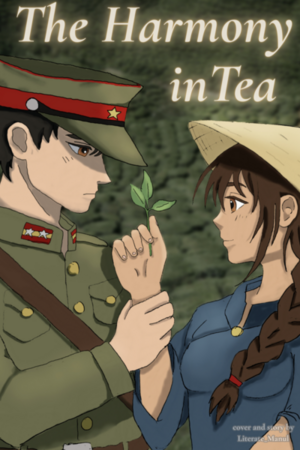
The Harmony in Tea
I was in the middle of inspecting the freshly harvested tea when one of the workers approached me.
The baskets were lined up in long rows before us, brimming with dark green leaves.
I took a handful, turned them over, examined them closely, then rubbed them gently between my fingers as I tested their scent.
“These should wither for another day,” I said at last. “There’s still too much moisture in them.”
She nodded politely, then hesitantly began to speak.
“Miss Lin... He is here again...”
I looked up, making an effort to appear indifferent.
“Who?”
A brief smile flickered across her face, as though she didn’t quite believe I didn’t already know.
“Taii Onodera,” she said.
Without meaning to, my fingers curled around the tea leaves in my palm.
Behind her, a second worker had stopped, her basket still resting against her hip, and she, too, was watching me with open curiosity.
“He says it’s about the delivery quantities for next month,” she added.
I wiped my hands on my apron, careful not to betray my unease, and straightened slowly.
“Where is he now?”
“At the warehouse,” the other replied. “Without an escort this time.”
They exchanged a glance.
I merely nodded, though my heart had already begun to race.
Only when I turned away did I realize I had been holding my breath.
Suddenly I was aware that every movement, every step I took, would now be read differently.
As I made my way across the yard, I heard quiet murmuring behind me.
Not loud enough to make out words, but clear enough to know that people were already talking.
About how Onodera came more often than mere inspections required.
About how he kept appearing unannounced, sometimes even without soldiers accompanying him.
Of course, he always arrived officially, never without a reason.
And yet it had begun to stand out.
“What does he want again?” people whispered.
“And why does he insist on discussing business with Miss Lin instead of the master?”
It did not go unnoticed among his own men either.
I overheard it myself in passing, conversations at the edge of the courtyard, voices that fell silent when I drew near.
Even the merchants and drivers who passed through the plantation carried news from the city.
They said it was being talked about in Taihoku as well.
That among Japanese soldiers there was quiet speculation.
What was the Devil of Xiaofeng doing up there so often, they wondered.
Was he neglecting his other duties because the tea tasted so good?
Or was there another reason?
The murmuring followed me a little way, then faded as I passed between the buildings.
As announced, Onodera was already waiting for me at the warehouse.
He greeted me briefly and, without preamble, gestured toward the lists he carried with him.
Only later, once we had discussed what was necessary, did he suggest taking a look at the fields.
And so he accompanied me between the rows of tea plants, while I explained procedures as usual and answered his questions.
He listened attentively, rarely interrupting, often waiting a long moment before speaking, as though weighing my words.
At one point he asked about a detail of the harvest, and as I explained it, I searched for a leaf to show him.
I handed it to him, and for a moment our fingers touched.
He flinched as if stung and drew his hand back at once.
The leaf fell to the ground, and his dark eyes sought mine.
“Forgive me…” he murmured at last, his expression unusually tense.
“It’s all right...” I replied softly.
A brief silence followed.
Why was my heart pounding so fiercely?
And why did he suddenly seem so vulnerable?
“We should head back,” he finally said, adjusting his cap and letting his gaze drift across the horizon.
I nodded, feeling something tighten inside me as we walked back together.
By the time we reached the main gate, the afternoon was already well advanced.
Onodera walked a few steps ahead of me, his hands clasped behind his back.
We had spoken little.
At last, he stopped and gestured toward the nearby warehouse.
The gates stood open, sacks and crates stacked high, workers coming and going.
“Something has caught my attention recently,” he said at last. His voice was calm, almost reflective. “Tea supplied from this plantation seems far less affected by spoilage than that of other suppliers. Why is that?”
I looked at him, surprised by the question.
Yet the fact that he asked it still brought a faint smile to my lips.
“Come,” I said. “I’ll show you.”
He raised an eyebrow and followed me inside.
I went to a wooden crate that had not yet been loaded, opened the lid, and indicated the carefully layered leaves.
“We don’t place the tea directly against the paper, as many manufacturers do. There’s a thin metal lining between the leaves and the wood.”
I reached inside, pulled out a small pouch, and held it up.
“And most importantly, each crate contains a tightly sealed sachet of burnt lime. We source it locally, from the same kilns used in city construction. It draws in moisture long before the tea can.”
Onodera frowned in surprise.
“Remarkable…”
I nodded.
“...And the reason our tea costs slightly more than that of others. But in return, it arrives fresh and unspoiled at its destination.”
He rubbed his chin thoughtfully, and something flashed in his eyes.
“I’ve only been responsible for matters like this for a short time,” he said evenly. “My experience is... limited.”
It was not an admission of weakness, merely a factual observation.
“Our losses to spoilage are small,” he continued, “but they exist. Not only with tea, but with rice and other goods as well.”
Then he turned to face me fully.
“Your experience with this kind of things might be of help to me.”
I startled, his words pulling me abruptly out of my work-focused mindset.
“What do you mean?”
“I want your opinion in person, about our bearing conditions and how it could be improved.”
The words were matter-of-fact, and yet I felt their weight.
“In Taihoku?” I asked cautiously.
“Yes.”
A nod.
“Of course, you will be compensated for your time, and I won’t demand more than necessary.”
Everything inside me tightened, and heat rose to my face.
Part of me felt almost euphoric.
Another part thought of the peoples glances, the whispering, the unspoken rules that governed life in Taiwan.
Didn’t he know what it would mean to be seen together? The Taiwanese Tea-Girl with a renown Japanese war hero in Taihoku?
“Well…” I began hesitantly.
He inclined his head just slightly, having noticed my discomfort.
“Simply let me know your availability, if it’s feasible for you.”
That was all he said.
He took his leave as formally and briefly as always and turned to go.
Only after he had taken a few steps did he pause.
“Miss Lin,” he said without turning around, “I… would be very grateful.”
Then he continued toward his car.
I remained standing between the warehouse gates.
The sounds of the workers reached me in muted waves, voices, footsteps, the thud of wood against wood.
Everything was as it had been before, and yet not the same.
People whould see us.
And as I watched him go, I did not know which weighed more heavily:
that I could not refuse his offer, or that I didn't want to.










Please sign in to leave a comment.