Chapter 3:
The Character of Tea
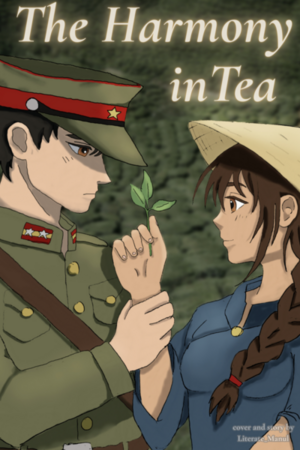
The Harmony in Tea
After breakfast, Yi-yun lingered in the doorway for a moment.
The table had been cleared, the last traces of danbing and sweetened soy milk settled warmly in her stomach.
Through the open window drifted the scent of damp earth and fresh leaves, accompanied by the loud chirping of birds.
Her grandmother washed the dishes slowly, unhurried, as though there were no reason at all to rush.
Yi-yun stepped outside.
“I’m going to have a look around!” she chirped, while Shu-fen merely smiled and nodded, continuing her work.
Gravel crunched softly beneath Yi-yun’s shoes as she followed the narrow path winding between the old plantation buildings.
In the morning light, the grounds seemed less gloomy than they had the day before.
Maybe, Yi-yun thought as she let her gaze wander, it wasn’t so bad here after all.
A low building at the edge of the grounds caught her attention.
Its walls were made of dark wood, weathered to a dull gray, and the door stood slightly ajar.
Curious, she stepped inside.
The room smelled different from the main building.
Heavier, earthier, with a faint bitter note lingering in the air.
Dust motes drifted through the slanted light, falling in through big windows.
Large pieces of equipment filled the space.
Wooden frames, shallow baskets, metal rollers polished smooth by years of use.
Everything looked old, yet carefully maintained, as though it could be put back into operation at any moment.
Yi-yun moved slowly between the machines.
In one corner stood a large, round device.
A crank protruded from its side, and inside she could make out grooves and rollers.
She carefully placed her hand on it.
“Yi-yun?”
Her grandmother’s voice echoed across the courtyard.
Yi-yun startled slightly.
“I’m heeere!” she called back, her voice muffled by the walls.
Footsteps approached and Shu-fen entered through the door, letting her gaze wander accross the room.
Yi-yun immediately pointed at the machine.
“What is this?”
Shu-fen froze at her words.
It lasted only an instant, scarcely longer than a breath.
Yet Yi-yun noticed it clearly, the stillness, the subtle tightening of her shoulders, as though the question had opened a door long kept shut.
Then the old woman smiled as she stepped closer.
“That,” she said, placing her hand on the device, “is a rolling machine.”
Yi-yun frowned.
“…Rolling?”
“Mhm.”
Her grandmother nodded. “After the leaves had withered, they were processed here. Pressed, to be precise. Their cell walls broke open, that’s the important thing. It’s what allowed the flavor and aroma to fully develop.”
Yi-yun studied the rollers, then her face brightened with sudden excitement.
“Did anyone ever got caught in it??”
A soft laugh.
“No, Yi-yun. Thank goodness, no.”
Yi-yun ran her fingers along the crank, slightly disappointed.
“So this is how you used to make tea then?”
Her grandmother met her gaze and nodded.
“The very best there ever was.”
For a moment, silence settled between them.
Then Yi-yun asked, almost casually:
“And Grandpa? Did he see this too, when he visited you here?”
Her grandmother closed her eyes.
When she opened them again, her gaze had grown distant, as though she were no longer seeing the room before her, but something else.
Something earlier.
“Yes,” she said quietly. “He did.”
᯽᯽᯽
“What is this?”
The question echoed through the cool hall of the tea processing facility.
Onodera had pushed back the sleeve of his uniform and was studying the machine with undisguised interest.
Not with the detached gaze of a famous war hero, but with a curiosity that surprised me.
“A rolling machine,” I replied. “For the second stage of processing.”
He stepped closer without hesitation.
“And what exactly does it do?”
I explained it to him the same way I had explained it to you.
He listened without interrupting.
“So this is where it’s decided,” he said slowly, “whether the tea develops character.”
I nodded.
“Or whether it becomes forgettable.”
For a moment, he looked at me.
Then, quite unexpectedly, he smiled.
And for the first time, I understood that he hadn’t come merely to inspect, but to understand.
After that, Onodera followed me across the rest of the plantation as I showed him everything.
His steps were calm and even, like everything about him.
As we walked between the rows of tea bushes, the sun had climbed higher, and a delicate fragrance hung in the air.
“The harvest is done in several passes,” I explained. “We don’t pick everything at once. Only the young leaves. Two, sometimes three. Everything else stays.”
He stopped and examined one of the bushes more closely.
“That takes time,” he observed.
“Yes.” I looked at him. “But quality cannot be forced.”
A faint smile flickered across his face, vanishing just as quickly.
“You speak as though you’ve never had to force anything.”
“One cannot force plants to ripen faster, any more than one can force people to grow wiser.” I replied calmly.
He looked at me sharply, as though I had brushed against an invisible boundary.
Then he turned his attention back to the fields as we continued on.
I showed him the withering areas, the flat bamboo mats on which the leaves were spread, explained how humidity and temperature determined whether a tea would become mellow or bitter.
He listened attentively, asking precise questions.
“You know every step,” he said at last.
I shrugged. “I have to.”
The longer we walked across the grounds, the more often I caught him studying me, as though I had said something that didn’t fit his expectations.
Each time, I met his gaze.
And each time, it took a heartbeat too long before I could focus on my words again.
I suddenly felt the sun on my cheeks, warmer than before, and I wasn’t certain whether it was truly the sun.
My own gaze lingered on him more often now.
On the way he walked, the way he paused, as though he assessed every place before allowing himself to enter it.
It unsettled me more than I cared to admit.
At last, I stopped before the small tea house set slightly apart from the others.
“Please,” I said. “If you’ll allow me.”
He nodded.
Inside, the air was cool and still.
A low table with two stools stood ready, teapot and cup already placed upon.
“Please, sit,” I said.
He did so, placing his jacket neatly behind him, and waited.
“I will prepare the tea now,” I said. “It will take a moment.”
He looked up. “I’ll wait.”
I left and changed myself in the adjoining room.
The simple qipao I put on was light in color, the fabric soft and unadorned.
It followed the lines of my body, fastened at the side with delicate buttons, its sleeves falling loosely at my sides.
When I had returned, Onodera looked at me strangely, almost in awe.
His posture, controlled only a moment before, tensed as though something had struck him unprepared.
Without saying a word, I sat down opposite him and began the preparation.
Heating the water.
Warming the teapot.
Let him inhale the fragrance of the leaves.
He followed my movements, yet I sensed that his attention was not where it ought to be.
His eyes returned to me again and again, searching my face, my hands.
“You perform this very calmly,” he said at last, as though trying to distract from it.
“Tea requires calm, as do most things” I replied.
At last, I offered him the cup.
He took it, hesitated briefly, then drank.
His gaze lowered, growing serious.
Another sip.
“Now I understand,” he said slowly, “why they call you the Tea Princess of Pinglin.”
I sighed softly.
“Names spread quickly, no matter if earned or not” I continued. “You should know that better than most.”
I met his eyes. “Devil of Xiaofeng.”
A shadow crossed his face.
His hand tightened around the cup before he set it down a little too abruptly, while his gaze slipped away from mine.
“That’s different for soldiers,” he said curtly. “In war, such titles are given often over trifles.”
“Trifles?” I tilted my head. “But it made you famous. It made you a hero.”
He flinched.
It wasn’t a large movement, more an involuntary tightening, as though I had brushed against something carefully concealed.
Abruptly, he stood.
“It’s late. I’ve already stayed far too long. I must go now.”
He reached for his jacket.
“But the tea...”
He was already at the door.
Then he stopped.
Without fully turning back, he added quietly:
“The tea was… good.”
A breath.
“You may continue supplying us.”
Then he was gone.
I remained seated.
Blinking.
To my own surprise, I didn’t think of the contract.
Not of the plantation.
But of him.
I felt suddenly warm, though the air in the tea house had remained cool.
I exhaled slowly.
“He addresses me by my title… and when I ask about his, this is how he reacts?” I murmured in disbelief.
The tea house answered with silence.
And only the scent of tea lingered in the air.










Please sign in to leave a comment.