Chapter 5:
Chapter 5: Regrets
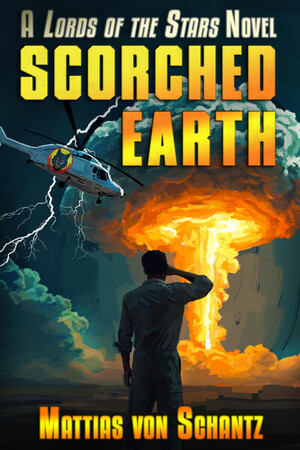
Scorched Earth
--- Part 2: Realization ---
2031 AD
Chapter 2: Regrets
July 11, 2031 AD, San Miguel de Amagasi, Quito, Ecuador, Earth
“Hey, little man!”
Thiago’s short legs carried him toward Carlos as the child ran across the broken asphalt of the sidewalk, beaming like the sun itself. The little boy buried his head against Carlos’s massive chest as his father embraced him in a deep hug.
Then the five-year-old, squirming like a worm, squeezed through the older Moreno’s arms in an attempt to get a peek at whatever it was that Carlos was hiding behind his back.
“What do you have there, Dad? Is it for me?”
“What do you mean?” Carlos replied with a grin. “I don’t have anything for you. I don’t know what you’re talking about!”
“Daddy! That’s not fair. Show me!”
Well, very little of life in Quito was fair these days, Carlos thought. But the reasons for that were not something Thiago would understand. Not yet, at least.
The boy kept trying to climb around his father, desperate to get a better look at what Carlos was holding in his hands. Eventually, neither the boy’s insistence nor the father’s heart allowed him to keep the secret any longer.
“Wow! Ice cream! Daaad!”
It was a rare treat, but if there was a day when such an indulgence was justified, it was today.
“Mommy! Mommy!” the little boy shouted back toward the house, his shrill voice echoing between the rundown buildings. “You’ll never guess what Daddy brought home with him!”
As Carlos looked up at his wife, standing there in the green doorway, a pinprick of guilt pierced his soul. But when the two of them locked eyes, he saw no condemnation in her beautiful eyes.
Father and son sat down on the low stone stairs leading up to the entrance to their apartment, Carlos’s strong left arm draped around Thiago’s tiny shoulders. Holding his ice cream in his right hand, he offered it to Teresa, standing behind him, but she declined. This was a moment between father and son. Not wanting to leave her entirely outside their little pocket of belonging, he blew her a kiss instead.
On the horizon, black clouds were gathering. This was the dry season, and there should have been no rain, yet this year it seemed as if generations of wisdom about the weather had been thrown out the window. Rain fell in the dry season, and crops withered and died from drought when water should have been pouring from the skies.
When the two Morenos had finished eating their ice creams—Thiago had been licking the stick until his tongue was raw—they found a dirty, cracked soccer ball, which they kicked around among the litter on the street until the rain eventually arrived and forced them to abandon their little game. Thiago was still reluctant to go inside despite the downpour, but he was too tired to argue, and eventually he relented to his father’s gentle appeals.
The rest of the evening was spent sharing the experience of a billion parents around the world who had boys too tired to understand that they needed to go to sleep. But, as was always the case, the squeaky little bed eventually won the battle, and as Thiago dozed off, his parents found themselves talking about topics that truly mattered.
“I’m sorry for the ice cream,” Carlos told Teresa. Knowing she didn’t hold a grudge against him for spending their hard-earned dollars wasn’t a shield he could hide behind. He still had to put his apology into words.
“It’s all right, love,” she replied, holding his hand. “You needed that. You both needed that.”
He sighed and looked at her in silence. It wasn’t fair. He could see how strained she was. He could see the lines in her face and how the skin stretched over her bones. What little they had was reserved for Thiago.
“Things will be better,” she continued. “Soon.”
“I know,” he said softly. “But it’s hard.”
“You’re doing what you can. You’re doing everything you can. It’s not your fault.”
It wasn’t, she was right about that. But that was beside the point. To Carlos, the heart of the matter was that their poverty-stricken lives weren’t Teresa’s or Thiago’s fault. He would survive, but it wasn’t fair that they should have to suffer.
“I’ll send money soon. Then you can eat better.”
She nodded, but there was no smile on her tired face. “You need to save for the ticket, too. So you can return to us.”
And that was the crux of the matter. To support his family, he had to leave them behind. But if he were ever to see them again, he’d have to use the money he earned for his own return ticket instead of sending it back to support them. It was a lose-lose situation, and they both knew it.
Still, it was better than doing nothing. Staying in Quito meant starvation.
It had all happened so quickly. Granted, Ecuador had never been a rich country, but the Morenos had always had what they needed. There had been food on their table and clothes on their backs. Now, every day was a struggle to feed his family.
He looked at the corner where they kept their bags of beans and rice. Where they used to keep them.
“There wasn’t anything to be had in the market today, was there?”
Teresa shook her head.
“No,” she said, her voice almost cracking with sorrow. “They said there might be tomorrow. Maybe.”
Maybe. They had said the same thing every day for the past week. The dry season of 2030 had never seemed to come to an end, and when 2031 eventually came around, there had still been no rain across large swaths of western South America. Then, suddenly, the weather had changed as though someone had flicked a switch, and in the midst of what should have been the dry season, the rains had begun to fall with a vengeance, a relentless downpour that washed away what little crops had survived the drought of the previous year.
Food prices had, of course, skyrocketed. But it wasn’t just that food was more expensive these days. Whatever forces were out there playing dice with the weather weren’t just affecting South America. It was one thing to see the price of rice go up every time you went to the market. It was another thing entirely to realize that the rice farms in Africa, India, and Southeast Asia didn’t produce enough to feed the populations of their own countries, let alone grow enough to allow exports to Ecuador.
Still, world trade was a market economy, and now and then some country was willing to starve a bit in exchange for money. Rice was still sold on the international market, but only barely. And when it was, the price was exorbitant. As was always the case, most of what was available went to the richer countries in the north.
A policeman’s salary was no longer enough to keep his family fed.
And as if the lack of food weren’t enough, there was also the recent outbreak of malaria in Quito to keep him up at night. Not that tropical diseases were exactly unheard of up here in the mountains—as the crow flies, the Amazon rainforest wasn’t that far away—but they used to be rare, imported exceptions. Now, malaria had become endemic to Quito, and to make matters worse, Carlos had recently heard rumors that dengue fever was creeping closer to the capital as well.
“Not that I object, but why are they going out of their way to hire a policeman from Ecuador?” Teresa asked, trying to change the subject to something less painful. “There’s got to be enough people with security experience to be found in Mexico.”
“Isn’t it obvious?” he replied, his face set in a mask of seriousness. “I’m just that good!”
As he had expected, she broke out into delicious laughter, which he eagerly joined. It felt good to know that despite their circumstances, they could still find happiness together.
“I know you are, sweetie,” she assured him. “I know you are. I’ve never doubted you.”
“It’s all about optics,” Carlos continued, knowing his wife needed not only the joke, but the real answer as well. “Chairman Castillo is a smart man. The OIY is a lobbying organization. If we’re going to convince the United States we’re a force to be reckoned with, we have to show them a united front. Having people around in Mérida from all the member states is a clear sign to the Americans that we all stand together. They can’t dismiss us as small, individual third world countries anymore. We work together, and we have each other’s backs. In the end, we’ll get them to understand our perspective. It’s only fair.”
“I hope you’re right,” Teresa said. “I’m sure things will be better here once Castillo convinces the United States to pay carbon reparations. Once we can afford to improve our infrastructure and water supply, we can grow food again. I know things will get worse before they get better, but we’ll get by. Don’t worry about us, honey. Just do a great job over there in Mérida, and maybe you’ll get a promotion. Then perhaps you’ll earn enough to both send some of it to us and save up money for your own return ticket once Ecuador is back on its feet again.”
Carlos nodded. “I just wish the ticket home were part of the deal too, but I can understand why they only pay their new employees for a one-way trip. There’d always be those who would take advantage of the system otherwise.”
She smiled at him. “But not my Carlos! Never!”
He smiled back at her, but said nothing. Instead, he put his hands around her waist and pulled her close as he planted a soft kiss on her lips.
“I’ll be back before you know it. I love you.”
He took a step back, dragging her with him, and swung her around himself in a half circle. The limited space of their small apartment abruptly cut their dance steps short, but that didn’t really matter. The tension they had felt earlier was now gone, and they could finally enjoy their last evening together.
Outside the windows, lightning flashed across a dark and turbulent sky, but the storm couldn’t touch them inside the walls of their apartment. Here, in the warm embrace of his wife, Carlos could for a moment almost forget that the wider world had seemingly gone down the drain.
Almost.
A soft sound from the direction of Thiago’s bed caught Carlos’s attention. It could be that the boy hadn’t fallen asleep as he had previously thought, or perhaps Thiago had woken up again from the quiet noise of Carlos’s and Teresa’s conversation. For a moment, he thought that giving the boy an ice cream for dinner just before going to bed might not have been the best of ideas.
“Shh,” he told his son. “Go back to sleep.”
The boy stirred and opened his eyes. When he saw his father standing above him, his face broke into a smile.
“Daddy! You’re back!”
“I never left, Thiago. I’m not going until tomorrow. Try to sleep now.”
The little boy hesitated for a moment. “I don’t want you to leave,” he said, eventually.
“I know. I don’t want to leave either. But sometimes grown-ups have to do things they don’t want to do. I’ll be back before you know it.”
The young boy still seemed sad.
“What do we always say?” Carlos continued. “Who am I?”
“You’re the wolf,” his son whispered.
“That’s right, Thiago. And the wolf always guards his flock.”
Suddenly, the five-year-old sat up in his bed, leaned forward, and threw himself into the waiting arms of his father. For a short moment, Carlos’s entire universe began and ended with his son.
Behind him, Teresa laid a soft hand on his shoulder.
He knew, in the end, everything would be all right.
Author's Note
The story you're reading is one of many set in the Lords of the Stars universe I've been creating over the past 30 years, where familiar characters and places reappear, and new favorites await discovery. Check out my profile to explore more stories from this universe.
While Scorched Earth is entirely standalone and can be read without any prior knowledge, I think you'll also enjoy Wonders From Beyond the Sky, Time for Memories and Choices of Steel, all of which are standalone sequels to this story.
Visit the official Lords of the Stars blog for more information about this hard sci-fi universe: https://lordsofthestars.wordpress.com
If you enjoyed this chapter, please consider giving it a like.






Please sign in to leave a comment.