Chapter 3:
The Question of How
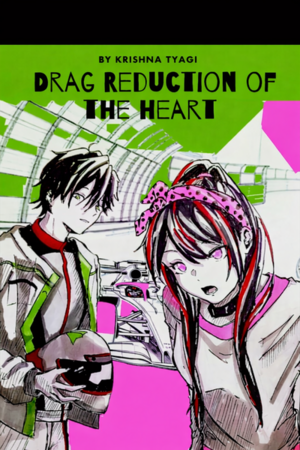
Drag Reduction of the Heart
The morning air cut sharp against Jonas’ face the moment he stepped out of the motorhome. Germany never eased him into the day. It threw itself at him all at once. The paddock was already alive—generators humming, tire blankets hissing softly, wheel guns whining somewhere down the lane. Mechanics moved fast and close, shoulders brushing as they passed, conversations overlapping in clipped fragments.
“Front left’s still two degrees low—”
“—run plan’s changed, tell him after—”
“Coffee?”
“No time.”
Someone laughed too loudly at something that wasn’t funny. Someone else swore in three languages at once when a trolley clipped a heel. Jonas pulled his jacket tighter and walked straight into it. “Morning,” someone said, already turning away.
A camera flashed from somewhere to his left. He didn’t look. He had learned that early eye contact invited questions, and questions invited narratives he didn’t have the patience to manage before breakfast. The helmet rested under his arm, scuffed and familiar. He liked carrying it. Liked the weight of it. It reminded him that no matter how loud everything became, there was still one place where the noise disappeared completely. Inside the car.
“Briefing in ten,” an engineer called from behind a laptop cart.
Jonas lifted two fingers in acknowledgment without slowing. Ten minutes meant eight. Eight meant now. He passed the garage entrance where mechanics were already arguing, not angry, not personal. Just precise. Hands moved as much as mouths did. Someone traced a braking zone in the air. Someone else shook their head and pointed at a tire carcass leaning against the wall.
“Grain’s coming in earlier than expected.”
“Because he’s loading it on entry.”
“No, because the track temp’s dropped.”
“It hasn’t.”
“Check sector two.”
Jonas heard it all without really listening. That was the thing about mornings like this. Noise everywhere. Expectations everywhere. Everyone wanted something from him before he’d even sat down. Inside the garage, the air smelled like rubber, oil, and something metallic he’d never learned the name for, but had known his entire life. Screens flickered awake along the walls, timing sheets filling, telemetry graphs stacking in colored lines that meant nothing to anyone without years of training. Jonas dropped into a chair, rolled his shoulders once.
He had woken early too. Because he couldn’t sleep.
The simulator room was colder than the garage. It always was. The door sealed shut behind him with a soft hiss, muting the paddock chaos into a distant hum. Lights dimmed as Jonas settled into the seat, harness clicking tight across his chest. The curved screen wrapped around his vision as the circuit loaded in smooth geometry curbs sharp, braking boards crisp, run-off painted a clean, artificial green.
“Alright,” a voice crackled through the headset. “Run three. Same aero. Same diff.”
Jonas flexed his fingers around the wheel.
“Copy.”
The car launched forward. Acceleration pressed him back as the virtual engine screamed. Corners arrived in rhythm, short burst, hard brake, trail in, power early. Jonas drove the way he always did: instinct first, calculation second. He felt grip through the wheel before he saw it in the numbers. Felt the limit before the warning tones even thought about sounding.
“Watch entry speed,” the race engineer said. “You’re loading the fronts.”
“I’m fine,” Jonas replied, already turning in harder than advised.
The lap time flashed. Purple. Fast. Too fast for the tires to like, maybe but fast. “Again,” the engineer said. Less enthusiasm this time. Jonas ran it again. Same aggression. Same commitment. Same warning light.
“Jonas,” another voice cut in older, calmer. “You’re quick. No one’s disputing that. But this won’t hold over a long run.”
Jonas exhaled slowly through his nose. “Then change the balance.”
A pause.
“We did. Twice.”
“Then do it again.”
The sigh that followed wasn’t frustrated. Just tired. “You’re asking the car to do things it physically can’t for fifty laps.” Jonas leaned into the next corner anyway, hands steady, braking late, carrying speed where the model said not to. “I only need it to do it for one,” he said.
Silence.
Then, quietly: “That’s not how championships are won.” Jonas crossed the virtual line again. Another purple sector. Another degradation warning. “I win races,” he said. No one contradicted him. That was the problem.
By midday, the media had found him. They always did.
Jonas stood just outside the garage, helmet clipped to his side now, as microphones crowded into his space. Team logos blurred at the edge of his vision. A boom mic dipped too close to his head and pulled back again.
“Jonas, your pace this morning looked aggressive, do you think you’re overdriving?”
He tilted his head slightly, considering. “No.”
A beat.
“Do you feel pressure heading into the next Grand Prix?”
“Pressure’s part of the job.”
“People say your driving style is risky, do you agree?”
Jonas gave the same half-smile he always did. Not rude. Not warm. “If you’re not on the limit, you’re not fast enough.”
“Your team mentioned tire management concerns—”
He cut in without raising his voice. “They manage the tires. I manage the car.” A ripple moved through the reporters, half chuckles, half raised eyebrows. “Does that cause tension internally?”
Jonas shrugged. “We talk. We work. That’s it.”
“Do you think strategy will decide the next race?”
He paused just long enough to be deliberate.
“Strategy always matters.”
Then he stepped back, helmet already in hand, conversation over. Behind him, as he walked away, someone muttered under their breath, “If he just listened…” Jonas pretended not to hear.
The afternoon debrief stretched longer than planned. Graphs replaced words. Lap deltas overlaid tire curves. Fuel loads adjusted. Someone rewound a clip again and again. Then a different feed appeared on the main screen. Not his. A rival team’s race simulation from the previous weekend. Clean. Controlled. Almost irritatingly smooth. “And here,” the performance engineer said, tapping the screen, “they boxed two laps earlier than the projected window. Undercut worked because traffic cleared exactly when they predicted.”
Jonas leaned back in his chair, arms crossed.
“That was a gamble,” he said.
“It was calculated,” another engineer replied. “They read the drop before it showed.”
The replay ran again. The call had come early. Before the tires screamed. Before the data turned red. Sharp. Jonas felt something settle in his chest. Not anger. Not jealousy. Respect.
“Whoever’s running their race is sharp,” someone muttered.
Jonas nodded once, eyes still on the screen.
“Yeah,” he said quietly. “They are.” He didn’t know why but that stayed with him.
That night, Jonas skipped the team dinner. He ordered room service he barely touched and sat on the edge of the hotel bed, lights off, city glow leaking in through the curtains. The television played on mute. His onboard footage looped again. Corner after corner. Braking points burned into muscle memory. A moment mid-lap where the rear stepped out just enough to be saved, but not without cost. If he’d lifted there, just a fraction… He paused the video. Stared at the frozen frame. Not regret. Just a question he didn’t like answering. Jonas shut the screen off instead.
Two days before the Grand prix. He heard it in passing the following morning, as engineers discussed freight timing near the transport crates.“Suzuka first.”
Jonas slowed.
“Different surface,” someone added. “Low grip early. Track evolves fast.”
“Tight margins.” Another voice, lower: “This next one won’t be won by instinct.”
Jonas smirked faintly. Didn’t reply.
Later, alone in the briefing room, he pulled up the track map on his tablet. Suzuka. Technical. Punishing. A circuit that rewarded patience as much as bravery. Jonas traced the layout with his finger. Stopped at one corner. A strange one. Tight entry. Deceptive exit. A place where the fastest line didn’t look like the right choice at all. He lifted his hand away.
Two days. The storm wasn’t behind him anymore. It was moving cities. And Jonas didn’t know it yet but the next race wasn’t going to ask how fast he could go.
It was going to ask how.










Please sign in to leave a comment.